Article Summary: An AI SEO execution platform helps small businesses turn SEO recommendations into completed work by connecting competitor research, content planning, content creation, internal linking, keyword tracking, and content refreshing within one workflow. Unlike traditional SEO tools that mainly provide reports and recommendations, Explofi helps businesses act on those insights. It can uncover content opportunities, create localized SEO content, strengthen internal links, track local keyword rankings, and improve older pages through Page Revive. The main benefit is simpler and more consistent SEO execution without relying on multiple disconnected tools, an expensive agency, or a full in-house SEO team.
Deep Dive with AI
What Is an AI SEO Execution Platform and How Does It Work?
An AI SEO execution platform is a unified system that helps businesses move from SEO research and recommendations to completed work. Instead of switching between separate tools for keyword research, content creation, internal linking, competitor analysis, rank tracking, and content updates, the platform connects these activities within one workflow. Each of these activities forms part of a broader search engine optimization strategy.
What separates an execution platform from traditional SEO software is its focus on action. Traditional tools often identify opportunities and leave the user responsible for completing the work. An AI SEO execution platform helps users turn those insights into practical next steps, such as creating optimized content, strengthening internal links, tracking keyword movement, and refreshing underperforming pages.
Explofi applies AI SEO for small businesses through an execution-first system that connects research, content, optimization and tracking. The platform brings together several important SEO functions, including:
- Analyzing competitors to uncover content gaps
- Planning and creating SEO-focused content
- Optimizing content around relevant keywords and search intent
- Identifying internal linking opportunities
- Tracking local keyword rankings
- Finding existing pages that may need to be refreshed
By connecting these functions in one place, Explofi helps small businesses execute SEO more consistently without relying on several disconnected tools or a full internal SEO team.
The Difference Between Traditional SEO Tools and AI SEO Execution Platforms
Traditional SEO tools usually operate on a reporting and recommendation model. They identify content gaps, ranking changes, technical issues, and optimization opportunities, but the user is still responsible for deciding what to prioritize and completing the work.
That gap between insight and action can drain significant time and resources, especially for small businesses working with lean teams. The same gap appears in the traditional agency model, where research, approvals and execution can be spread across long timelines. Our Explofi versus SEO agency comparison examines the differences in cost, speed, control and execution. A recommendation only creates value when someone turns it into an optimized page, a stronger internal link, a refreshed article, or another completed SEO task.
AI SEO execution platforms are designed to reduce that gap. Instead of simply presenting data, they connect analysis with the workflows needed to act on it. This can include identifying content opportunities, preparing optimized content, recommending relevant internal links, monitoring keyword movement, and highlighting pages that need improvement.
Explofi follows this execution-first model by bringing competitor analysis, content planning, localized content creation, internal linking, local keyword tracking, and content refreshing into one connected platform. Small businesses can move from discovering an opportunity to working on it without transferring information between several disconnected tools.
The distinction is not that every SEO change happens automatically. The distinction is that research, recommendations, and execution are connected in a clearer workflow, reducing repetitive work and helping businesses maintain a more consistent SEO process.
How AI Algorithms Process and Act on SEO Data
AI algorithms within SEO platforms process data by identifying patterns across keyword performance, competitor content, existing pages, and search visibility. Instead of requiring a small-business owner to manually review every metric, the system can organize the data and highlight the opportunities that deserve attention first.
The analysis may include:
- Identifying unusual changes in keyword rankings
- Mapping content gaps against competing pages
- Evaluating whether existing content fully matches search intent
- Finding pages that may benefit from stronger internal links
- Highlighting older content that may need to be refreshed
- Prioritizing SEO actions based on potential value
Explofi uses this type of analysis to help small businesses move from raw SEO data to practical action. For example, competitor analysis can reveal missing topics, local keyword tracking can show where visibility is changing, and Page Revive can help identify existing content that may need improvement.
The AI does not need to make unrestricted changes to a website to be useful. Its value comes from processing more information than a small team could reasonably review manually and turning that information into clearer, faster SEO decisions.
The Role of Automation in Bridging Strategy and Execution
Automation helps close the gap between knowing what needs to be done and actually completing the work. This is where many small businesses lose momentum. SEO recommendations may be available, but without enough time or staff, tasks such as internal linking, content refreshing, keyword monitoring, and content optimization can remain unfinished.
An AI SEO execution platform reduces this burden by connecting strategy with the workflows needed to act on it. Instead of requiring a business owner to manually organize every recommendation, the platform can help identify priorities, prepare the work, and guide the user toward the next action.
Explofi supports this process by helping small businesses:
- Identify content opportunities through competitor analysis
- Create and optimize SEO-focused content
- Find relevant internal linking opportunities
- Monitor changes in local keyword rankings
- Identify older pages that may need to be refreshed
This level of automation does not mean removing human judgment. It means reducing repetitive work and making it easier for small businesses to execute SEO consistently without relying on a large internal team.
Why Small Businesses Have Always Struggled With SEO
Small businesses often struggle with SEO because consistent execution requires time, expertise, and resources that lean teams may not have. Improving search visibility involves more than publishing an occasional blog post. Businesses must research keywords, create useful content, maintain their website, monitor performance, and improve existing pages over time.
The traditional approach can also require expertise across several areas:
- Keyword research and content planning
- Technical website maintenance
- Content writing and optimization
- Internal linking and site structure
- Performance tracking and content refreshing
Without a dedicated SEO team, these responsibilities often fall on an owner or a small marketing team already managing other parts of the business. As a result, important SEO opportunities may be identified but delayed, handled inconsistently, or never completed. This resource imbalance is one reason small businesses are replacing traditional SEO agencies with AI tools.
Explofi is designed to reduce that execution burden by bringing content planning, competitor analysis, localized content creation, internal linking, local keyword tracking, and content refreshing into one platform built for small businesses.
The Knowledge Gap That Keeps Small Businesses Behind
For many small businesses, the biggest SEO challenge is not a lack of effort. It is knowing what to prioritize. Owners may see keyword data, ranking changes, technical warnings, and content recommendations without knowing which action is most likely to improve visibility first.
That uncertainty can slow execution. A business might spend time rewriting a page that only needs stronger internal links, publish new content when an existing article should be refreshed, or overlook a valuable topic already gaining impressions in search.
Explofi helps reduce this knowledge gap by turning SEO data into clearer workflows. Competitor analysis can uncover missing topics, local keyword tracking can show where visibility is changing, and content-planning tools can help businesses decide what to create or improve next.
The goal is not to make every small-business owner become an SEO expert. It is to give them a more practical way to understand what needs attention and move the right work forward.
Small businesses can still rank on Google without hiring an SEO agency when the highest-priority actions are organized into a manageable workflow.
The Time and Resource Constraints of Running SEO In-House
Running SEO in-house requires more than creating content. A small team must research opportunities, plan articles, optimize pages, build internal links, monitor rankings, and revisit existing content over time.
The work becomes even harder when each task happens in a separate tool. Data must be transferred between platforms, recommendations must be organized manually, and someone still has to decide what should be completed next.
A traditional in-house SEO workflow may involve several responsibilities:
- Researching keywords and competitors
- Planning and writing optimized content
- Reviewing internal linking opportunities
- Monitoring keyword performance
- Identifying pages that need updates
- Coordinating each task from research through completion
For a small business, those responsibilities often fall on one owner or a lean marketing team. This makes consistency difficult, even when the business understands the value of SEO.
Explofi helps reduce this operational burden by connecting content planning, competitor research, content creation, internal linking, local keyword tracking, and content refreshing within one platform. Instead of replacing an entire team, Explofi helps smaller teams complete more of the SEO workflow with the resources they already have.
Consistent execution is especially important because businesses need realistic expectations about how long SEO takes for a small business.
Why Legacy SEO Tools Were Built for Agencies, Not Small Business Owners
Many traditional SEO platforms were designed for experienced marketers, agencies, and larger teams managing complex campaigns. Tools such as Ahrefs, Semrush, and Moz can provide valuable data, but they often assume that someone already knows how to interpret that information and turn it into a working SEO strategy.
For a small-business owner managing customers, operations, finances, and marketing at the same time, that creates a practical problem. The software may surface keyword opportunities, technical warnings, competitor data, and ranking changes, but the owner is still responsible for deciding what matters most and completing the work.
Advanced features such as large reporting dashboards, API access, multi-user workspaces, and detailed technical analysis can be useful for professional SEO teams. However, they may add complexity for a business that simply needs to know:
- What content should we create next?
- Which existing pages need improvement?
- Where should internal links be added?
- Which local keywords are gaining or losing visibility?
- What action should be taken first?
Explofi is built around those execution needs. Instead of requiring a small business to assemble several tools and interpret every data point alone, Explofi connects competitor analysis, content planning, localized content creation, internal linking, local keyword tracking, and content refreshing within one platform.
The difference is not that traditional SEO tools lack useful information. The difference is that Explofi is designed to help small businesses turn that information into clearer, more manageable action.
The Three Core Gaps an AI SEO Execution Platform Fills
Three gaps commonly prevent small businesses from turning SEO strategy into consistent results:
Gap 1: Content Creation Without a Full SEO Team
Producing SEO content consistently is one of the most resource-intensive parts of improving search visibility. A business must identify relevant topics, understand search intent, review competing pages, organize the article, create the content, and optimize it before publishing.
For a small business without a dedicated content team, completing that process consistently can be difficult. AI-assisted content workflows reduce the manual burden by helping businesses move from research to an optimized draft more efficiently.
Explofi supports this process through competitor analysis, localized AI content creation, and its Smart Article Planner. These tools help small businesses:
- Identify content opportunities based on competing pages
- Plan articles around keywords and search intent
- Create SEO-focused drafts for a specific audience
- Evaluate content quality while writing
- Maintain a more consistent content workflow
- Build a topical map that organizes related content opportunities
AI does not remove the need for human review. It reduces the time required to organize research, prepare content, and move an article closer to publication.
Gap 2: On-Page Improvement and Internal Linking Without Disconnected Tools
Creating an article is only one part of SEO execution. Pages also need to be connected to the rest of the website, aligned with relevant search intent, and improved as the site grows.
Small businesses often manage these tasks manually or overlook them entirely. A new article may be published without links to related service pages, while older pages may remain isolated from newer content.
Explofi helps reduce this gap through content optimization and Smart Internal Linking. The platform can help businesses:
- Identify relevant connections between existing pages
- Strengthen topic clusters through internal links
- Improve the structure of newly created content
- Connect supporting articles with important service or product pages
- Reduce the amount of manual page-by-page review required
These activities fall under on-page SEO, which includes improving content, headings, metadata, page structure and internal links
This is different from claiming that the platform autonomously changes technical code or deploys developer-level fixes. Those developer-facing changes generally belong to technical SEO, which covers crawling, indexing, site architecture, speed and other website infrastructure. The value comes from making important on-page SEO tasks easier to identify and complete.
An execution platform may also analyze competitors and backlink profiles, but relationship-based link acquisition remains part of off-page SEO. This includes earning backlinks, securing brand mentions, contributing to industry publications and building authority outside the business’s own website.
Gap 3: Performance Monitoring and Content Refreshing
SEO does not end when a page is published. Rankings, impressions, clicks, competing pages, and search behavior can change over time. Without ongoing monitoring, a small business may not notice when an article begins losing visibility or when an existing page presents a new opportunity.
Explofi helps businesses respond by connecting local keyword tracking with content-refresh workflows. This can help teams:
- Monitor changes in local keyword rankings
- Identify pages that may be losing momentum
- Recognize content that needs updated information
- Find opportunities to improve an existing page instead of publishing a duplicate
- Use Page Revive to refresh content that may no longer perform as well as it once did
The goal is not to make unrestricted changes without human oversight. It is to help small businesses recognize performance changes sooner and take the appropriate next action.
Monitoring and refreshing matter because understanding why SEO results take time helps businesses distinguish normal movement from a genuine performance problem.
Key Features to Look for in an AI SEO Execution Platform
When evaluating an AI SEO execution platform, small businesses should look beyond basic content generation or reporting. The most useful platforms connect SEO data with practical workflows that help users decide what to work on and move that work toward completion.
Important features include:
- Competitor and content-gap analysis
- Keyword research connected to content planning
- AI-assisted content creation and optimization
- Brand voice controls that help maintain a consistent tone
- Internal linking recommendations
- Keyword performance tracking
- Content-refresh tools for existing pages
- Clear priorities and recommended next actions
- An intuitive interface designed for users without extensive SEO experience
Small businesses should also look for transparent reporting that connects SEO activity with performance. A useful platform should make it easier to understand which pages are gaining visibility, which keywords are moving, and which content may need additional work.
Explofi brings these capabilities together through competitor analysis, localized content creation, the Smart Article Planner, Smart Internal Linking, local keyword tracking, and Page Revive. Instead of giving small businesses another collection of disconnected reports, Explofi helps organize these workflows within one execution-focused platform.
The strongest AI SEO platform is not necessarily the one that makes every change automatically. It is the one that helps a business identify the right opportunity, complete the relevant work, and understand what should happen next.
Explore the complete Explofi SEO tool stack to see how these workflows connect inside the platform.
Automated Keyword Research That Is Fully Integrated Into Content Workflows
Keyword research becomes more valuable when it connects directly to content planning and creation. Instead of collecting keywords in one tool, moving them into a separate document, and then building a content brief manually, an integrated platform keeps the research and writing process connected.
This matters because fragmented workflows can lead to inconsistent targeting. A writer may work from an incomplete keyword list, misunderstand the primary search intent, or overlook relevant supporting topics that should be included in the article.
Explofi helps connect keyword and competitor research with content execution. Through competitor analysis and the Smart Article Planner, small businesses can identify content opportunities, organize relevant topics, and evaluate whether a draft covers the information searchers are likely looking for.
This connected workflow can help businesses:
- Keep the primary keyword aligned with the article’s search intent
- Include relevant supporting topics and related phrases
- Organize headings around the questions searchers are asking
- Evaluate content against competing pages
- Reduce the need to transfer research between disconnected tools
- Move more efficiently from an opportunity to an optimized draft
Long-tail keywords can also play an important role because they often reflect more specific searches and clearer customer needs. Rather than adding every variation unnaturally, the goal is to use those terms to understand the full topic and create content that answers the search more completely.
Some informational and commercial keywords are best served through a well-structured listicle page, especially when searchers are comparing options, methods or solutions.
AI-Driven Content Generation and On-Page Optimization Capabilities
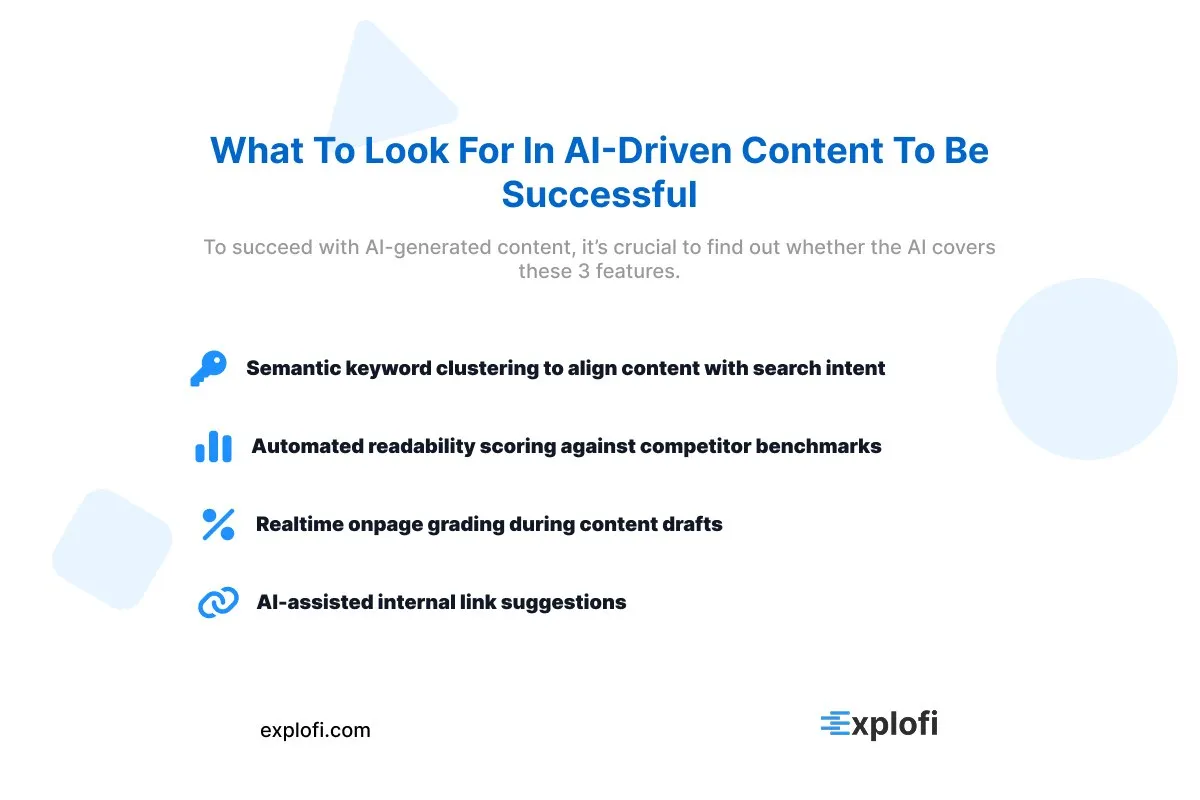
AI-driven content generation within an SEO execution platform should go beyond producing a basic first draft. The platform should help businesses create content that aligns with search intent, covers the topic thoroughly, uses a clear heading structure, and connects naturally with related pages across the website.
The strongest systems use competitor and keyword data to guide the content before and during the writing process. This helps small businesses create pages that are more focused, complete, and relevant without relying on guesswork.
Explofi supports this workflow through localized AI content creation, competitor analysis, the Smart Article Planner, and Smart Internal Linking. Together, these capabilities can help businesses:
- Structure content around search intent
- Identify important subtopics covered by competing pages
- Evaluate a draft while it is being created
- Improve readability and heading organization
- Include relevant supporting keywords naturally
- Find internal linking opportunities based on existing site content
- Maintain a consistent brand voice across articles
These AI capabilities are designed to support human judgment rather than replace it. Business owners can review the content, add firsthand knowledge, verify claims, and make sure the final page accurately represents their services and customers.
By combining AI-assisted creation with on-page guidance, Explofi helps small businesses move from a keyword or content opportunity to a stronger, publication-ready draft within one connected workflow.
Local SEO Execution and Local Keyword Tracking
Local SEO requires more than maintaining accurate business listings. Small businesses also need content that reflects their services, locations, and the way nearby customers search.
An AI SEO execution platform can help connect local keyword research with content planning, page creation, internal linking, and performance monitoring. Instead of treating local SEO as a separate project, the platform can incorporate location-specific opportunities into the broader SEO workflow.
Explofi supports local SEO execution through localized content creation and local keyword tracking. These capabilities can help small businesses:
- Identify keywords customers use in specific cities or service areas
- Create content around local services and customer needs
- Develop stronger service and location pages
- Monitor how keyword rankings change by location
- Connect local articles with relevant service pages
- Identify content that may need to be improved or refreshed
This gives small businesses a clearer view of how their website performs across different markets while helping them create content that is more relevant to the customers they want to reach.
Citation consistency remains an important part of local SEO, but listing management is a separate function from the content, tracking, and optimization workflows that Explofi provides.
SEO Performance Tracking and Transparent Reporting
Transparent reporting helps small businesses turn SEO data into practical decisions. Instead of presenting a dashboard filled with disconnected metrics, an AI SEO execution platform should make it clear which keywords are moving, which pages are gaining visibility, and where additional work may be needed.
Effective performance tracking may include:
- Changes in keyword rankings over time
- Local ranking movement by city or service area
- Page-level impressions and clicks
- Organic click-through rate trends
- Content performance changes
- Pages that may need to be refreshed or strengthened
- Clear recommendations for the next action
Explofi supports this workflow through local keyword tracking and content-refresh tools. Small businesses can monitor where their visibility is improving, identify pages that may be losing momentum, and use those insights to decide whether a page needs updated information, stronger internal links, or broader topical coverage.
Reporting should not require a business owner to interpret every metric like an SEO specialist. The goal is to make performance easier to understand and connect the data with the work that should happen next.
Workload Automation That Reduces Repetitive Manual Tasks
AI automation can reduce the repetitive work that slows down SEO execution for small businesses. Tasks that once required moving between several tools can be organized and completed within a more connected workflow.
Depending on the platform, this may include:
- Identifying relevant internal-linking opportunities
- Helping generate optimized titles and meta descriptions
- Preparing content around target keywords and search intent
- Highlighting older pages that may need improvement
- Monitoring keyword movement over time
- Organizing recommended SEO actions by priority
Explofi helps reduce repetitive work through Smart Internal Linking, AI-assisted content creation, local keyword tracking, competitor analysis, and Page Revive. Instead of manually reviewing every page and transferring information between separate tools, small businesses can manage more of the SEO process within one platform.
How AI SEO Execution Platforms Differ From General AI Marketing Tools
General AI marketing tools are designed to support a wide range of activities, including social media posts, email campaigns, ad copy, and general content creation. While these tools can help produce a blog draft, they are not necessarily built around the complete SEO workflow required to improve search visibility over time.
AI SEO execution platforms are more specialized. They connect content creation with SEO-specific activities such as competitor analysis, keyword targeting, content planning, internal linking, rank tracking, and content refreshing.
The difference becomes clear after the first draft is created. A general AI tool may produce text, but the user must still determine:
- Which keyword and search intent the page should target
- How the content compares with competing pages
- Which related topics should be included
- Where internal links should be added
- How the page performs after publication
- Whether the content should be updated later
Explofi brings these SEO-specific workflows together through competitor analysis, localized AI content creation, the Smart Article Planner, Smart Internal Linking, local keyword tracking, and Page Revive. This allows small businesses to move beyond isolated content generation and manage more of the SEO process within one platform.
General AI tools can still be useful for brainstorming and broad marketing tasks. However, a purpose-built AI SEO execution platform is designed to keep research, creation, optimization, monitoring, and improvement connected around the specific goal of increasing search visibility.
SEO-Specific Workflows vs. Broad Marketing Automation
SEO-specific workflows are built around the sequence of actions required to improve search visibility over time. That can include keyword research, competitor analysis, content planning, on-page optimization, internal linking, keyword tracking, and content refreshing within one connected process.
General marketing automation platforms are designed for broader campaign activities, such as email scheduling, audience segmentation, social media publishing, and ad delivery. Those workflows can support marketing as a whole, but they are not necessarily built around the ongoing SEO process.
This difference matters for small businesses. A general AI or marketing platform may help create content, but the business still has to connect that content to keyword research, competing pages, internal links, performance tracking, and future updates.
Explofi is designed around those SEO-specific connections. Its workflows can help small businesses:
- Turn competitor and keyword insights into content plans
- Create optimized content around search intent
- Evaluate articles as they are being developed
- Identify relevant internal-linking opportunities
- Monitor local keyword movement
- Refresh existing pages when additional work is needed
These workflows treat SEO as an ongoing process rather than a collection of isolated tasks. Research informs content, content connects to existing pages, performance is monitored, and older pages can be improved over time.
Why Purpose-Built SEO Platforms Outperform Generic AI Tools for Search Growth
Purpose-built SEO platforms are designed around one primary goal: helping businesses improve and maintain search visibility. General AI tools can support writing, brainstorming, email creation, social media, and other marketing activities, but they are not necessarily built around the complete SEO workflow.
A dedicated SEO platform connects the activities required to turn an opportunity into measurable work. This includes researching competitors, planning content, creating optimized pages, strengthening internal links, monitoring keyword performance, and improving existing content over time.
For small businesses, a purpose-built SEO platform can help with:
- Identifying content gaps through competitor analysis
- Organizing keywords and topics around search intent
- Creating optimized content for specific services and locations
- Evaluating whether a draft covers the topic thoroughly
- Finding relevant internal-linking opportunities
- Monitoring local keyword movement
- Refreshing existing pages when performance begins to change
Explofi brings these SEO-specific workflows together through competitor analysis, localized AI content creation, the Smart Article Planner, Smart Internal Linking, local keyword tracking, and Page Revive.
A general AI tool may help generate ideas or produce a first draft. Explofi is designed to connect that content to the broader SEO process, helping small businesses understand what to create, how to improve it, how it performs, and what action should come next.
The advantage of a purpose-built platform is not simply that it uses AI. It is that its features are organized around the ongoing work required to build search visibility.
The Execution Layer That Most AI Marketing Tools Are Missing
Most general AI marketing tools stop after producing an output. They may generate a blog draft, suggest keywords, or create marketing copy, but the business is still responsible for connecting that output to the rest of its SEO strategy.
That missing connection is the execution layer. It is the workflow that turns research and recommendations into coordinated actions across content planning, creation, optimization, internal linking, performance tracking, and future updates.
Without an execution layer, a small business may need to manually:
- Transfer keyword research into a content brief
- Compare the draft with competing pages
- Decide which internal links should be added
- Monitor how the page performs after publication
- Recognize when the content needs to be refreshed
- Determine what SEO task should happen next
Explofi connects these stages within one SEO-focused platform. Competitor analysis can inform the content plan, the Smart Article Planner can support content creation, Smart Internal Linking can help connect the new page to the rest of the website, local keyword tracking can monitor visibility, and Page Revive can help identify future improvement opportunities.
This connected process is what separates isolated AI output from SEO execution. Each action supports the next, helping small businesses build a repeatable workflow rather than managing separate tasks across disconnected tools.
The Rise of Generative Engine Optimization and What It Means for Small Businesses
Generative Engine Optimization, often called GEO, focuses on helping content become discoverable and useful within AI-generated search experiences such as Google AI Overviews and other answer engines.
Understanding the difference between GEO and SEO helps businesses prepare for AI-generated answers without abandoning the search fundamentals that already work.
For small businesses, this does not replace traditional SEO. The same fundamentals still matter: publishing helpful original content, answering customer questions clearly, building topical depth, strengthening internal links, and making pages easy for search engines to understand. Google’s guidance indicates that websites do not need special AI-specific markup to appear in its generative search features.
An AI SEO execution platform can support generative-search visibility by helping businesses:
- Identify the questions customers are asking
- Create clear, useful answers around those questions
- Build deeper coverage around important topics
- Strengthen connections between related pages
- Keep older information accurate and current
- Monitor how search visibility changes over time
Explofi supports these fundamentals through competitor analysis, content planning, localized AI content creation, Smart Internal Linking, local keyword tracking, and Page Revive. These workflows help small businesses create and maintain content that can perform across traditional search results and emerging AI search experiences.
How Generative Engine Optimization Differs From Traditional Blog Content
Generative Engine Optimization does not require businesses to abandon traditional SEO or completely reinvent their content strategy. Instead, it places greater emphasis on making information clear, useful, well-supported, and easy for search systems to understand.
Traditional SEO content and GEO-focused content share many of the same fundamentals. Both should satisfy search intent, demonstrate expertise, use a logical structure, and provide accurate information. The difference is that content intended for AI-generated search experiences may place additional emphasis on direct answers, clearly organized sections, credible sourcing, and complete coverage of related questions.
Helpful practices include:
- Answering important questions clearly and directly
- Organizing information under descriptive headings
- Supporting factual claims with credible sources
- Covering a topic thoroughly instead of repeating keywords
- Connecting related pages through internal links
- Keeping older information accurate and up to date
Explofi supports these practices through content planning, competitor analysis, localized AI content creation, Smart Internal Linking, and Page Revive. This helps small businesses create content that is useful for readers while strengthening its ability to appear across traditional and AI-powered search experiences.
For a complete explanation of the distinction, readers can visit your existing GEO vs. SEO article.
Why AI Answers and Featured Snippets Are Changing Small Business SEO

Featured snippets have shifted from optional visibility wins to essential competitive ground for small businesses. Google's AI Overviews now pull directly from featured snippet-eligible content, meaning a business that earns a snippet position has a significantly higher probability of being cited in an AI-generated answer.
Research shows that pages holding featured snippets appear in AI Overviews at nearly twice the rate of pages that only rank in traditional positions. For small businesses, this creates a concrete content priority:
- Answer questions in 40 to 60 words using direct, factual language
- Use structured headers that mirror common search queries
- Include schema markup to reinforce content credibility with Google's AI systems
Platforms built around these specific signals help small businesses consistently produce content that qualifies for both snippet positions and AI Overview citations, turning a single piece of content into dual-channel visibility.
Local companies can take additional steps to show up in ChatGPT and Google AI Overviews by strengthening content, business information, reviews, citations and entity signals.
How an AI SEO Execution Platform Prepares Your Content for Generative Search
An AI SEO execution platform can help prepare content for generative search by making the research, writing, organization, internal linking, and updating process more consistent. It cannot guarantee that Google or another AI system will cite a page, but it can help a business create content that is clearer, more complete, and easier to understand.
Content that supports both traditional and generative search should:
- Answer important customer questions clearly
- Organize information under descriptive headings
- Cover the topic thoroughly without unnecessary repetition
- Support factual claims with reliable sources
- Connect related pages through relevant internal links
- Keep older information accurate and current
- Add original knowledge that goes beyond a generic AI-generated summary
Explofi supports this process through competitor analysis, the Smart Article Planner, localized AI content creation, Smart Internal Linking, and Page Revive. Competitor analysis can uncover questions or subtopics that a page may be missing, while the Article Planner helps organize those ideas into a useful structure. Smart Internal Linking connects related information across the website, and Page Revive helps businesses revisit content as information or search behavior changes.
Structured data may still be useful when it accurately represents visible page content and qualifies a page for supported rich-result features. However, Google does not require special structured data or AI-specific markup for inclusion in its generative search experiences.
The goal is not to reverse-engineer a guaranteed AI Overview format. It is to create well-organized, trustworthy content that answers the searcher’s question and can remain useful across both traditional and AI-powered search.
Local SEO and Citation Sync: The Foundation Most Small Businesses Skip
Local SEO requires more than maintaining accurate business listings. Small businesses also need content that reflects their services, locations, and the way nearby customers search.
An AI SEO execution platform can help connect local keyword research with content planning, page creation, internal linking, performance tracking, and content refreshing. This makes local SEO part of a repeatable workflow instead of a collection of disconnected tasks.
Explofi supports local SEO execution by helping small businesses:
- Identify keywords customers use in specific cities and service areas
- Create localized articles and service-page content
- Analyze competitors for missing local topics
- Connect local content with relevant service pages
- Track keyword movement across target locations
- Identify existing pages that may need to be improved or refreshed
These capabilities help businesses create more relevant content for the markets they serve while maintaining a clearer view of how their local search visibility changes over time.
Accurate business listings and consistent name, address, and phone information remain important parts of local SEO. However, citation syncing and directory management are separate services from the content, tracking, internal linking, and optimization workflows Explofi currently provides.
How a Connected Local SEO Content Network Works
A strong local SEO strategy requires more than publishing one general service page. Small businesses need a connected network of pages that reflects the services they offer, the locations they serve, and the questions nearby customers are searching for.
A connected local SEO content network may include:
- Core service pages for the business’s main offerings
- Location or service-area pages for relevant markets
- Supporting articles that answer local customer questions
- Internal links connecting informational content with service pages
- Updated pages that reflect current services, locations, and customer needs
- Local keyword tracking to measure visibility across target areas
Explofi helps small businesses build and maintain this type of network through localized content creation, competitor analysis, Smart Internal Linking, local keyword tracking, and Page Revive.
For example, a local HVAC company could create a central air-conditioning repair page, supporting articles about common cooling problems, and location-focused content for the cities it serves. Explofi can help uncover missing topics, create relevant content, connect those pages through internal links, monitor local rankings, and identify pages that may need refreshing later.
This connected structure helps search engines and customers understand what the business offers, where it operates, and which pages are most relevant to specific searches.
How Disconnected Local Content Hurts Search Visibility
Small businesses can struggle in local search when their website does not clearly connect services, locations, and customer questions. A business may have useful pages, but if those pages are isolated or poorly organized, search engines and customers may have difficulty understanding which page is most relevant to a local search.
Common problems include:
- Service pages with little location context
- Location pages that repeat the same thin content
- Blog articles that do not link to relevant service pages
- Important pages buried deep within the website
- Older content that no longer reflects current services
- Multiple pages targeting the same local search intent
Explofi helps small businesses address these issues through localized content creation, competitor analysis, Smart Internal Linking, local keyword tracking, and Page Revive.
For example, local keyword tracking can reveal which services or locations are gaining visibility, while competitor analysis can uncover missing topics. Smart Internal Linking helps connect supporting articles to core service pages, and Page Revive helps identify older content that may need improvement.
A connected local content structure gives each page a clearer purpose and helps the business build visibility across the services and markets it wants to reach.
Automating Local SEO Content Workflows With an AI Platform
AI automation can reduce the manual work required to manage local SEO content across multiple services and locations. Instead of researching every city, service, topic, and internal-link opportunity separately, a connected platform can help organize the process within one workflow.
For small businesses, this may include:
- Identifying local keyword opportunities by city or service area
- Creating localized content for specific services
- Comparing local competitors to uncover missing topics
- Connecting blog content to relevant service pages
- Monitoring local keyword movement over time
- Identifying older local pages that may need refreshing
Explofi supports these workflows through localized AI content creation, competitor analysis, Smart Internal Linking, local keyword tracking, and Page Revive.
For example, a local service business can use Explofi to identify a missed location-based topic, create a relevant article, connect it to an important service page, track how the target keyword performs, and revisit the content later when improvement is needed.
The value of automation is not that every website change happens without oversight. It is that the research, creation, linking, tracking, and refreshing process becomes easier to manage and repeat.
Review Explofi pricing to compare the available plans and choose the level of SEO execution your business needs.
Frequently Asked Questions
What Exactly Is an AI SEO Execution Platform and How Is It Different From Traditional SEO?
An AI SEO execution platform automates and implements SEO tasks directly, rather than just providing recommendations. Traditional SEO tools analyze and suggest improvements, but execution platforms actually carry out those changes. The key difference is automation of implementation, reducing manual work by up to 90% while continuously optimizing content, technical elements, and rankings without requiring constant human intervention.
What Is the Best AI SEO Tool for a Small Business?
The best platform depends on the business’s goals, experience, budget, and required workflows. A small business should look for software that is easy to use and connects research, content creation, optimization, internal linking, tracking, and refreshing.
Explofi is designed specifically for small businesses that want a connected SEO execution workflow rather than another reporting dashboard.
How Much Does an AI SEO Platform Cost?
Pricing varies depending on the platform, number of websites, keyword limits, content features, and level of automation. Some tools charge for individual features, while others combine several SEO workflows into one subscription.
Small businesses should compare the total cost of the platform with the cost of using several separate tools, hiring freelancers, or paying an agency retainer.
How Does an AI SEO Platform Improve Existing Content?
An AI SEO platform can identify pages that may be outdated, incomplete, losing visibility, or missing relevant subtopics and internal links. It can then help the business prepare a stronger version of the page.
Explofi’s Page Revive workflow helps small businesses recognize content-refresh opportunities and improve existing pages instead of always creating new ones.
Can AI SEO Help With Local Search Rankings?
Yes. AI SEO platforms can help identify local keywords, create content for services and locations, analyze local competitors, connect related pages, and track ranking movement across target areas.
Explofi supports local businesses through localized content creation, local keyword tracking, competitor analysis, Smart Internal Linking, and Page Revive.
What Is the Difference Between an AI SEO Platform and ChatGPT?
ChatGPT is a general AI assistant that can generate ideas, explain SEO concepts, and help draft content. An AI SEO platform is built around ongoing search workflows and may connect competitor research, content planning, optimization, internal linking, keyword tracking, and content refreshing.
Explofi is designed to manage those connected SEO activities rather than producing isolated text outputs.
Will an AI SEO Platform Guarantee Higher Google Rankings?
No platform can guarantee rankings. Search performance depends on competition, website quality, content usefulness, authority, location, technical condition, and many other factors.
An AI SEO execution platform can make the work more organized and consistent, but businesses should avoid any provider promising guaranteed rankings.