Deep Dive with AI
How Long Does SEO Typically Take to Produce Results?
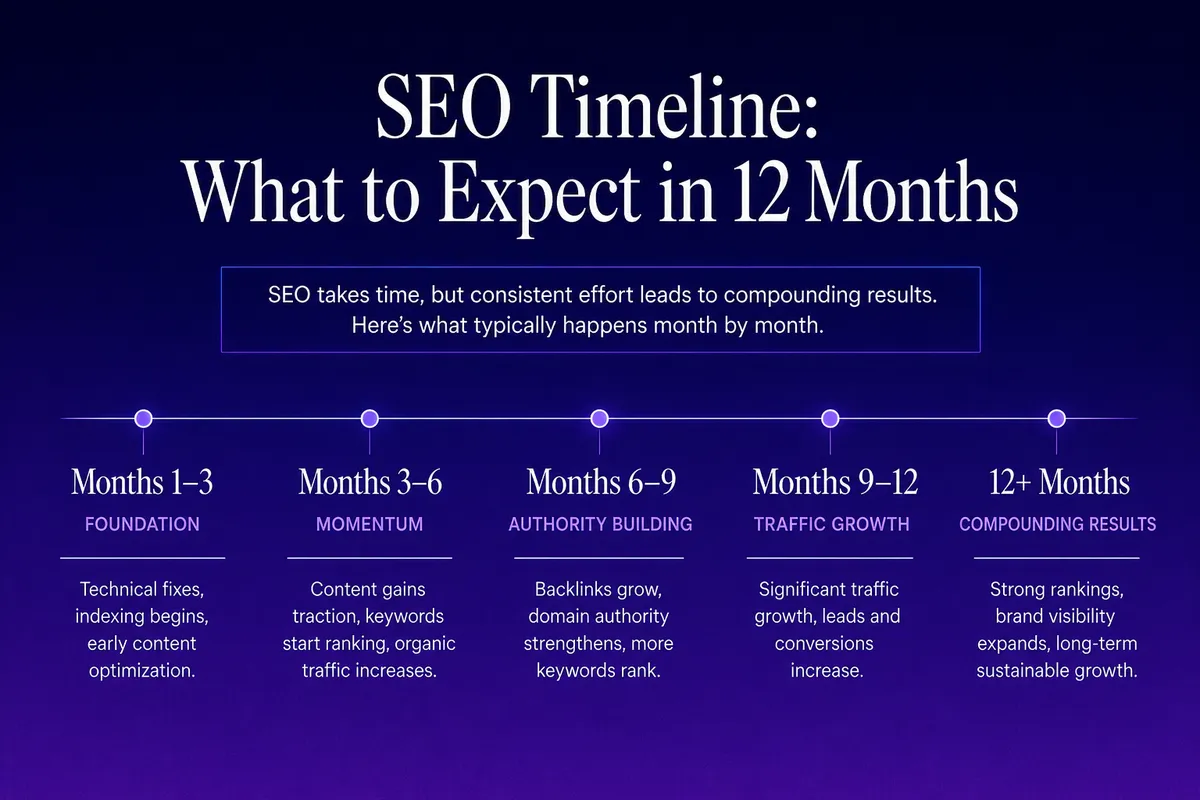
SEO takes time, and the data backs this up clearly. 95% of newly published pages don't reach Google's top 10 search rankings within a year of going live. The typical SEO timeline runs between 6 to 12 months before meaningful organic traffic growth becomes visible, though this depends heavily on keyword difficulty and your existing domain authority.
Newer domains with thin backlink profiles often sit at the longer end of that window, while older domains with established ranking power tend to see movement closer to the 3-month mark. Search engines evaluate hundreds of ranking factors simultaneously, meaning consistent effort across technical SEO, content creation, and link building compounds gradually rather than producing results overnight.
Short-Term Results (1-3 Months)
Within the first 30 days, technical fixes like resolving broken links or duplicate content issues become crawlable improvements Google registers quickly. By month three, sites targeting long-tail keywords typically see measurable organic traffic shifts, with some reporting 20-30% visibility gains.
Medium-Term Results (3-6 Months)
Between months 3 and 6, organic traffic gains become measurable. Ahrefs data shows sites typically see a 20-30% traffic increase during this window, largely driven by improved topical authority and consistent link building efforts compounding over time.
Long-Term Results (6-12+ Months)
By the 6-12 month mark, compounding SEO efforts begin driving measurable organic traffic growth, with many sites seeing 30-100% increases in impressions. A stronger backlink profile built over this period signals increased authority to search engine algorithms, which directly lifts rankings for competitive target keywords.
Sites maintaining consistent quality content output typically sustain these gains long-term.
The Core Reasons Why SEO Takes So Long to Work
SEO timelines frustrate most website owners because the process operates on Google's schedule, not yours. Search engine optimization requires Google to crawl, index, and evaluate your content before any rankings shift, a process that can span weeks alone. According to Ahrefs, only 5.7% of pages rank in the top 10 within a year of publication, meaning the vast majority of organic traffic gains take far longer.
Several compounding factors slow this down:
- A weak backlink profile signals low authority to Google
- Poor technical foundation delays crawling and indexing
- Domain age and domain history affect trust signals
- Thin or misaligned content fails to match search intent
Each layer compounds the others, stretching timelines considerably.
Building Domain Authority Is a Slow and Steady Process
Domain authority grows through consistent link building over time, as sites with stronger backlink profiles rank significantly higher. According to Ahrefs, the top-ranking pages have 3.8x more backlinks than lower-ranked competitors, and earning quality links from a reputable source can take 12 to 24 months.
The Google Sandbox Effect and New Websites
New websites often spend 3 to 6 months in what's commonly called the Google Sandbox, a probationary period where organic traffic remains suppressed regardless of SEO efforts. During this period, even strong quality content and solid link building rarely produce visible rankings. Google uses this filter to assess trustworthiness before rewarding new domains, meaning your backlink profile and site performance need consistent development long before results appear.
Algorithm Updates Constantly Shift the Playing Field
Google releases thousands of algorithm updates yearly, with major core updates like the 2023 Helpful Content Update reshaping rankings overnight. Each update can reverse months of SEO progress, forcing strategies to adapt as search intent signals are constantly re-evaluated.
Search Competition Makes It Harder to Rank Quickly
High competition in your niche directly affects how long SEO takes to deliver results. Ahrefs data shows that the average top-ranking page is over two years old, meaning established competitors have deeply developed backlink profiles and authority that newer pages simply cannot bypass quickly. Effective competitor analysis reveals that top-ranking sites often hold hundreds of referring domains, making organic traffic gains a slow, methodical climb rather than something that happens overnight.
Why There Are So Many Things to Fix Before Growth Can Begin
Before a single page climbs in rankings, search engine optimization requires resolving a layered stack of problems that most site owners never anticipated. A technical audit alone can surface dozens of issues, including:
- Broken internal linking structures
- Crawl errors flagged in Google Search Console
- Poor mobile usability scores
- Missing or duplicate title tags
- Slow page load times that damage user experience
Each of these problems signals distrust to Google's crawlers, and Google has confirmed that technical issues directly limit how efficiently a site gets indexed. With over 200 ranking factors in play, unresolved errors compound quickly, meaning your organic traffic potential stays capped until the foundation is genuinely clean.
Technical SEO Issues That Hold Back Rankings
Crawl errors, broken links, and slow page speeds directly suppress rankings before any content strategy can take hold. Google's own documentation confirms that Core Web Vitals, including Largest Contentful Paint under 2.5 seconds, are ranking signals. Poor technical SEO silently blocks organic traffic regardless of content quality.
Poor Site Structure and Internal Linking Problems
Broken internal linking forces crawlers to miss key pages entirely, which directly delays indexing. Sites with poor internal linking structure see up to 40% less crawl coverage, according to industry data. Without proper internal linking, link equity fails to distribute across pages, weakening overall organic traffic potential.
Outdated or Thin Content That Fails to Rank
Pages with fewer than 300 words or outdated statistics rank significantly lower, as Google's quality rater guidelines classify them as low-value. Thin written content fails to match search intent, directly reducing organic traffic since Google prioritizes depth, accuracy, and relevance in every ranking decision. Already have pages like this sitting on your site? A content refresh usually recovers rankings faster than writing something new from scratch.
How Each Pillar of SEO Impacts Your Ranking Timeline
Technical SEO, content, and link building each carry different ranking weights, meaning your backlink profile alone can delay results by 3 to 6 months, while quality content typically signals Google within 4 weeks of indexing.
Content Quality and Topical Authority
Topical authority is built when a site consistently publishes quality content that fully covers a subject area, and Google's own documentation confirms it evaluates content using E-E-A-T criteria (Experience, Expertise, Authoritativeness, Trustworthiness). Sites demonstrating depth across related topics tend to rank faster.
Key factors that accelerate this process include:
- Covering search intent precisely across related subtopics
- Publishing content clusters rather than isolated pages
- Maintaining consistent publishing frequency
Technical SEO and Site Health
Crawl errors, slow page speeds, and broken links can delay ranking progress by weeks or even months. Google Search Console reveals these issues directly, showing which pages face indexing problems that prevent organic traffic from growing. A site loading above 3 seconds loses roughly 53% of mobile visitors, according to Google's own data, meaning poor technical health actively damages user experience and signals low quality to search engines before a single piece of content is even evaluated.
Internal and External Link Profiles
A strong backlink profile typically requires 3-6 months to show measurable ranking improvements. Internal linking accelerates this by distributing page authority across your site, while external links from high-domain-authority sources signal credibility to Google. Sites earning backlinks from domains with a DA above 60 see ranking shifts notably faster, making link building a timeline-defining factor in your SEO strategy.
A Month-by-Month SEO Timeline: What to Expect in the First 12 Months
Months 1 through 3 are purely foundational, where Google Search Console gets configured, technical audits run, and keyword targeting gets locked in. By month 4, organic traffic typically shows its first measurable lift, around 5-10% growth. The real compounding effect hits between months 6 and 9, where quality content and a strengthening backlink profile push rankings into page one territory.
Studies show 95% of pages get zero organic traffic, making consistent link building through months 9 to 12 the difference between stagnation and sustainable visibility.
Month 1: Technical Auditing and Foundational Fixes
During Month 1, a thorough technical audit using Google Search Console reveals crawl errors, indexing gaps, and broken links that silently suppress rankings. Studies show that pages with Core Web Vitals failures see up to 24% higher bounce rates, directly harming user experience. Fixing these foundational issues, from redirect chains to sitemap errors, gives your SEO efforts a structurally sound base before any content work begins.
Months 2-3: On-Page Optimization and Initial Content Creation
During months 2-3, aligning page content with search intent becomes the priority. Target pages get optimized by:
- Updating title tags and meta descriptions
- Structuring content around specific search queries
- Improving user experience signals like page speed
Months 4-5: Authority Building and Internal Structure Improvements
By months 4 and 5, link building becomes measurable, with a stronger backlink profile directly influencing domain authority scores. Internal linking improvements, like connecting pillar pages to supporting content, reduce crawl depth and boost page indexing. Sites implementing structured internal links see up to 40% faster crawl rates, accelerating ranking progress.
Months 6-7: Monitoring Performance and Refining Strategy
By months 6 and 7, your Google Search Console data becomes genuinely actionable, revealing which pages earn impressions but struggle with click-through rates below the 2-3% benchmark. Refining your SEO strategy here means cross-referencing ranking shifts with search intent alignment, since Google's own research confirms that satisfying user intent directly influences position stability.
Pages misaligned with search intent typically see bounce rates exceeding 70%, signaling a need for targeted content adjustments.
Months 8-9: Expanding Brand Visibility and Topical Coverage
By months 8 and 9, brand visibility expands through broader topical coverage, with sites publishing content clusters seeing 30% more organic impressions. Strengthening your backlink profile through strategic link building during this phase compounds domain authority gains already established in earlier months.
Months 10-11: Reviewing Data and Adjusting for Growth
By months 10 and 11, Google Search Console data reveals clear patterns, showing which pages drive clicks and which underperform. Refining your SEO strategy here means reallocating efforts toward high-impression, low-click pages, since improving their CTR by even 1-2% compounds ranking gains significantly.
Month 12: Scaling What Works and Closing Gaps
By month 12, your SEO strategy should have enough performance data to identify which pages drive the most organic traffic and which still underperform. Scaling means doubling down on high-converting content while auditing your backlink profile for toxic links. Studies show pages ranking in Google's top 3 generate 54.4% of all clicks, making gap-closure critical:
- Expand topperforming content
- Disavow lowquality backlinks
- Target untapped keyword clusters
Frequently Asked Questions About SEO Timelines
How Long Does SEO Take for a New Website?
For a new website, SEO typically takes 6 to 12 months before meaningful results appear. This extended timeline exists because search engines need time to crawl, index, and evaluate your site's authority and relevance. New domains lack the trust signals established sites carry, making the process slower.
Consistent content creation and link building can help accelerate progress during this period.
Why Does SEO Take Longer for Competitive Industries?
Competitive industries have more established websites with stronger backlink profiles, higher domain authority, and years of optimized content. Outranking them requires building equivalent trust signals, which Google's algorithms evaluate over time. Studies show competitive niches can take 12 to 24 months to see meaningful rankings, compared to 3 to 6 months for lower-competition markets.
Can You Speed Up SEO Results Without Risking Penalties?
Yes, results can come faster with strategic actions like fixing technical errors, improving page speed, and targeting low-competition keywords. Publishing high-quality content consistently also accelerates progress. However, avoid black-hat tactics like keyword stuffing or buying links, as Google's guidelines explicitly penalize these practices, potentially causing ranking drops that set back progress far longer than a patient, ethical approach would.
How Much Does SEO Cost and Does Budget Affect the Timeline?
Monthly SEO retainers typically range from $500 to $10,000+, depending on the scope and competition level. Budget directly impacts timeline , higher investment allows for more content creation, technical fixes, and link building simultaneously. Limited budgets often mean slower progress, as fewer tasks can be executed at once, naturally extending the time needed to see meaningful ranking improvements.
Is SEO Still Worth It Even Though It Takes So Long?
Despite the long timeline, SEO remains one of the highest-return digital marketing strategies available. Studies show organic search drives over 53% of all website traffic, making it a dominant acquisition channel. While paid ads stop the moment you stop paying, SEO compounds over time, delivering lasting visibility and traffic.
The upfront investment typically pays off significantly as rankings and authority grow.
What Are the Earliest Signs That Your SEO Is Working?
Early signs of SEO progress include improved crawl rates, which can appear within days of publishing optimized content. Google typically takes 4 to 6 weeks to index new pages, so initial ranking fluctuations are normal. Other early indicators include increased impressions in search results, longer average session durations, and slight upticks in organic click-through rates before significant ranking improvements occur.