Deep Dive with AI
The Real Cost of SEO Agencies vs. AI Tools for Small Businesses
Hiring an SEO agency typically costs small businesses between $1,500 and $5,000 per month, according to data from Ahrefs. For a full year, that totals anywhere from $18,000 to $60,000 before a single page ranks. AI-powered tools, by contrast, run between $50 and $500 monthly, covering content creation, keyword targeting, and optimized content generation at a fraction of that price.
The cost gap becomes even sharper when you factor in that AI platforms can produce content and analyze search patterns at a speed no agency team matches. For small businesses watching every dollar, redirecting those marketing efforts toward scalable AI tools means maintaining a stronger online presence without the overhead of a traditional retainer.
If you need to refresh your understanding of what SEO means, read here.
Why Small Business Owners Are Growing Frustrated With Traditional SEO Agencies
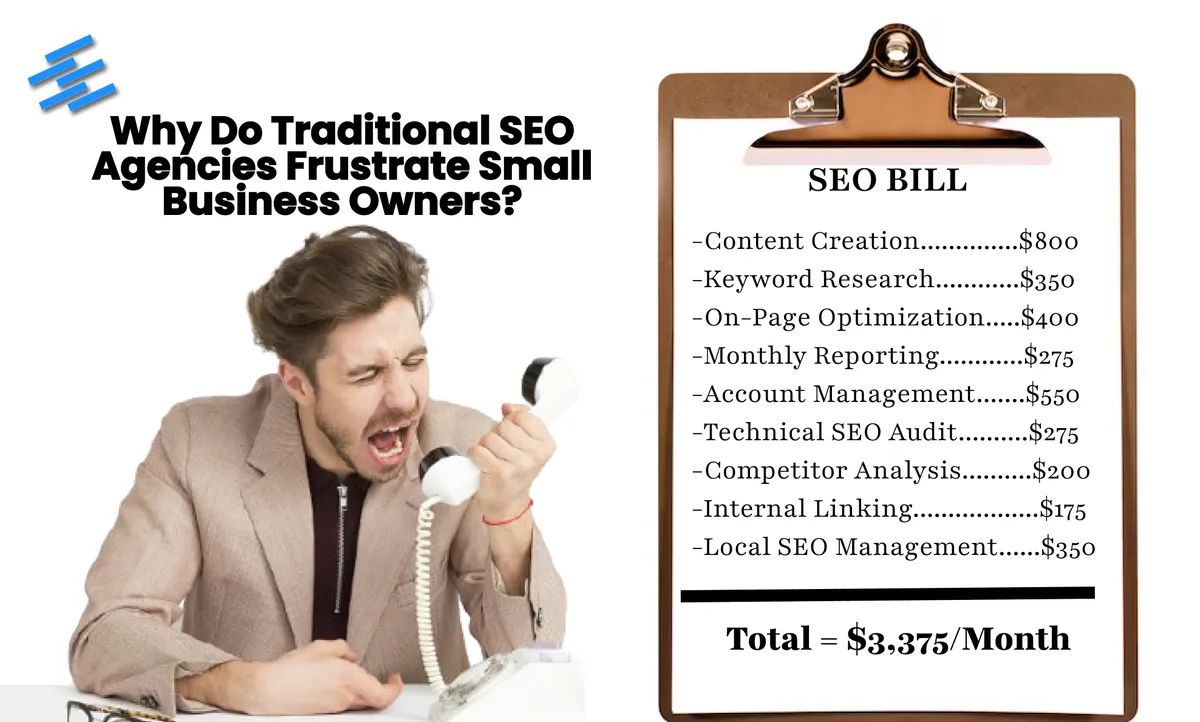
Small businesses are increasingly walking away from traditional SEO agencies, and the frustration is backed by real numbers. According to a 2023 Semrush survey, 57% of small businesses reported dissatisfaction with the ROI delivered by their SEO agency within the first year. The core complaint centers on rigid retainer models, where businesses pay between $1,500 and $5,000 monthly with little transparency into how those dollars translate into organic traffic or qualified leads.
Beyond pricing, agencies often treat small businesses as low-priority accounts, cycling through templated digital marketing strategies rather than addressing specific local market needs. For a business serving a defined service area, that generic approach directly undermines their ability to reach potential customers searching with clear buyer intent.
Explofi has also conducted extensive research on SEO agency retainers. What we found was that dissatisfaction rates were higher for businesses with agencies, compared to businesses without agencies. Businesses using Explofi, paired with their in-house team on average saved 20%-30% more on marketing than businesses without it.
This compounded can make a huge difference for small businesses.
The Long Wait Times That Kill Small Business Momentum
Traditional SEO agencies typically operate on 3 to 6 month timelines before delivering measurable results, a pace that directly suffocates small businesses running on tight budgets and tighter windows. For a local retailer or service provider trying to generate leads before a slow season hits, waiting 90 to 180 days for organic traffic to move is simply not viable.
Research from BrightEdge found that organic search drives 53% of all website traffic, meaning every delayed week costs real revenue. Small businesses need their SEO efforts to produce results within weeks, not quarters. Agencies juggling dozens of clients rarely prioritize accordingly, leaving small business owners watching competitors capture local customers while their own campaigns sit in a content queue.
Hidden Fees and Unclear Pricing Structures at Traditional SEO Firms
Traditional SEO agencies have long relied on opaque pricing models that leave small businesses blindsided by unexpected costs. A 2023 survey by Clutch found that 34% of small businesses reported being charged fees they did not anticipate when signing with an SEO agency. These hidden costs often appear as separate line items for backlink building, content creation, technical audits, and local searches optimization, each billed independently despite being bundled in initial proposals.
A retainer that starts at $1,500 per month can quietly balloon to $4,000 once these charges surface. Beyond the billing surprises, contract terms averaging 12 months lock small businesses into agreements with little measurable return on organic traffic, making it increasingly difficult to justify the ongoing spend.
Lack of Transparency in Reporting and Strategy Communication
Many small businesses report feeling left in the dark about what their SEO agency actually does month to month. A 2023 survey by Databox found that 60% of businesses were dissatisfied with the reporting they received from their marketing agencies, citing vague metrics and no clear connection to revenue.
Rather than receiving detailed breakdowns of organic traffic shifts or changes tied to an algorithm change, most clients get surface-level reports showing keyword rankings without context. Effective SEO strategies require transparent communication about:
- Which pages are driving search intent
- How structured content changes affect rankings
- What specific actions were taken and why
- How results connect to lead generation goals
Without this clarity, small businesses cannot make data-driven decisions about their investments.
One-Size-Fits-All Approaches That Ignore Small Business Needs
Many SEO agencies build their strategies around enterprise-level frameworks, then scale them down for smaller clients without meaningful adjustments. A local bakery competing in a three-block radius has fundamentally different needs than a national retailer, yet agencies routinely apply the same keyword volume thresholds, backlink quotas, and content calendars to both.
Research from Clutch found that 50% of small businesses invest in SEO, but many report feeling underserved by agency deliverables that prioritize broad organic traffic gains over hyper-local searches. Agencies often ignore local searches entirely, skipping Google Business Profile optimization and service area targeting in favor of generic blog posts that attract irrelevant visitors.
This misalignment between templated seo strategies and actual small business goals is a core driver of the growing frustration pushing owners toward more targeted solutions.
How AI Has Fundamentally Changed the SEO Landscape for Small Businesses
AI has quietly rewritten the rules of search engine optimization, and small businesses are feeling the shift most acutely. Where ranking on Google once required expensive agency retainers averaging $2,500 to $10,000 per month, AI tools now handle keyword research, content creation, and technical audits at a fraction of that cost. If you want to dive deep on how businesses are ranking on google without agencies, then read the article linked.
The evolving digital landscape has particularly disrupted how search engines interpret user intent, with Google's AI-powered systems like RankBrain and BERT now processing over 8.5 billion daily searches by analyzing conversational patterns rather than just keywords. For small businesses, this means that organic traffic is now driven by relevance and context, not just backlink volume, fundamentally shifting what effective AI SEO actually requires to compete.
The Shift From Manual Keyword Research to AI-Powered Buyer Intent Analysis
Manual keyword research once meant hours of guessing which terms might actually bring customers to your door. AI-powered buyer intent analysis has replaced that guesswork with precision, processing search behavior signals across millions of queries to identify exactly where a potential customer is in their buying journey.
For small businesses this shift is significant. Instead of targeting broad keywords and hoping they convert, AI tools can now analyze search intent in real time, separating informational searches from transactional ones so you know exactly what type of content to create and when. Rather than building pages around assumed demand, you build them around actual demand, the specific phrases local customers use moments before they call, book, or buy.
Explofi uses this same intent logic to help small businesses move from guessing to executing. Instead of handing you a spreadsheet of keywords and leaving you to figure out what to do next, Explofi analyzes what is already working in your market, identifies the content gaps your competitors have not filled, and helps you create localized content built around the searches that actually drive revenue for businesses like yours.
How AI Tools Now Automate Tasks That Once Required an Entire Agency Team
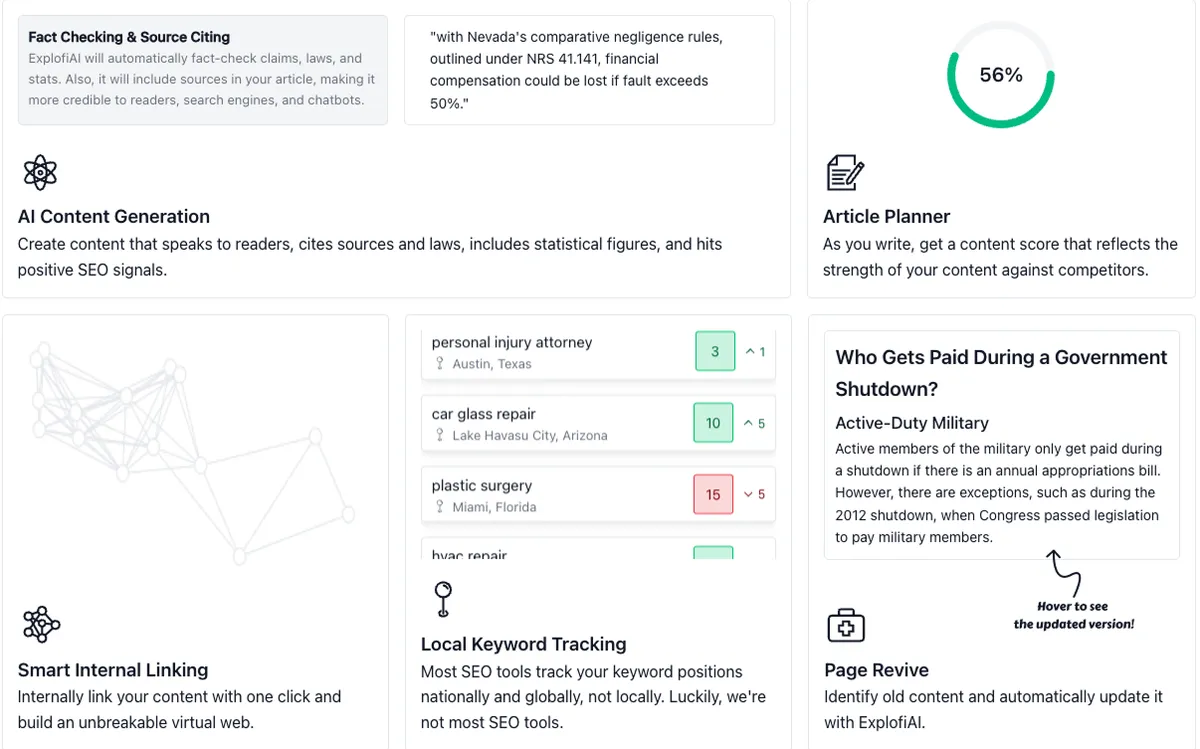
AI tools now handle keyword research, content briefs, competitor analysis, and content creation simultaneously. Tasks that once required specialists across multiple departments. What used to take an agency team 20 to 40 hours per month to deliver can now be executed inside a single platform in a fraction of the time.
For small businesses this shift changes everything. Agency workflows that once demanded a dedicated writer, SEO strategist, and account manager just to produce a few blog posts and a monthly report can now be replaced with an AI execution system that runs continuously and costs a fraction of the retainer.
Explofi is built specifically for this shift. Instead of spreading your budget across an agency team billing by the hour, Explofi compresses the entire SEO execution workflow into one platform. Competitor analysis, localized content creation, service page generation, internal linking, page refreshes, and local keyword tracking all happen inside a single system built for small businesses that need results without the overhead.
The businesses winning local search right now are not the ones with the biggest agency retainers. They are the ones that found a faster, cheaper way to execute the same work.
The Rise of Generative Engine Optimization and What It Means for Small Businesses
Generative Engine Optimization (GEO) is reshaping how small businesses approach ai search visibility, shifting focus from traditional keyword rankings to being cited within AI-generated responses. Unlike conventional SEO, GEO targets platforms like ChatGPT, Google's AI Overviews, and Perplexity, where answers are synthesized rather than linked.
Research from Princeton, Georgia Tech, and other institutions found that GEO strategies can increase visibility in AI-generated responses by up to 40%. For small businesses, this means:
- Writing authoritative, cite worthy content
- Structuring responses in direct question and answer formats
- Building topical depth across service areas
- Earning mentions on trusted third party platforms
If you want to understand the difference between GEO and SEO read this article for an analysis.
What Traditional SEO Agencies Do That AI Tools Still Cannot Fully Replace
Traditional SEO agencies bring something that AI tools genuinely struggle to replicate: relationship-driven authority building. Securing a backlink from a high-authority publication, for example, requires direct human outreach, negotiation, and trust-building that no AI can fully automate. A study by Backlinko found that the top-ranking pages on search engines have an average of 3.8x more backlinks than those in positions two through ten.
Beyond link acquisition, agencies also conduct technical audits that identify crawl errors, Core Web Vitals issues, and indexing gaps that directly affect organic traffic. These strategy-based decisions require contextual judgment shaped by years of experience, something AI tools currently lack the nuance to provide at that level of depth.
Building Genuine Relationships for Authoritative Link Acquisition
Authoritative backlinks remain one of the strongest ranking signals for search engines, with studies showing links account for a significant portion of Google's algorithm weight. Unlike AI tools that can identify link opportunities or automate outreach templates, seasoned SEO agencies build real editorial relationships with publishers, journalists, and industry bloggers over years.
These connections produce organic traffic-driving placements that a cold automated email simply cannot replicate, making genuine human networking an irreplaceable asset for small businesses pursuing sustainable growth through authoritative link acquisition.
Navigating Complex Algorithm Updates That Require Strategic Human Judgment
When Google rolled out its Helpful Content Update in 2024, sites that relied purely on automated SEO strategies saw organic traffic drops of up to 45% almost overnight. That kind of algorithmic shift demands more than pattern recognition; it requires a seasoned strategist who can read between the lines of a vague policy document and make calculated pivots.
AI tools process historical data well, but they struggle to interpret the intent behind a new ranking signal before enough data accumulates to reflect it. Experienced SEO professionals identify which content clusters to protect, which to rewrite, and which to consolidate, decisions that directly improve SEO performance across an entire domain without waiting months for machine learning models to catch up.
That gap is exactly what Eve is being built to close.
Eve is Explofi's upcoming AI SEO operator. Where most AI tools process data and hand the decisions back to you, Eve is designed to interpret what is happening in your market, tell you what it means for your specific business, and guide you through exactly what to do next.
When an algorithm update hits, Eve will not just flag the change. It will analyze your content, identify which pages are at risk, tell you what to protect, what to rewrite, and what to consolidate so your rankings recover faster than competitors who are still waiting on their agency to respond.
For small businesses that do not have a seasoned SEO strategist on staff, Eve becomes that strategist. The one that reads the signals, makes the call, and keeps your SEO execution moving without you needing to understand every algorithm change that rolls out.
Eve is coming. If you want to be the first to know when it launches, sign up for Explofi free today and you will be first in line.
Crafting Brand Voice and Storytelling That Resonates With Local Audiences
Local audiences respond to stories that feel lived-in, not algorithmically assembled. Traditional SEO agencies bring human strategists who interview business owners, study neighborhood culture, and translate those details into brand voices that carry real weight. A bakery in a tight-knit community, for instance, needs content creation that references local landmarks, seasonal traditions, and the specific language its customers actually use.
This kind of storytelling directly supports customer engagement because it builds trust before a sale ever happens. According to a 2023 Edelman Trust Barometer report, 81% of consumers say trust influences their purchasing decisions, making authentic narrative a measurable business asset rather than a soft skill.
When you create content inside Explofi you are not getting generic AI output that sounds like it could belong to any business in any city. Explofi lets you define your brand voice so the content it generates sounds like you. The way you talk to customers. The words your community actually uses. The tone that fits your neighborhood, your industry, and your business specifically.
A roofing company in Las Vegas does not need content that sounds like a roofing company in Boston. A family-owned bakery does not need copy that reads like it came from a corporate content farm. Explofi uses your voice inputs to generate localized content that carries the personality and authenticity your local audience responds to.
The result is content that feels lived-in because it is built around how you actually communicate, not around what an algorithm assumes you should sound like.
Key Differences Between AI SEO Tools and Traditional SEO Agency Services
AI SEO tools and traditional agency services differ in ways that directly affect how small businesses grow their organic traffic. Traditional agencies rely on human strategists who build custom SEO strategies over weeks, often billing $1,500 to $5,000 monthly for their expertise. AI SEO tools, by contrast, process data and generate optimization recommendations in minutes at a fraction of that cost.
The key distinctions come down to:
- Speed: AI tools analyze thousands of keywords instantly, while agencies take days
- Cost: AI platforms average $50 to $300 monthly versus agency retainers
- Scalability: AI handles content creation across hundreds of pages simultaneously
- Customization: Agencies offer nuanced, strategy based thinking tailored to brand voice
Speed and Scalability of Content Production and Optimization
AI SEO tools can generate and optimize dozens of pieces of content in the time it takes a traditional agency to produce one. What used to require days of research, briefing, writing, editing, and approval can now be executed inside a single platform in minutes.
For small businesses this speed directly impacts organic traffic growth. Publishing frequency is a proven ranking factor and studies show websites publishing 16 or more posts per month earn 3.5 times more traffic than those publishing fewer than four. Most small businesses never hit that volume because they are waiting on an agency that is juggling 30 other clients or a writer who has a backlog.
Explofi removes that bottleneck entirely. Instead of waiting days for a content brief or weeks for a finished article, you enter your business type, location, and target topic and Explofi generates localized, competitor-informed content built to rank in your specific market. You can scale your content output without scaling your costs, without adding headcount, and without being dependent on an agency timeline that was never built around your business in the first place.
Customization and Personalization of SEO Strategy for Niche Markets
AI SEO tools have reshaped how small businesses approach niche market targeting by analyzing hyper-specific audience behavior patterns that broad agency strategies often overlook. Unlike agency-built strategies that tend to follow industry templates, AI-driven platforms can process niche-specific data points from long-tail keyword clusters to micro-segment search intent, generating strategies tailored down to the service or product level.
A boutique candle shop benefits far more from content targeting "soy wax candles for anxiety relief" than from generic lifestyle content an agency might produce. Studies show that personalized content strategies generate conversion rates up to six times higher than non-personalized approaches.
Explofi's AI Topical Map is built exactly for this. Instead of guessing what content to create next, the topical map analyzes your niche, your location, and your competitors to build out a complete content cluster around your specific services. You see exactly what to write, in what order, and how each piece connects to build topical authority in your market. The strategy does not stay static between monthly reporting cycles. It evolves as your content grows and your market shifts, so your SEO execution always stays ahead of what your competitors are doing.
If you want to understand the importance of an AI topical map for small businesses, read this article.
Access to Real-Time Data and Predictive SEO Analysis
Traditional agency reporting runs on a monthly cycle. By the time you get the report, review it, schedule a call, and wait for the agency to act on it, weeks have passed. Rankings have shifted. Competitors have moved. And you are still looking at data that is already a month old.
AI SEO tools process live search data continuously so you know what is happening in your market the moment it changes. Ranking shifts, keyword movement, and content gaps surface in real time instead of sitting in a PDF that arrives on the first of the month.
Explofi's local keyword tracker is built around this principle. Instead of waiting on a report to tell you what happened last month, you can see daily ranking movement for your specific keywords in your specific city. When something shifts you know immediately and you can act on it immediately. Studies show businesses that monitor SEO performance daily resolve ranking issues up to 60% faster than those relying on periodic reporting.
That speed compounds over time. Small businesses that catch drops early, refresh the right pages, and build content around emerging opportunities consistently outpace competitors who are still waiting on their agency to notice the same thing.
How AI Tools Are Transforming Keyword Research for Small Business Owners
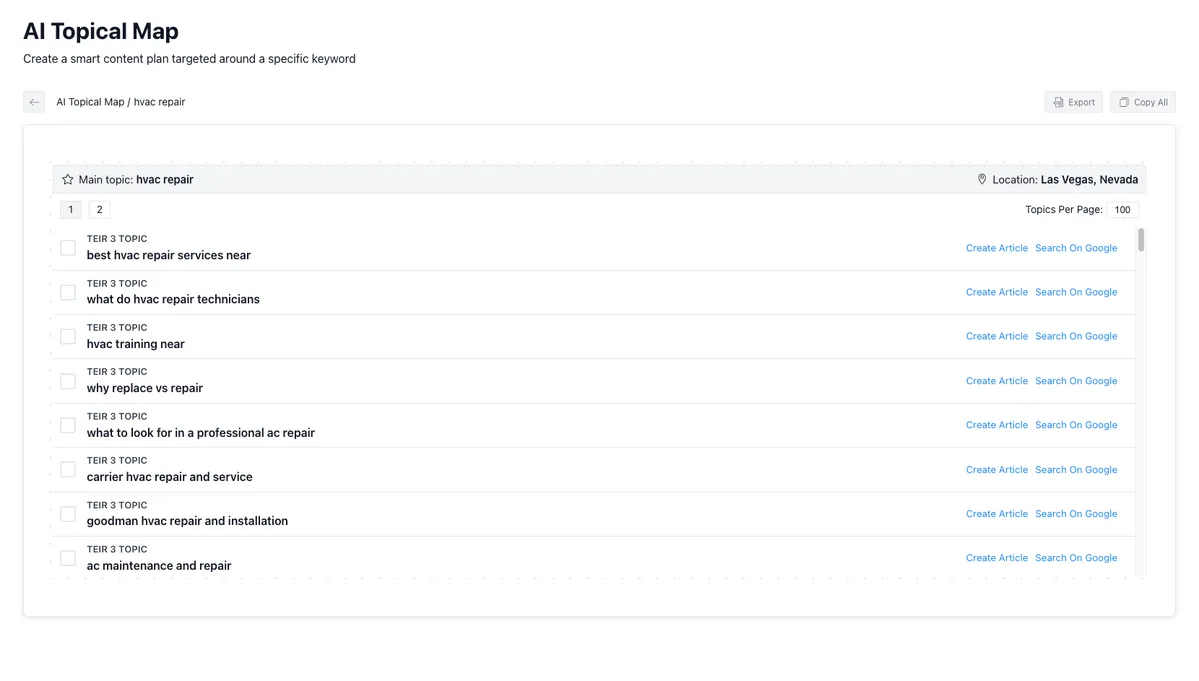
Keyword research has historically been one of the most time-consuming aspects of SEO strategies for small businesses, often requiring hours of manual analysis. AI tools have fundamentally changed this dynamic by processing search volume data, competition metrics, and user intent signals simultaneously, cutting research time by up to 70% according to recent industry reports.
Rather than paying agencies $1,500 to $5,000 monthly for keyword research alone, small businesses can now use AI-powered platforms to uncover high-opportunity, low-competition keywords in minutes. These tools analyze patterns across search engines at scale, identifying long-tail keyword clusters that would take a human researcher days to compile, giving small business owners a precision advantage that was previously reserved for enterprise-level marketing teams.
Moving Beyond Guessing Keywords to Owning Buyer Intent
Buyer intent is what separates a visitor who browses from one who buys, and AI SEO tools have gotten remarkably precise at identifying that difference. Rather than targeting broad terms like "shoes," these tools analyze search behavior patterns to surface phrases like "best waterproof hiking shoes under $100," which carry a far stronger purchase signal.
For small businesses, this precision matters because organic traffic built on high-intent keywords converts at rates up to 3x higher than generic keyword traffic. AI tools pull from real-time search data across search engines to map exactly where buyers are in their decision journey, grouping keywords by awareness, consideration, and purchase stages:
- Informational intent: "how to fix a leaky faucet"
- Comparative intent: "plumber vs DIY repair cost"
- Transactional intent: "emergency plumber near me"
Identifying Long-Tail and Conversational Keywords for Voice Search Optimization
Voice search queries convert at a significantly higher rate because users searching by voice tend to have stronger purchase intent, with studies showing voice-driven searches are three times more likely to be locally focused. AI tools now analyze natural speech patterns to surface long-tail phrases like "where can I find affordable handmade jewelry near me" rather than the fragmented "handmade jewelry cheap" a traditional keyword tool might suggest.
This shift matters because roughly 71% of consumers prefer using voice search over typing when looking for quick answers. For small businesses, targeting these conversational keywords through AI SEO strategies means capturing zero-click searches and featured snippet placements, which drive organic traffic without requiring paid campaigns.
AI tools process thousands of query variations simultaneously, identifying question-based phrases starting with "how," "what," and "where" that align precisely with how real customers speak.
Using AI to Uncover Competitor Keyword Gaps Without Agency-Level Budgets
Competitor keyword gap analysis used to require an agency retainer averaging $3,000 to $10,000 per month just to access the expertise and tools needed to run it properly. AI has changed that completely. Small businesses can now identify exactly which keywords their competitors rank for that their own site is missing, without paying a retainer and without waiting weeks for a deliverable.
The logic is simple. If a competing local bakery ranks for "gluten-free wedding cakes near me" and your site does not, that is a direct revenue gap. Every day that page exists and yours does not is a day that customer is calling your competitor instead of you.
Explofi is built around this exact insight. When you enter your business type, location, and competitors, Explofi analyzes what is already ranking in your market and surfaces the content gaps your site needs to fill. You see which topics your competitors are winning, which service pages they have that you do not, and what content to build next to close the gap. The analysis that used to take an agency team weeks to produce happens inside Explofi in minutes, so you can stop guessing and start building the pages that actually bring customers in.
How Small Businesses Are Using AI to Build a Content Engine Without an Agency
Small businesses are increasingly building full content engines using AI tools, cutting out the middleman entirely. Platforms like Explofi allow owners to research keywords, draft blog posts, and optimize for search engines in a single workflow, tasks that once required a $3,000-per-month agency retainer.
According to HubSpot's 2023 State of Marketing Report, 33% of marketers already use AI for content creation, and that number is climbing fast among independent business owners. Rather than waiting two weeks for an agency deliverable, a business owner can publish SEO-optimized content daily, generating a steady flow of organic traffic without outsourcing.
AI handles structure, tone, and keyword density, making engaging content accessible even without a dedicated marketing team.
Transforming Infrequent Blog Posts Into a Consistent Authority-Building Strategy
Publishing one blog post per month generates roughly 67% less organic traffic than publishing weekly, according to HubSpot research. AI SEO tools close that gap by turning a single topic idea into a structured content calendar, mapping subtopics, target keywords, and publishing dates automatically.
Rather than scrambling for ideas, small businesses maintain a predictable publishing rhythm that search engines reward with stronger crawl frequency and improved domain authority over time.
Creating Complete Marketing Funnels With AI-Generated Content at Every Stage
AI-generated content now covers every layer of a funnel with surprising precision, from awareness-stage blog posts that drive organic traffic to decision-stage comparison pages that convert browsers into buyers. Small businesses using tools like ChatGPT or Explofi report cutting content creation time by up to 70%, which means a single operator can produce top, middle, and bottom-funnel assets in one sitting.
At the awareness stage, AI drafts educational articles targeting informational keywords. Moving into consideration, it produces detailed product breakdowns and FAQs. At the conversion stage, it generates:
- Targeted landing page copy
- Email nurture sequences
- Objection handling product descriptions
- Retargeting ad scripts
This full-funnel coverage replaces what agencies once charged $3,000 to $8,000 monthly to manage.
Scaling Content Production Without Scaling Headcount or Agency Retainers
AI-powered content creation tools have made it possible for small businesses to publish at agency-level volume without the $3,000 to $10,000 monthly retainer. Platforms like Explofi allow a single operator to produce optimized blog posts, landing pages, and social media copy in a fraction of the time traditional workflows require.
A 2023 HubSpot report found that businesses using AI for content creation published 3x more content than those relying solely on human writers. That output directly compounds organic traffic over time, since search engines reward consistent, high-quality publishing frequency. For a lean team, artificial intelligence effectively absorbs the workload that previously required a dedicated content department to manage.
The Agency Era for Small Business SEO Is Over
The businesses winning local search right now are not the ones with the biggest retainers. They are the ones that stopped paying agencies for work that software can do faster, cheaper, and without a 12 month contract.
Everything you just read about keyword research, content production, competitor gap analysis, topical maps, local keyword tracking, and real time data is available inside Explofi today. No agency. No retainer. No waiting two weeks for a deliverable that should have taken two hours.
Small businesses that make the switch stop renting their SEO execution and start owning it.
If you are ready to stop paying for work that a platform built for your business can handle, sign up for Explofi free today and see exactly what your competitors are ranking for that you are not.
Frequently Asked Questions
Is AI replacing SEO agencies for small businesses?
AI is not replacing the entire agency model overnight but it is replacing the repeatable execution work that agencies have charged small businesses thousands of dollars per month to deliver. Content creation, keyword research, competitor analysis, page refreshes, internal linking, and local keyword tracking can all be handled inside an AI platform today. What agencies still bring is relationship-driven link building and high-level strategic judgment. Everything else has become a software problem. Explofi is built specifically to handle that execution layer so small businesses stop paying retainer prices for work that no longer requires a full agency team.
How much can a small business save by switching from an agency to Explofi?
A traditional SEO agency retainer for a small business typically runs between $1,500 and $5,000 per month. That is $18,000 to $60,000 per year before a single page ranks. Explofi starts at a fraction of that cost and covers content creation, competitor analysis, local keyword tracking, topical maps, page refreshes, and internal linking inside one platform. For most small businesses the switch represents tens of thousands of dollars in annual savings while actually increasing the volume and speed of SEO execution.
Can AI tools really replace the strategy an agency provides?
For most small businesses the honest answer is yes for the execution layer and increasingly yes for the strategy layer too. AI tools can now analyze search intent, identify keyword gaps, surface competitor content, and build topical maps that tell you exactly what to create and in what order. Where human judgment still matters is in interpreting major algorithm updates and building editorial relationships for link acquisition. That is why Explofi is building Eve, an AI SEO operator designed to guide small businesses through exactly those decisions so they never need to depend on an agency retainer to know what to do next.
What does Explofi do that an SEO agency does not?
Explofi executes immediately. There are no kickoff calls, no onboarding delays, no waiting two weeks for a content brief. You enter your business type, location, and competitors and Explofi starts identifying what your market is searching for, what your competitors are ranking for, and what content you need to build to close the gap. You get localized content, service pages, internal linking, local keyword tracking, topical maps, and page refreshes inside one platform built specifically for small businesses. Agencies build strategies and hand off deliverables on their timeline. Explofi puts the execution in your hands and keeps it moving every day.
How long does it take to see results with Explofi compared to an agency?
Traditional agencies operate on 3 to 6 month timelines before delivering measurable organic traffic results. Explofi speeds up that timeline by helping you publish consistent, localized, competitor-informed content immediately instead of waiting for an agency content queue to move. Publishing frequency is a proven ranking factor and businesses that publish consistently see ranking movement significantly faster than those waiting on monthly agency deliverables. You can start creating and publishing content on day one with no ramp up period and no onboarding delay.
Is Explofi only for businesses that already understand SEO?
No. Explofi is built specifically for business owners who do not have time to become SEO experts. You do not need to understand keyword difficulty scores, crawl budgets, or topical authority to use it. You enter your business information and Explofi guides the execution from there. The platform handles the strategy layer so you can focus on running your business while your content, service pages, and local rankings keep building in the background.
What happens when Google updates its algorithm?
This is where most small businesses that rely on agencies feel the pain most. By the time an agency notices a ranking drop, schedules a call, and puts together a response plan, weeks have passed. Explofi's local keyword tracker monitors your rankings daily so you see shifts the moment they happen. And with Eve coming, Explofi will be able to interpret what an algorithm change means for your specific content and tell you exactly what to protect, rewrite, or consolidate so you recover faster than competitors still waiting on their agency to respond.