Deep Dive with AI
What Is a Listicle Page in Digital Marketing?
A listicle page in digital marketing is a piece of listicle content structured around a numbered list or bullet points to present information in a scannable, digestible way. Unlike traditional long-form blog posts, listicles organize content into clearly defined list items, making them exceptionally effective for capturing short attention spans.
Research from BuzzSumo found that list-based articles generate up to 2x more social shares than other content formats. For small businesses, this format works particularly well because it mirrors how potential customers search for answers online, such as:
- Top product comparisons
- Step-by-step how-to guides
- Ranked recommendations by category
Search engines also favor this readable format, frequently pulling listicle structures into featured snippets, which dramatically increases organic visibility.
The Basic Definition of a Listicle
A listicle is a list article that structures content around numbered or bulleted points, making information easier to scan and absorb. Unlike traditional long-form articles, the listicle format organizes each idea under its own entry, such as "5 Ways to Lower Your Energy Bill." Research from Nielsen Norman Group found that readers consume only 20% of text on a page, making this list format particularly effective for holding attention and delivering value to a specific audience quickly.
How Listicle Pages Differ From Traditional Blog Posts
Unlike traditional blog posts, listicle pages use numbered headings and structured list formats to deliver content in scannable chunks. Blog content typically flows as long-form prose, while listicles break information into digestible points that grab attention faster. Research from Nielsen Norman Group shows readers scan 79% of web pages rather than reading word for word, making the listicle format particularly effective for engaging content that keeps potential customers on the page longer.
Common Formats and Structures Used in Listicle Pages
Listicle pages follow distinct structural patterns that directly affect how readers consume content. The most common formats include:
- Numbered lists (e.g., "7 Effective Ways to Boost Engagement")
- Ranked lists organized by priority or performance
- Unordered bullet lists for non-sequential tips
Numbered formats consistently outperform other structures, with studies showing they increase click-through rates by up to 36%. A clear list heading paired with quality images strengthens both readability and content strategy.
The Anatomy of a High-Performing Listicle Page
A high-performing listicle page is built around a few non-negotiable structural elements. Each item needs a distinct heading, a supporting detail of two to three sentences, and where relevant, a visual with proper alt text for SEO.
A Compelling Headline With a Numeric Value
Headlines with a specific number, like "7 Ways to Drive Traffic to Your Business Blog," consistently outperform vague titles. According to content marketing research, numbered headlines generate 36% more clicks than non-numbered ones. The specificity of a numeric value signals a clear, structured promise to your target audience, which builds trust before they even read the first word.
Odd numbers, particularly 7 and 3, tend to perform strongest.
An Engaging Introduction That Sets Expectations
The opening lines of a listicle determine whether a reader stays or leaves. Research shows that 55% of visitors spend fewer than 15 seconds on a page, making a sharp, promise-driven intro critical. An effective listicle introduction should:
- State exactly how many points follow
- Identify the specific problem being solved
- Preview the value potential customers will gain
Well-Organized and Clearly Structured List Items
Each list item in a great listicle follows a tight, predictable pattern: a bold label, a concise explanation, and one supporting detail. Research from the Nielsen Norman Group found that clear formatting improves content scanning by up to 47%, meaning potential customers absorb structured lists far faster than dense paragraphs.
Visual Components That Support Each Point
Images placed directly beside or beneath each list item reduce bounce rates by keeping readers visually anchored. According to studies, content with relevant visuals gets 94% more views than text-only formats. For a business owner, icons, infographics, or product photos tied to each point make the listicle meaning clearer, helping potential customers absorb information faster and increasing time spent on the page.
Relevant Internal and External Links Throughout
Both internal and external links strengthen a listicle's value by guiding readers deeper into relevant content. Strong listicles typically include:
- Internal links to related blog posts or service pages
- External links to credible sources that build credibility
Studies show pages with strategic links see up to 40% longer session durations from potential customers.
Why Listicle Pages Are Ideal for Small Business Websites
Listicle pages fit naturally into a small business's marketing strategy because they match how people actually read online. According to Nielsen Norman Group, users read only 20% of text on a webpage, making scannable formats critical. A numbered or bulleted structure gives potential customers exactly that:
- Fast, digestible information
- Clear value without dense paragraphs
They Are Easy to Plan and Write on a Tight Schedule
Listicles cut planning time significantly because their numbered structure removes guesswork. To write listicles efficiently, follow this process:
- Pick 5 to 10 clear points
- Write 1 to 2 sentences per point
- Skip lengthy transitions
This format lets potential customers find value fast, and even coffee shops producing weekly content can publish a polished listicle in under two hours.
They Appeal to Time-Strapped Readers Who Skim Content
Readers spend an average of 37 seconds reading online content, according to research by Medium. A listicle's structure naturally fits that window through:
- Scannable numbered points
- Bold headers
- Bitesized chunks
This keeps potential customers engaged without overwhelming them.
They Clearly Communicate Value Before the Reader Clicks
Numbered lists signal value instantly, giving potential customers a clear preview of what they'll gain. Studies show scannable formats boost comprehension by 47%. A listicle's structure:
- Removes guesswork
- Sets clear expectations
This naturally helps increase conversions before a single click.
How Listicle Pages Improve SEO for Small Businesses
Listicle pages give small businesses a measurable edge in search rankings by structuring content in a way that search engines can easily parse. Google's algorithm favors content with clear organization, and listicles naturally create that structure through numbered or bulleted formats. Research from Backlinko found that list posts generate 218% more backlinks than traditional how-to articles, making them powerful for building online presence.
Specifically, listicles tend to capture featured snippets, which appear at position zero in search results and drive significantly higher click-through rates. For potential customers searching comparison or "best of" queries, these formats appear more frequently because they:
- Match high intent search patterns
- Reduce bounce rates through scannable content
- Signal topical authority to crawlers
Why Search Engines Favor the Listicle Format
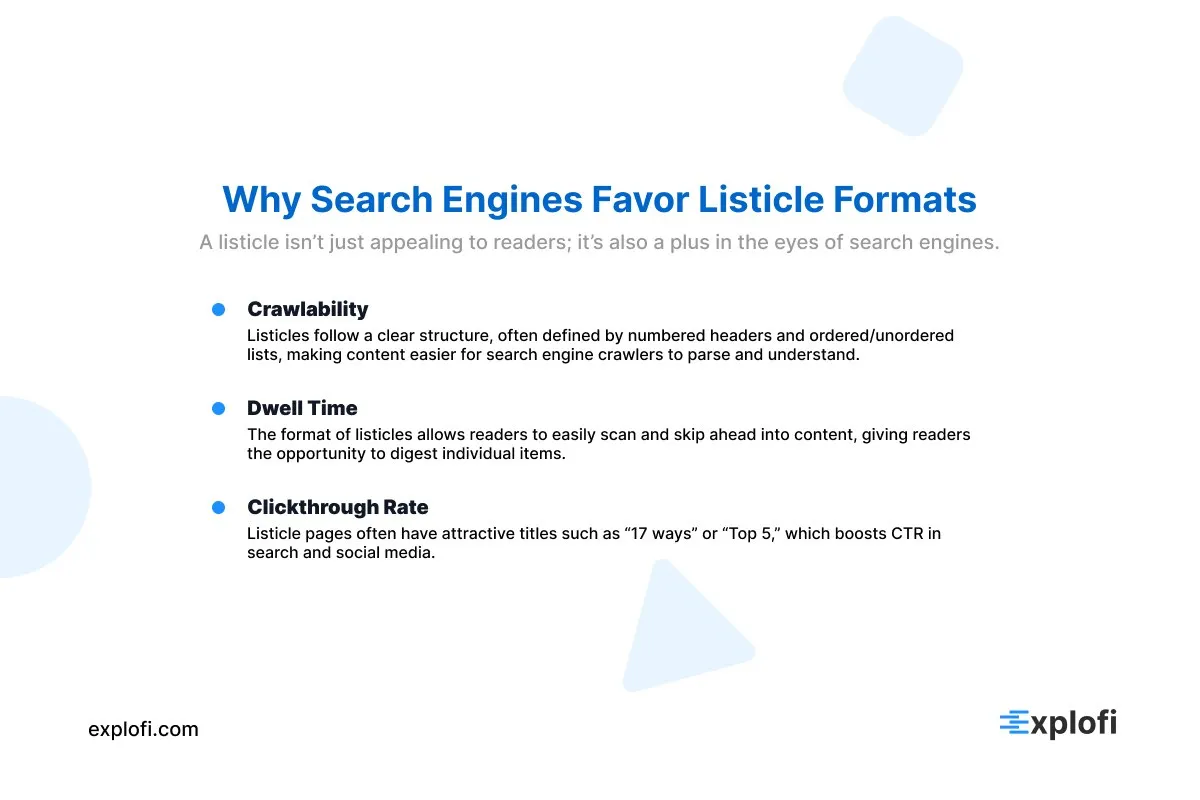
Search engines reward listicle pages because their structured format signals clear, organized content. Ranked lists reduce bounce rates by keeping readers engaged longer, a key ranking factor. Google's algorithm also favors scannable content, as it improves:
- Crawlability
- Dwell time
- Clickthrough rates
How Listicles Help Target Long-Tail Keywords Effectively
Listicles naturally mirror how potential customers search online, making them ideal for capturing long-tail keywords. Phrases like "best affordable tools for small bakery owners" or "5 ways to reduce shipping costs for online stores" reflect real search queries that broader content misses. According to Ahrefs, long-tail keywords drive 70% of all web traffic, and listicles, structured in a clear blog format, align perfectly with these specific, intent-driven searches.
The Role of Listicle Pages in Building Backlink Opportunities
Listicle pages naturally attract backlinks because curated, list-based content is among the most shared formats online. Sites referencing useful resources tend to link to listicles that organize clear, digestible information for potential customers. Formats that perform well include:
- "Top 10" roundups
- Resource lists
- Comparison listicles
The Psychology Behind Why Readers Engage With Listicles
Readers engage with listicles because the brain processes numbered structures faster than dense paragraphs. Research shows people retain 80% more information presented in lists versus prose. The format reduces cognitive load by offering:
- Predictable, scannable chunks
- Clear visual breaks
- Defined reading endpoints
This keeps potential customers engaged longer on your content.
How Numbered Lists Create a Sense of Order and Clarity
Numbered lists tap into a cognitive principle called "chunking," where the brain organizes information into distinct, manageable units. Research from Princeton University found that structured content improves retention by up to 40% compared to unformatted text. For potential customers scanning a webpage, numbers signal a clear beginning and endpoint, reducing mental fatigue.
A numbered format tells readers exactly how much content to expect, which builds trust naturally and keeps engagement higher throughout the entire piece.
Why the Brain Processes List-Based Content More Efficiently
The brain naturally gravitates toward structured information because it reduces cognitive load. Research from Princeton University found that the brain processes organized, list-based content up to 40% faster than dense paragraph text. This efficiency stems from pattern recognition, a hardwired cognitive function that makes clear, numbered structures easier to scan.
For potential customers skimming content, this faster processing directly increases engagement and retention.
The Connection Between Listicle Readability and Time on Page
Listicle readability directly influences how long potential customers stay on a page. Research from the Nielsen Norman Group found that users read only about 20% of text on a webpage, yet structured list formats improve content consumption significantly. Clear visual breaks between points reduce cognitive load, which keeps people engaged longer.
A well-formatted listicle typically achieves:
- Faster scanning speeds
- Lower bounce rates
- Higher content completion rates
Ready to Turn Your Listicle Strategy Into a Full Content Plan?
Publishing listicles is one of the fastest ways to build topical authority and capture long tail keywords. But knowing which listicles to write, in what order, and how they connect to your other content is where most small businesses get stuck.
Explofi's AI Topical Map takes the guesswork out of content planning. Enter your business type, location, and competitors and Explofi builds out a complete content cluster showing you exactly what to write next, how each piece connects, and which topics your competitors are already ranking for that you are not.
Stop guessing what content to create. Build a topical map that tells you.
Build Your AI Topical Map with Explofi
Frequently Asked Questions
What Is a Listicle Page in Digital Marketing?
A listicle page is a piece of content structured around a numbered or bulleted list rather than traditional long-form prose. Each point gets its own heading and a short supporting explanation, making the format easy to scan. Listicles work well for small businesses because they mirror how potential customers actually search online, such as "best" or "top" queries, and search engines frequently pull them into featured snippets.
Why Do Listicles Rank Better than Traditional Blog Posts?
Listicles rank well because their numbered structure signals clear organization to search engines, which improves crawlability and dwell time. Research from Backlinko found list posts generate 218% more backlinks than standard how-to articles, and their scannable format tends to reduce bounce rates, both of which support stronger rankings over time.
How Many Points Should a Listicle Include?
Most effective listicles include 5 to 10 points, though the right number depends on the topic and how much value each point genuinely adds. Odd numbers, particularly 7 and 3, tend to perform strongest in headlines, likely because they read as more specific and less rounded than even numbers.
Do Listicles Need Internal and External Links?
Yes. Strong listicles include internal links to related blog posts or service pages to keep readers exploring a site, along with external links to credible sources that reinforce trust. Studies show pages with strategic linking see notably longer session durations from readers.
Are Listicles Good for Targeting Long-Tail Keywords?
Listicles are one of the most effective formats for long-tail keywords, since phrases like "best affordable tools for small bakery owners" mirror exactly how people search. The listicle format naturally aligns with that intent-driven search behavior.