Article Summary: AI-powered SEO gives small business owners a faster and more affordable way to improve their search visibility. It can automate keyword research, content planning, technical audits, internal linking, competitor analysis, and local rank tracking. This allows small businesses to identify opportunities faster, fix SEO issues earlier, build topical authority, and compete with larger companies without needing a full in-house SEO team or expensive agency.
Deep Dive with AI
What Is AI-Powered SEO and Why Does It Matter for Small Businesses
AI-powered search engine optimization uses machine learning to automate tasks that traditionally required hours of manual work, like technical website audits, keyword research, and content structuring. For a small business owner, this matters enormously because good AI SEO platforms compress what used to take weeks into days.
Studies show that businesses using AI-driven SEO consistently outperform competitors by ranking faster and sustaining those rankings longer. Rather than hiring full SEO teams on an enterprise budget, AI tools continuously monitor your site for broken links, evaluate keyword difficulty, and analyze user behavior patterns in real time.
The result is a leveled playing field where local businesses can compete with larger brands using real performance data instead of guesswork.
How AI Has Transformed the Way Search Engines Rank Content
AI-driven ranking systems now evaluate content through behavioral signals, semantic relevance, and user satisfaction rather than simple keyword density. Search engines process:
- Context and search intent
- Structured data markup
- Content depth and expertise signals
The Difference Between Traditional SEO and AI-Driven SEO Approaches
Traditional SEO relies on manually researching target keywords, on-page SEO improvements, building backlinks, and updating content on a fixed schedule, often requiring weeks before results appear. AI-driven local SEO, by contrast, uses powered tools to continuously analyze ranking signals in real time. Studies show AI seo strategy cuts optimization time by up to 50%, giving small businesses a measurable competitive advantage over rivals still using outdated manual methods.
Why Small Businesses Can No Longer Afford to Ignore AI SEO
Businesses winning in local searches today are doing so because AI SEO tools analyze ranking patterns, identify content gaps, and handle ongoing optimization automatically at a scale no human team can match. Traditional SEO methods now require hundreds of manual hours that small businesses simply cannot spare.
Consider what gets left unaddressed without AI:
- Critical technical SEO issues
- Google Business Profile optimization
- Managing local citations
- Analyzing local competitor strategies
How AI Has Changed the Search Landscape in 2026
By 2026, Google AI Overviews now surface generated answers directly on results pages, shrinking click-through rates for traditional search results. Small businesses must now understand the difference between GEO and traditional SEO.:
- Optimize for generative engine optimization
- Structure content to answer questions directly
The Rise of AI Overviews and Generative Search Results
Generated answers now appear at the top of Google search results, pushing traditional blue links down the page. For small businesses, this shift means:
- Appearing in AI overviews requires structured, authoritative content
- Local AI search visibility depends on optimized business profiles
Small businesses should also learn how to show up in ChatGPT and Google AI Overviews as search behavior moves beyond traditional blue links.
How Search Intent Has Become More Complex and Nuanced
Search intent has shifted far beyond simple keyword matching. Today, ai systems interpret layered user motivations, distinguishing between informational, transactional, and navigational queries with remarkable precision. A search like "best pizza near me open now" carries urgency signals that traditional search never processed at this depth.
What the Shift to Conversational Search Means for Small Business Websites
Conversational search queries now average 23 words, compared to traditional search's 2-3 keyword phrases. Small businesses must restructure content to:
- Answer full questions directly
- Mirror natural spoken language patterns
- Target long tail conversational phrases
This shift rewards genuine expertise over simple keyword matching.
Why the Competitive Landscape Has Shifted in Favor of Agile Small Businesses
The shift is rooted in speed and structural advantage. Small businesses operating with lean teams can now deploy AI platforms that execute technical audits, content adjustments, and ranking analysis in real time, something enterprise competitors running legacy workflows genuinely struggle to replicate.
AI systems have compressed what once took dedicated SEO experts weeks into automated cycles measured in hours. Automation can speed up execution, but businesses should still understand why SEO takes time to produce results. Consider that businesses using AI-powered SEO efforts see ranking improvements up to 50% faster than those relying on manual processes. The structural advantages that once belonged to large agencies, including:
- Continuous site monitoring
- Competitor gap analysis
- Intent matched content deployment
now sit directly within reach of any small business willing to adopt the right tools.
Speed of Implementation as a Small Business Advantage
Small businesses can now test, deploy, and refine AI SEO strategies within days, while enterprise teams navigate approval chains that stretch weeks. Powered SEO consistently outperforms legacy workflows precisely because iteration cycles shrink from months to hours.
How Niche Topical Authority Gives Small Businesses an Edge
Niche topical authority lets small businesses dominate specific subject areas that larger competitors overlook. A focused strategy built around a topical map for your local business helps cover related subjects in enough depth to build authority.
- Cover subtopics exhaustively
- Target long tail queries
The Role of Authentic Voice in Outperforming Larger Competitors
Audiences increasingly trust brands with a distinct, human perspective, and small businesses naturally carry that authenticity. Unlike corporate content, personalized storytelling signals genuine expertise to ai systems, which reward specificity and original insight with stronger rankings.
- Relatable tone
- Community rooted narratives
The Real Advantages of AI SEO for Small Business Owners
AI SEO tools designed for small businesses eliminate the resource gap that once made competing with larger brands nearly impossible. A single AI SEO platform generates keyword clusters, audits page structure, and monitors off-page SEO signals like backlink profiles simultaneously, replacing tasks that previously required three to five specialized hires.
For small businesses operating on tight margins, this translates to roughly 60-70% reductions in SEO overhead costs. Rather than spending weeks on manual content creation optimized for a single keyword, AI systems process hundreds of ranking signals at once. Google rankings improve month over month when content aligns with real-time algorithm shifts, something static SEO strategies simply cannot achieve.
The measurable output includes:
- Automated technical fixes
- Predictive keyword targeting
- Continuous competitor gap analysis
The difference in cost, speed and control helps explain why small businesses are leaving SEO agencies for AI tools.
Smarter Keyword Research and Content Strategy at a Fraction of the Cost
AI tools like Explofi identify high-value keyword clusters by analyzing:
- Search volume
- Competition gaps
- User intent signals
Small businesses can generate optimized content strategies for under $100/month, replacing agency retainers that previously averaged $3,000-$5,000 monthly. See our full Explofi versus SEO agency comparison for a closer look at the differences in cost, speed and execution.
Automation of Time-Consuming and Repetitive SEO Tasks
AI systems now automate meta tag updates, internal linking adjustments, and crawl error fixes on a continuous cycle. Tasks that once consumed 15-20 hours weekly now run passively, freeing small businesses to focus on growth rather than technical upkeep.
- Meta tag optimization
- Crawl error resolution
- Internal link restructuring
Greater Precision in Matching Content to User Search Intent
AI systems now analyze behavioral signals like click-through rates and dwell time to understand search intent at a granular level. This precision allows content to align with three specific user needs:
- Informational
- Navigational
- Transactional
Small businesses that match keywords to these categories see measurably higher rankings.
Faster Identification of Technical SEO Issues Before They Hurt Rankings
AI systems flag crawl errors, broken links, and indexing gaps in real-time, catching issues that traditional search audits miss for weeks. Specifically, tools detect:
- Core Web Vitals failures
- Duplicate content conflicts
- Mobile usability errors
The Drawbacks and Risks of AI SEO Small Businesses Should Know
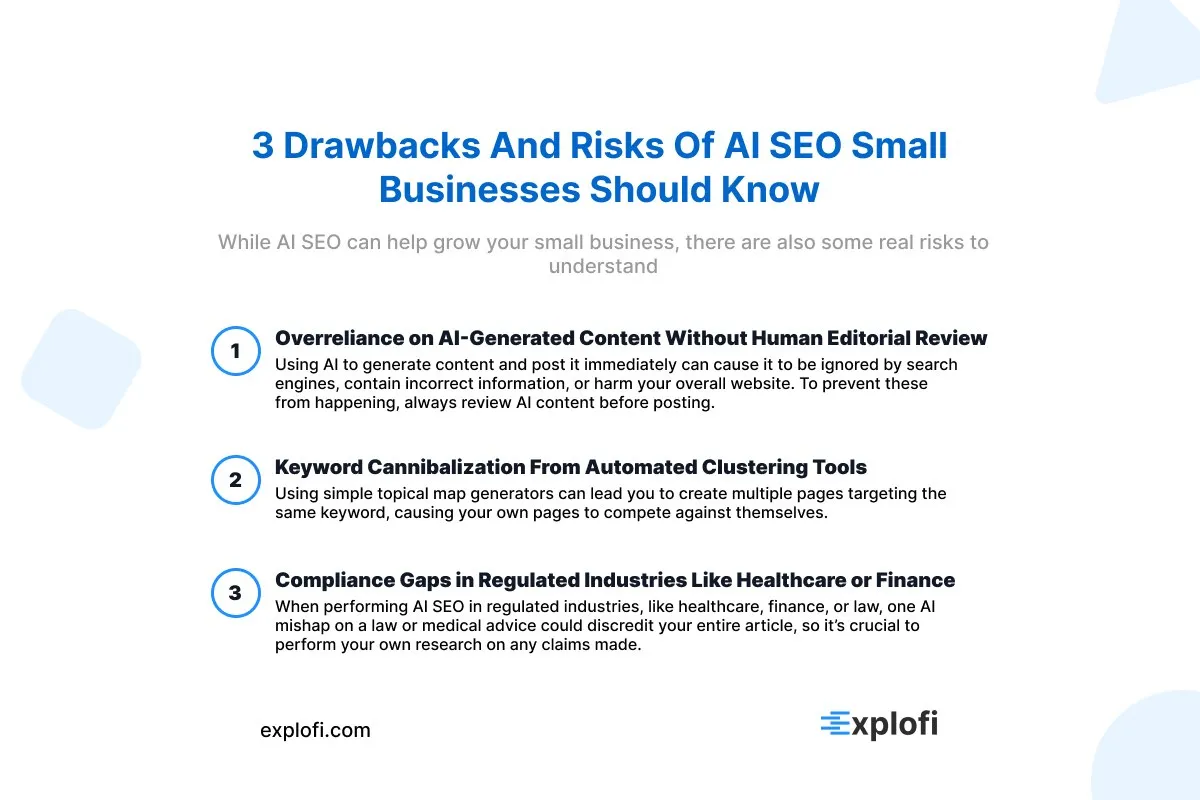
While AI SEO offers clear advantages for small businesses, the risks deserve equal attention. Generated content carries a significant accuracy problem, as AI systems hallucinate facts at a measurable rate, with some studies showing error rates between 15-20% in AI-written drafts. Beyond accuracy, Google's helpful content guidelines directly penalize thin or generic generated content that lacks genuine expertise.
Small businesses also risk over-optimization, where AI tools aggressively stuff keyword targets into copy, triggering algorithmic penalties. Consider these specific vulnerabilities:
- Over reliance on AI generated content without human editorial review
- Keyword cannibalization from automated clustering tools
- Compliance gaps in regulated industries like healthcare or finance
Maintaining a strong online presence requires treating AI SEO as a starting point, not a finished product.
Why AI-Generated Content Can Become a Double-Edged Sword
AI systems producing content at scale can quietly erode small businesses' credibility when generated answers contain unverified claims. Studies show AI hallucination rates reach up to 27% in factual content, meaning nearly one in three outputs may require correction before publication.
One method for reducing these problems is retrieval-augmented generation, which grounds AI output in external sources instead of relying entirely on static training data.
Increased Technical Requirements That Can Overwhelm Small Teams
Deploying AI systems for SEO introduces technical layers that small teams often lack the bandwidth to manage. Effective implementation typically demands:
- API integrations
- Schema markup configuration
- Crawl budget management
Without dedicated technical staff, these requirements create operational bottlenecks that offset AI's efficiency gains, leaving small businesses worse off than with traditional seo services.
The Cost and Expertise Barriers That Come With Advanced AI Tools
Premium AI SEO platforms like Explofi and Surfer SEO run between $100 and $400 monthly, costs that strain small businesses operating on lean margins. Beyond pricing, these tools demand proficiency in:
- API configuration
- Data pipeline management
- Model finetuning
Without this expertise, ai systems deliver incomplete or misapplied results.
How Over-Reliance on AI Can Dilute Your Brand's Authentic Voice
Repeated use of AI systems to generate brand messaging strips away the specificity that makes a business recognizable. Tone, vocabulary, and storytelling patterns become averaged and generic across outputs. Consider what gets lost:
- Local cultural references
- Founder specific perspective
- Industry specific nuance
This homogenization weakens small businesses' online presence against competitors with distinct voices.
The AI Content Trap That Is Quietly Hurting Small Business SEO
Many small businesses fall into a compounding trap: they adopt AI systems to scale content output, but the efficiency gains quietly introduce ranking risks that traditional SEO services would typically catch through human review. Google's March 2024 core update specifically targeted scaled content abuse, resulting in a 40% reduction in low-quality, unoriginal content appearing in search results.
The pattern typically looks like:
- High volume content production without topical depth
- Keyword insertion that disrupts natural sentence flow
- Identical structural templates repeated across multiple pages
- Missing EEAT signals that Google's quality raters actively evaluate
Each of these issues compounds over time, quietly degrading a site's online presence rather than building it, making recovery significantly harder than prevention.
What Thin AI-Generated Content Actually Looks Like in Practice
Thin AI-generated content typically shares identifiable patterns:
- Broad claims with no supporting data
- Generic advice applicable to any industry
- Zero location specific context
Such content simply fails to signal relevance to small businesses serving specific communities, which search engines increasingly penalize.
The Risk of Publishing Without Editing or Human Review
Unedited AI content carries real penalties: Google's spam policies explicitly target "scaled content abuse," and sites flagged for it can lose rankings entirely. Without human review, factual errors slip through at rates up to 27%, directly damaging:
- Trust signals
- EEAT scores
- Online presence
Why Ignoring Local Specifics Creates Generic and Ineffective Content
AI systems trained on broad datasets lack the neighborhood-level nuance small businesses depend on. Generic outputs miss:
- Local zoning specifics
- Regional pricing norms
- Community event references
This directly weakens online presence, since Google prioritizes hyper-local relevance signals in local search rankings.
How Keyword Stuffing on Autopilot Can Trigger Google Penalties
When AI systems generate content at scale without oversight, keyword density can spike well past Google's 1-2% threshold, triggering algorithmic penalties that suppress your online presence in traditional search results almost immediately.
What Google Actually Rewards in the Age of AI
Google now rewards experience, authoritativeness, and trustworthiness signals, meaning small businesses that blend AI systems with genuine human expertise outperform purely automated competitors. Specifically, Google's helpful content system targets:
- Shallow, unedited generated answers
- Missing firsthand experience signals
E-E-A-T: Experience, Expertise, Authoritativeness, and Trustworthiness Explained
E-E-A-T signals require demonstrated real-world experience, not just accurate information. Google evaluates:
- Firsthand knowledge
- Verifiable credentials
- Citation from authoritative sources
For small businesses, this means online presence must reflect genuine expertise, as Google's quality rater guidelines score content on all four dimensions simultaneously.
Why First-Hand Perspective and Real Data Matter More Than Ever
First-hand data, like actual customer reviews, specific service outcomes, and real pricing details, directly strengthens E-E-A-T signals that small businesses need. Google's systems detect:
- Specificity of claims
- Source credibility
- Real world experience markers
This separates genuine expertise from ai systems generating hollow, unverifiable content.
How Helpful and Experience-Driven Content Earns Higher Rankings
Content that earns rankings combines AI-generated structure with verified, first-hand experience. Google's quality raters measure this through three factors:
- Depth of topic coverage
- Source credibility
- User engagement signals
For small businesses, writing blog posts grounded in real customer interactions boosts these signals measurably, improving online presence in traditional search.
Key Components of a Winning AI SEO Strategy for Small Businesses
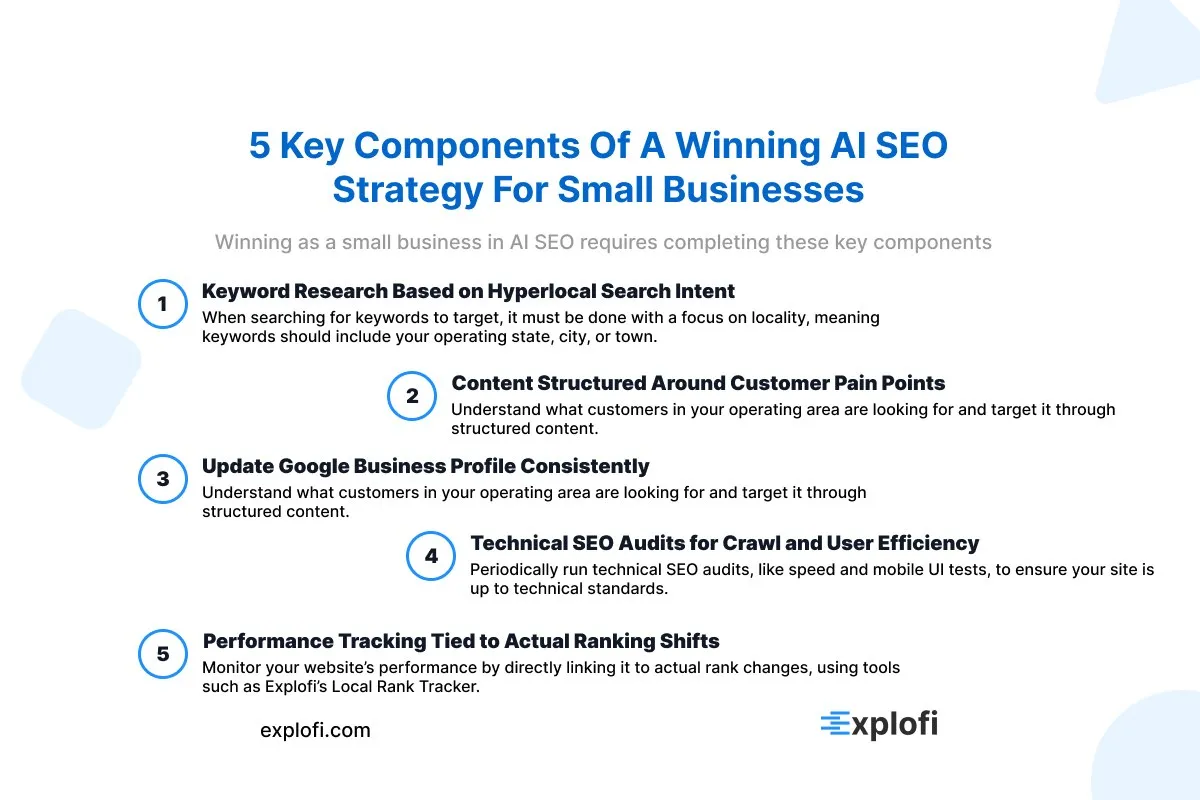
A winning AI SEO strategy for small businesses balances automation with intentional, targeted inputs across several core components:
- Keyword research grounded in hyperlocal search intent
- Content structured around verified customer pain points
- Google Business Profile optimization updated consistently
- Technical SEO audits run through AI systems for crawl efficiency
- Performance tracking tied to actual ranking shifts
Your google business profile score directly influences local pack visibility, making consistent profile optimization non-negotiable. AI systems can automate metadata tagging and schema markup, cutting the time traditional methods require by roughly 60%. Pairing these automated processes with human-reviewed content keeps keyword density within Google's 1-2% threshold while strengthening the E-E-A-T signals that sustain long-term online presence.
AI-Powered Keyword Research for Small Business Websites
AI-powered keyword research gives small businesses a measurable edge by identifying long-tail, hyper-local search terms that traditional keyword tools frequently miss. Rather than targeting broad phrases like "plumber near me," AI systems analyze actual search behavior patterns, surfacing queries like "emergency pipe repair under $200" that carry stronger purchase intent.
Research from Backlinko confirms that long-tail keywords drive 91.8% of all search traffic, making this precision critical for small businesses competing against larger domains. The most effective approach involves feeding AI tools with:
- Verified customer reviews
- Location specific service pages
- Competitor gap data
- Seasonal search trend variations
This input quality directly shapes keyword accuracy, ensuring your online presence targets phrases with realistic ranking potential rather than oversaturated generic terms.
How AI Tools Identify High-Value and Low-Competition Keywords
AI tools cross-reference search volume against domain authority scores, flagging keywords where:
- Competition scores fall below 30
- Monthly searches exceed 500
This pinpoints gaps where small businesses can realistically rank without competing against high-authority domains.
Using Long-Tail and Conversational Keywords to Capture Local Search Traffic
Conversational queries like "where can I find an affordable plumber near me" convert at significantly higher rates than short-tail terms. AI tools surface these natural-language patterns by analyzing:
- Voice search queries
- Google autocomplete suggestions
- "People Also Ask" data
This helps small businesses target intent-driven traffic with precision.
Building a Keyword Cluster Strategy That Establishes Topical Authority
Topical authority builds when related keywords cluster around a core topic, signaling deep expertise to Google. Effective clusters include:
- A pillar page targeting broad terms
- Supporting pages targeting specific subtopics
- Internal links connecting both layers
Automated Technical SEO Audits and What They Reveal
Automated technical SEO audits scan for crawl errors, broken links, and page speed issues that silently suppress rankings. Tools like Screaming Frog identify these within minutes, revealing that slow-loading pages increase bounce rates by 32%, directly impacting small businesses' search visibility.
Common Technical Issues AI Audits Uncover That Manual Reviews Miss
AI audits detect issues like duplicate meta tags, crawl budget waste, and broken internal links that manual reviews routinely overlook. For small businesses, these hidden errors directly suppress rankings by:
- Blocking Googlebot from indexing key pages
- Triggering duplicate content penalties
How to Prioritize Technical Fixes Based on Their Impact on Rankings
Fixes with the highest ranking impact should come first. Prioritize in this order:
- Core Web Vitals failures (LCV under 2.5s threshold)
- Crawlability errors blocking indexation
- Broken internal links diluting page authority
Addressing Core Web Vitals alone can lift rankings measurably for small businesses.
Fixing Your Technical Foundation Before Investing in New Content
Resolving technical errors before publishing new content prevents wasted resources. A crawlable, fast-loading site ensures every published page gets properly indexed. For small businesses, this means:
- Fixing broken internal links
- Compressing images below 100KB
- Resolving duplicate meta descriptions
Small Businesses Use Explofi For AI SEO
AI SEO has been a topic of discussion for Small businesses around the country. By using Explofi as your AI SEO execution platform, you are guaranteeing output. Explofi offers:
- AI Content Generation for AI SEO optimized and localized content that captures clicks in search engines and chatbots for small businesses
- AI Topical Map that works as an in house SEO strategist, telling you what to publish in order to gain topical authority
- AI Smart Article Planning that plans your brief based off of competitor data, so no more guess work
- Local Keyword Tracking that tells you where you rank for keywords, from your state to your local neighborhoods
Explofi is being used by small businesses around the US, effectively ending the age of human ran workflows. Now it is AI workflows with human intervention.
Frequently Asked Questions
What Makes AI SEO Different From Regular SEO?
Traditional SEO is a manual process that requires consistent time, expertise, and effort. AI SEO reduces the redundant task that search engine optimizers have to do. For example keyword research, content creation, local keyword tracking, technical audits, and competitor analysis are some of the key processes AI SEO platforms handle. The result is faster improvements, consistent results, and increased revenue.
Is AI SEO Safe? Will it Get My Website Penalized?
AI SEO tools that are designed for legit website optimization are completely safe. Explofi's platform follows Google's guidelines for ethical SEO - we prohibit spammy tactics, keyword stuffing, or black-hat techniques. Explofi's approach is built for sustainable, compounding, and straightforward long term rankings.
Is Explofi an AI SEO Execution Platform for Small Businesses?
Yes. Explofi is an AI SEO execution platform for small businesses. Explofi packages daily SEO workflows such as keyword researching, article planning, local keyword tracking, page updating and optimized content generation into a straightforward and easy to use software.
Do I Need Technical Knowledge to Use an AI SEO Platform?
No. Good AI SEO execution platforms such as Explofi is designed for business owners, not SEO experts. You should be able to log in, check rankings, update pages, and understand what needs to be done without having a deep technical background.
How Much of My Website Content will my AI SEO platform generate?
It is all up to the user and their particular strategy. Some users find it easier to allow their platform to handle SEO for them, others seek to provide their expertise to create the most optimal content. Explofi creates blog content and service page copy for all small businesses. Allowing the platform to work for you and you not work for it, has shown to be the best way for users to get the most our of AI SEO softwares.