Deep Dive with AI
What Is a Content Refresh and How Does It Differ from a Full Rewrite?
A content refresh means strategically updating existing content to restore or improve its search performance, without replacing the entire piece. Unlike a full rewrite, refreshing content targets specific elements, such as outdated statistics, broken internal links, or weakened meta descriptions, while preserving the original structure and URL equity.
A full rewrite, by contrast, abandons the accumulated ranking signals tied to that URL. Research from HubSpot found that updating existing blog posts can drive traffic increases of up to 106%, precisely because organic search authority built over time compounds when refreshed rather than discarded.
Search intent shifts also distinguish these approaches, since a focused refresh realigns content with how people search today without sacrificing established domain signals.
The Spectrum from Light Edits to Complete Overhauls
Content refreshes exist on a wide spectrum, ranging from minor copy tweaks to full structural rebuilds. A light edit might mean simply replacing outdated statistics or fixing broken external links, which alone can recover lost rankings. A mid-level refresh involves updating internal links, rewriting the meta description, and restructuring headers for clarity.
At the deepest level, a complete overhaul restructures the entire piece around new search intent, which Studies show can increase organic traffic by up to 106% compared to publishing new blog posts on untouched topics.
Key Differences Between a Content Refresh, a Content Update, and a Content Rewrite
A content refresh, update, and rewrite each serve distinct purposes that determine how much effort your existing content actually needs. A refresh typically involves replacing outdated statistics, adjusting meta descriptions, and updating internal links without restructuring the piece. A content update goes slightly deeper, targeting specific sections losing relevance while preserving the overall framework.
A full rewrite, by contrast, rebuilds the piece from scratch, which can split signals across versions and temporarily hurt rankings. Studies show refreshed content can drive up to 111% more organic traffic than newly published pieces, making the scope of changes a critical strategic decision.
Why a Content Refresh Outperforms Publishing Brand-New Content
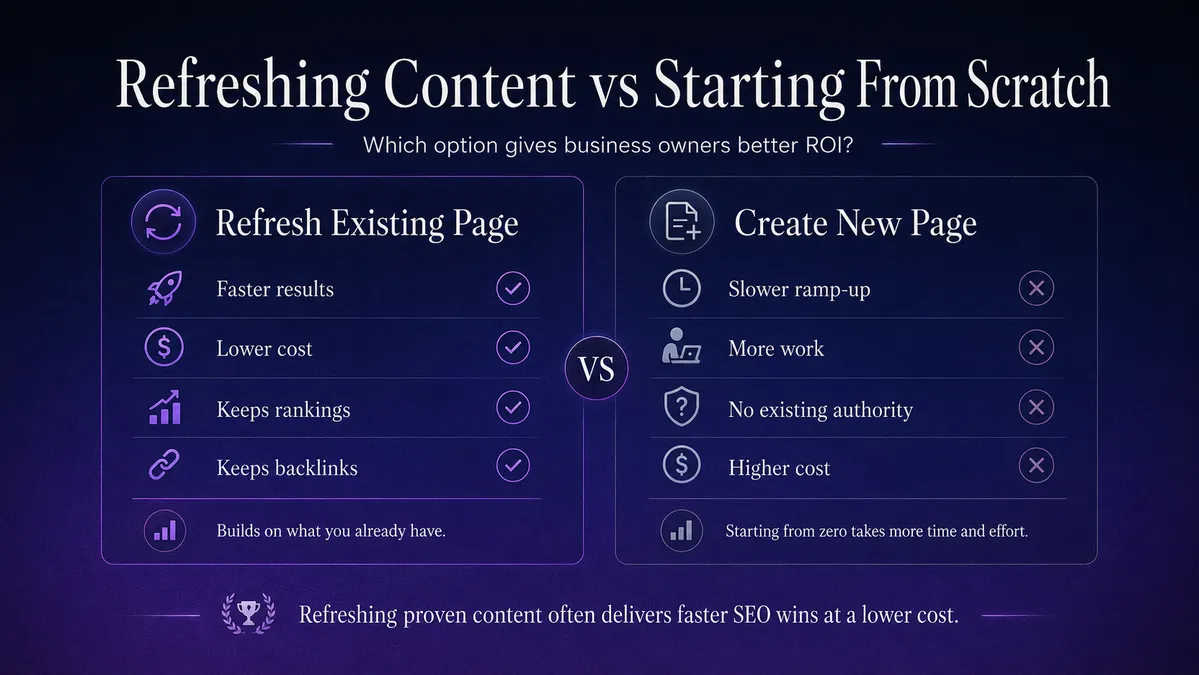
Refreshing existing content consistently outperforms publishing new content because Google already has ranking signals attached to your older pages. According to Semrush, updated blog posts can generate up to 106% more organic traffic than freshly published ones. A strategic content refresh works with that existing authority rather than starting from zero.
Search engines reward pages that demonstrate sustained relevance, and refreshing content signals exactly that. For SaaS founders, this matters because a single piece of key content sitting on page two can reach page one simply by replacing outdated statistics and tightening internal links, without spending months building new backlinks or domain authority from scratch.
Refreshed Content Inherits Existing Domain Authority and Backlinks
When you refresh existing content, it retains every backlink pointing to that URL, which new pages simply cannot claim. A study by Ahrefs found that 66.31% of pages have zero backlinks, meaning a brand-new page starts at a severe disadvantage. Refreshed content, by contrast, carries accumulated domain authority built over months or years.
This inherited link equity directly helps improve rankings without rebuilding from scratch. Pages that already have backlinks benefit from:
- Established crawl priority from search engines
- Trust signals passed through referring domains
- Compounding authority that strengthens your overall SEO strategy
It Takes Less Time and Budget to Refresh Than to Build from Scratch
Refreshing existing content typically costs 50-75% less than producing a net-new piece, according to content marketing research from Siege Media. A well-structured blog post already has its foundation built, meaning research, structure, and tone are already established. Rather than spending weeks on ideation and drafting, a content refresh strategy targets specific gaps like outdated statistics, broken internal links, or a weak meta description.
That focused effort delivers stronger SEO results in a fraction of the time, making refreshing content one of the highest-return investments for teams managing large content inventories on limited budgets.
Refreshing Maximizes the ROI of Your Original Content Investment
Refreshing existing content delivers measurably stronger ROI than starting from scratch. A piece already indexed by search engines carries domain authority, backlink equity, and historical engagement data that new content simply lacks from day one. According to Ahrefs, only 5.7% of newly published pages reach Google's top 10 within a year, making your already-ranking blog posts significantly more worth refreshing than abandoning.
How Search Engines Reward Fresh and Updated Content
Search engines are built to surface the most accurate, current information, and Google's own documentation confirms that "freshness" is a ranking signal weighted by query type. For time-sensitive topics, refreshing content can produce bigger ranking lifts than publishing something entirely new, since the existing page already carries domain authority and backlink equity.
A [2023 study by Semrush](https://www.semrush.com) found that updated blog posts generated up to 106% more organic traffic than their original versions. Beyond traditional search, AI overviews pull from content that demonstrates recency and credibility, meaning outdated content gets filtered out of generated answers almost entirely.
Keeping data points current and replacing outdated statistics signals to search engines that your existing content remains the most relevant source on a given topic.
Why Google Favors Recently Updated Pages Over Stale Ones
Google's own documentation confirms that its search algorithms factor in "query deserving freshness" (QDF), a signal that prioritizes recently updated pages for time-sensitive searches. Pages left unchanged for 12 or more months steadily lose ranking positions as *refreshing content* signals relevance to search engines.
A 2023 study by Ahrefs found that the average top-ranking page is over two years old, yet those pages consistently receive content updates. Stale *outdated content* drops in crawl priority, meaning Google indexes competitors' updated pages faster, directly weakening your *content ranking* over time.
How Content Freshness Signals Influence Crawl Frequency and Indexing
Googlebot adjusts crawl frequency based on how often a page changes, meaning *content refreshes* signal to *search engines* that a URL deserves more frequent revisits. Pages with stale *publication dates* and unchanged content can fall into low-priority crawl queues. Key freshness signals Googlebot tracks include:
- Edit timestamps in sitemaps
- Structured data markup changes
- Internal link updates
- New content blocks or sections
Refreshing content can push pages from weekly to daily crawl cycles.
How Content Freshness Affects AI Citations and LLM Rankings
AI systems extract information differently than traditional search engines, and content freshness plays a direct role in whether your existing content gets cited. Large language models are trained on data with specific cutoff points, but retrieval-augmented generation systems actively pull current web content when generating answers.
Research shows that answer engines like Perplexity prioritize pages updated within the last 90 days when sourcing citations. For a content refresh strategy focused on ai visibility, replacing outdated statistics and updating internal links signals recency to these systems. Pages with stale data are increasingly skipped during ai citations, making refreshing content a higher-leverage move than publishing something entirely new.
Why Large Language Models Show Recency Bias Toward Updated Pages
LLMs like GPT-4 and Google's Gemini are trained on data snapshots, but their citation behavior heavily favors pages with recent update signals. Research from Originality.ai found that AI-generated answers pull from sources updated within the past 12 to 24 months far more consistently than older, static pages.
When refreshing content, even minor updates to statistics or structure trigger re-crawling, which resets freshness signals that AI systems read. Outdated content, by contrast, loses citation priority as models increasingly treat update timestamps as a proxy for accuracy.
How Refreshed Content Improves Visibility in AI-Powered Search Tools Like Perplexity
Perplexity pulls its AI answers from sources it deems current and authoritative, meaning outdated content is actively filtered out of its citation pool. When you refresh content by replacing outdated statistics and updating internal links, your pages signal recency to these systems. Perplexity's own documentation confirms it prioritizes recently updated sources, making content refreshes a direct lever for visibility in AI-driven results rather than a secondary SEO consideration.
The Most Compelling Reasons to Refresh Existing Content
Refreshing existing content consistently outperforms publishing new content, and the numbers back this up. According to HubSpot, updating old blog posts can increase organic traffic by as much as 106%. Rather than starting from scratch, a well-executed content refresh strategy targets pages already indexed by search engines, giving them a significant ranking boost with far less effort.
Outdated content quietly erodes your credibility, particularly when statistics are no longer accurate or internal links point to dead pages. Beyond rankings, refreshing content directly improves user experience, keeping readers engaged with accurate, relevant content. The biggest gains typically come from pages sitting on page two of Google, where minor updates can push them into high-visibility positions.
Search Intent, User Behavior, and Audience Needs Evolve Over Time
Search intent shifts constantly, and outdated content fails to reflect what users actually want. For example, a blog post targeting "content refresh strategy" written in 2020 may have ranked well then, but today's searchers expect updated frameworks, current data, and voice-search-optimized answers.
Studies show that 53% of searches are now conversational. Audience needs evolve across:
- Purchase stage
- Device preference
- Query format
Outdated Statistics, Broken Links, and Deprecated Sources Erode Credibility
Outdated statistics cited in blog posts can quietly destroy reader trust, especially when numbers are traceable to sources that no longer exist. A 2023 Semrush study found that 46% of marketers struggle with outdated content, which directly affects how search engines evaluate page authority. When refreshing content, replacing deprecated sources and broken links is critical since Google treats link rot as a signal of neglect.
Updating content with current, verifiable data also reduces bounce rates, as readers are far less likely to abandon pages that cite accurate, living references.
Industry Standards and Best Practices Change Faster Than Most Content Does
Industry standards shift constantly, and outdated content quietly erodes your credibility with both readers and search engines. Google's own Search Quality Evaluator Guidelines, which exceed 160 pages, are updated multiple times annually, meaning best practices from even 18 months ago may now conflict with current ranking signals.
A blog post recommending a technical SEO practice that Google has since penalized, for example, can actively damage trust. Refreshing content to reflect current standards is not optional for sites that want to stay competitive. Studies show pages with updated, accurate information earn 30% more organic clicks than stale counterparts covering identical topics.
Stale Content in YMYL Niches Creates Trust and Compliance Risks
In YMYL (Your Money, Your Life) niches like health, law, and finance, outdated content doesn't just hurt rankings; it creates real liability. Google's quality rater guidelines explicitly flag stale YMYL pages as low-quality. A legal blog post citing a repealed statute or outdated statistics on drug interactions can mislead readers into harmful decisions, eroding trust and exposing publishers to compliance risks that refreshing content directly addresses.
Content Refreshes Are a Natural Opportunity to Fix Keyword Cannibalization
Refreshing content creates a direct opening to resolve keyword cannibalization, where multiple pages compete for the same search term and split ranking authority. Through Google Search Console, you can identify which URLs are stealing impressions from each other. From there, consolidating overlapping blog posts or redirecting weaker pages to a stronger one restores focus.
Search engines reward clear topical authority, making cannibalization fixes one of the highest-impact opportunities within any content refresh strategy.
How to Recognize the Warning Signs of Content Decay
Recognizing content decay early saves you from watching rankings quietly slip away. The most telling signal is a consistent drop in organic traffic over 3 to 6 months, which you can track directly through Google Search Console under the "Performance" report. Beyond low traffic, watch for these specific warning signs:
- Clickthrough rates falling below 2% on previously strong blog posts
- Outdated content referencing statistics older than 2 years
- Broken or irrelevant internal links pointing to deprecated pages
- A meta description that no longer reflects the page's current focus
- Impressions holding steady while clicks decline sharply
Identifying content decay through engagement patterns rather than just traffic data gives you a sharper picture of which existing content is quietly losing ground in search engines.
Declining Organic Traffic and Falling Keyword Rankings
A steady drop in organic traffic is one of the clearest signals that your existing content has begun to decay. The average top-ranking page loses roughly 5-10% of its clicks each month without updates. Google Search Console makes this visible through its Performance report, where declining impressions and click-through rates on once-strong blog posts reveal that search engines have begun favoring fresher, more relevant competitors.
High Impressions but Low Click-Through Rates in Search Console
When your content appears on the search results page thousands of times but users scroll past without clicking, Google Search Console is telling you something critical. A healthy click-through rate typically falls between 3% and 5%, so anything below that threshold signals a metadata problem. Your meta description may no longer reflect what searchers actually want, making a content refresh strategy the faster fix compared to publishing something entirely new.
Engagement Metrics Like Bounce Rate and Time on Page Are Deteriorating
Bounce rate spikes and shrinking time-on-page are reliable early signals that your existing content is losing relevance. According to Contentsquare's 2023 Digital Experience Benchmark, the average bounce rate across industries sits at 50.9%, and pages with outdated content consistently trend above it.
When visitors land on a page and leave within seconds, search engines interpret that behavior as a quality signal, quietly pushing your rankings down over time.
Content References Outdated Events, Tools, Statistics, or Terminology
Referencing a tool like Google Analytics Universal Analytics (which sunset in July 2023) or citing a 2018 statistic signals to readers that your existing content hasn't kept pace with the market. Search engines also penalize this kind of staleness by ranking fresher, more accurate pages higher. Outdated terminology, like "mobile-first" being a novel concept, further erodes trust, making a content refresh strategy essential for maintaining authority.
Conclusion
Content refreshes are a key pillar in acquiring business through search engines. Explofi offers page revive, which effectively analyzes pages that may be decaying and in need of update. Sign up for Explofi for 3 free articles.