Deep Dive with AI
How Long Does SEO Take For A Small Business?
Search engine optimization typically takes three to six months before small businesses see meaningful results. The timeline depends heavily on your site's current health, domain age, and competition keywords you're targeting. During earlier months, focus on technical SEO basics like fixing crawl errors, improving site speed, and establishing quality content creation habits.
Building topical authority through consistent content efforts helps search engines understand your website's purpose. Your backlink profile matters too, as quality backlinks from relevant sites signal trustworthiness. Track progress through search console and analytics to measure traffic growth. Remember that competitive terms take longer to rank faster than less competitive keywords, so patience and ongoing optimization remain essential for sustainable success.
Why SEO Takes Time For Small Businesses
Search engines need time to discover and evaluate your website. When you publish new content or make changes, search engines must crawl your pages and assess their quality. This crawling process takes patience since search engines prioritize established websites with strong site history and robust backlink profiles.
Building quality backlinks and establishing relevant content takes consistent effort over months. Small businesses often face competition from larger companies with more resources dedicated to their content strategy and technical SEO optimization. Additionally, your website's technical foundation matters greatly.
Issues like crawl errors, broken links, and poor core web vitals can slow your progress significantly.
Google's algorithms evaluate numerous ranking factors simultaneously. Improving your technical audit results, fixing duplicate content issues, and strengthening your internal links architecture all contribute to better rankings. However, these improvements rarely show immediate results in traffic gains.
The Google Sandbox Effect
New websites often face a delay indexing period known as the Google Sandbox Effect. Search engines treat fresh domains with caution, meaning your quality content won't rank faster initially. During this phase, search engines spend time crawling and evaluating your site's credibility. Most SEO experts agree this probationary period lasts between three to six months.
Your backlink profile and technical optimization matter, but they won't guarantee immediate visibility. Patience during this sandbox phase is essential for long-term success.
Indexing and Crawling Delays
Search engines like Google need time to discover and process your website's pages. When you publish new content or make updates, Google's crawlers must find these pages first. This process isn't instant. Google crawls websites based on their authority and update frequency. A brand new site might wait weeks for its first crawl, while established sites get crawled more often.
According to Google Search Advocate John Mueller, server issues or poor internal linking can slow how quickly your website gets indexed. Once crawled, Google must then process and index the content before it can potentially rank in search results.
Building Domain Authority
Domain authority develops gradually through consistent effort. Building a strong backlink profile takes months or even years because search engines need to verify that links come from reliable sources. Quality backlinks signal trustworthiness to search engines, but earning them requires:
- Publishing valuable content that others want to reference
- Establishing your site as a reliable source in your industry
- Earning mentions across the web over time
- Demonstrating consistent expertise through quality content
New websites lack this foundation entirely. Without established trust signals, search engines evaluate your content more cautiously, causing rankings to move slowly compared to established sites with proven authority.
Establishing Competitive Positioning
Small businesses face intense competition when establishing their online position. Your competitors' backlink profile and quality content already dominate search results, making it harder to break through. Building quality backlinks and improving your technical SEO requires sustained effort. Even with strong performance improvements, ranking higher demands more authority signals than your competitors possess.
This competitive landscape extends timelines significantly beyond initial expectations.
Key Factors That Influence SEO Timeline For Small Businesses
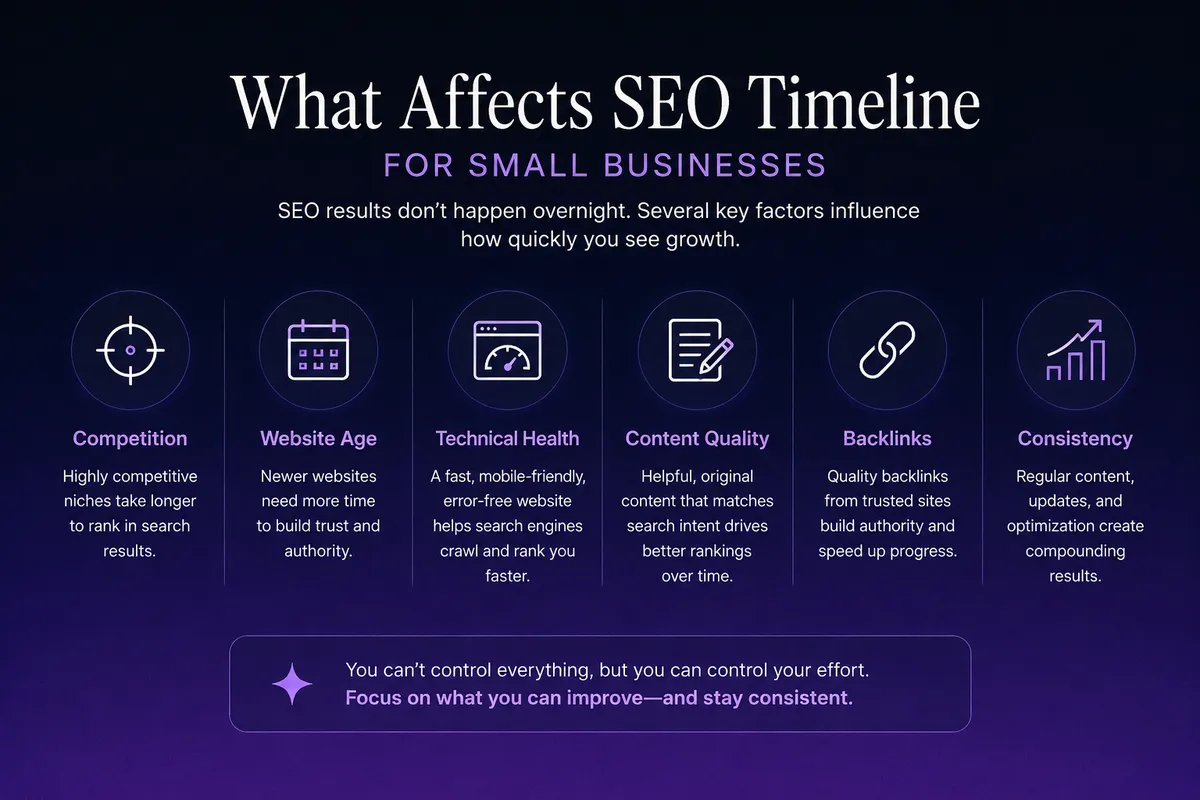
Several important factors shape how quickly your website climbs search rankings. Your current website's health matters greatly, since technical issues like crawl errors and broken links slow progress significantly. When you start working on quality content, search engines need time to discover and evaluate it.
Your backlink profile also plays a crucial role in determining speed. Websites with stronger quality backlinks tend to rank faster than those building from scratch. The competition in your industry affects timelines too. If you're targeting volume keywords in highly competitive spaces, expect longer waits than pursuing less contested terms.
Your content strategy and how well you understand search intent influence results as well. Finally, how consistently you publish and maintain content updates directly impacts your SEO work's effectiveness and overall success.
Website Age and History
Older websites often rank faster than brand-new domains. New websites under 12 months old may experience a delay called the sandbox effect while search engines evaluate trustworthiness. Sites recovering from penalties also need extra time to rebuild trust. According to research, nearly 70% of pages ranking in Google's top ten results are at least three years old, showing how domain age impacts your seo timeline and overall rankings.
Current Website Health and Technical Foundation
A website's technical foundation determines how quickly it can rank. Strong technical health ensures search engines can efficiently crawl and index your pages without delays from errors or performance issues. Before launching a content strategy, conduct a technical audit to identify crawl errors, broken links, and schema markup problems.
These foundational fixes help search engines understand your site structure better. Quality content starts with a solid technical base because without proper crawlability and indexability, even exceptional pages won't rank. Your current health directly impacts your seo timeline, making this assessment the logical first step for any small business pursuing rankings.
Content Quality and Publishing Consistency
Quality content beats quantity. Publishing one exceptional piece monthly outperforms four mediocre articles weekly. Your publishing strategy should include:
- One highquality article per month minimum
- Content addressing real audience problems
- Strategic keyword alignment with search intent
- Consistent editorial calendar
High-quality content increases impressions in search console and helps establish topical authority. Meanwhile, aggressive low-value publishing causes severe click drops. Google prioritizes helpful, people-first content over scaled material designed primarily to rank. Regular, strategic publishing signals freshness to search engines while building the quality backlinks and rankings your small business needs for sustainable growth.
Backlink Profile and Authority Building
A strong backlink profile takes time to develop and directly impacts how quickly your site can rank faster in search engines. Established domains with solid backlink profiles benefit from Google's existing trust, allowing new content to gain visibility more quickly. However, building quality backlinks requires a strategic link-building campaign targeting relevant, authoritative websites.
According to a case study, one site strengthened its authority through coordinated off-page efforts, eventually seeing organic traffic rise from 1,922 to 10,104 visits. This demonstrates that authority building compounds gradually rather than delivering instant results.
Competition Level in Your Industry
In highly competitive industries, ranking becomes significantly more difficult. Your competitors are constantly working to maintain their positions, which means you're fighting against established websites that already have strong authority and backlinks. The stronger your competition terms are, the longer your SEO timeline will extend.
Keyword difficulty matters tremendously. Highly competitive keywords like "buy iPad" with 78% keyword difficulty take longer to rank for than low-competition alternatives. Search engines favor established pages, so newer websites struggle to break through on popular search terms. However, targeting less competitive keywords allows you to rank faster and build momentum before tackling harder competition terms.
Understanding your competition level helps shape realistic expectations for your content strategy and overall efforts.
Available Budget and Resources
Your budget directly shapes how quickly you can rank faster and improve your website's health. Small businesses often lack dedicated teams, so tasks take longer because fewer hours are available to execute them. Quality content, technical SEO improvements, and quality backlinks all require writers, designers, engineers, and analysts.
Without sufficient resources, even the most solid content strategy stalls. Think of it like a house renovation: hiring a full crew with clear plans produces faster results than working alone nights and weekends. Limited budgets mean slower progress, but strategic prioritization helps maximize your efforts.
Keyword Difficulty and Search Intent Targeting
Targeting low-competition keywords helps your website rank faster than pursuing high-difficulty terms. For example, "buy iPad" carries a 78% keyword difficulty rating, while "iPad comparison" sits at 51%, making the latter easier to rank for initially. Understanding search intent matters too, people searching "buy iPad" show purchase intent and generate revenue, whereas comparison searches indicate research-phase users.
Quality content that aligns with what users actually seek outperforms generic pages. Even competitive keywords deserve attention since properly optimized pages eventually rank, though the timeline extends significantly longer when competing against established authority sites.
The Month-By-Month SEO Timeline For Small Businesses
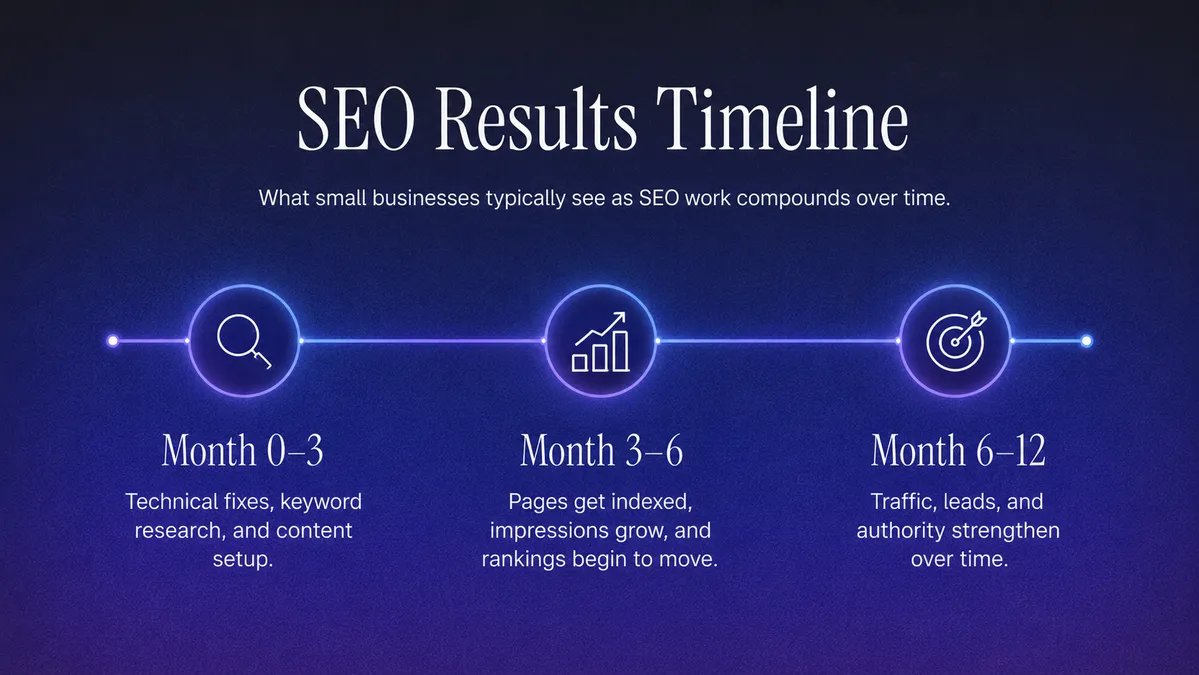
Small business owners should understand that SEO unfolds gradually across months rather than delivering instant results. Month one focuses on building your foundation through keyword research, technical audits, and content planning. During month two, you'll fix on-page issues like broken links and enhance user experience while ramping up quality content creation.
By month three, your efforts begin showing initial traction as search engines crawl your optimizations.
Key activities include:
- Conducting technical audits to identify crawl errors
- Developing priority keywords and content strategy
- Improving site structure and fixing broken links
- Publishing quality content aligned with search intent
According to Shopify's SEO Lead, "Most sites can expect to see measurable results from their SEO efforts within three to six months." The timeline varies based on competition level and your website's current health. Patience during these early months compounds into stronger rankings down the road.
Month 1: Auditing and Foundation Building
During month one, your SEO team runs a comprehensive technical audit to identify crawl errors, broken links, and indexing problems that slow your site's performance. They set up tracking through Google Search Console and analytics tools to understand your baseline. Keyword research uncovers attainable terms while competitor analysis reveals content gaps.
Your team creates a keyword-driven content strategy and makes initial fixes for site speed and mobile usability. Expect minimal ranking changes this month. Building a strong foundation through technical SEO and strategic planning is essential for helping your efforts rank faster later.
Month 2: Technical Implementation and Strategy Setup
During month two, search engines begin crawling your improved structure. Start by refining your site architecture to ensure logical internal linking throughout. Submit updated XML sitemaps to speed up crawling and indexing of your pages. Improve structured data or schema markup for products to increase chances of appearing in rich results.
Meanwhile, begin developing high-quality blog content aligned with your content strategy, targeting long-tail search queries with informational intent. Though visible ranking changes remain limited, these technical SEO improvements and quality content efforts build momentum toward future visibility.
Month 3: Content Creation and On-Page Optimization
By month three, refined keyword selection becomes critical. Long-tail keywords attract precise audiences likely to convert. Publishing quality content now takes priority, with articles exceeding 2,000 words generating higher organic traffic and more backlinks. Product descriptions and blog posts targeting strategic keywords go live.
Link-building efforts intensify as content promotion begins earnestly. Well-optimized content starts climbing search rankings, and you should see significant movements in your SEO metrics through search console tracking and analytics data.
Month 4: Crawling, Indexing, and Early Signals
By month four, search engines begin crawling your improved site structure more thoroughly. Google often deliberately shifts pages up and down after big changes to test how they perform for searchers, a "trial period" that can last 60 to 90 days. During this phase, rankings might dip before they improve.
You should regularly publish quality content, focusing on creating one exceptional piece per month rather than multiple mediocre ones. In Search Console, impressions increase even if rankings fluctuate. Some low-competition keywords may reach page one, marking early signs of traction from your content strategy and technical efforts.
Month 5: Initial Traction and Performance Tracking
By month five, your SEO efforts should demonstrate clear progress through measurable metrics. You'll notice increased organic traffic and potentially higher conversion rates. Using tools like Google Search Console and analytics, track key performance indicators including SERP rankings, bounce rates, and conversion metrics.
This assessment reveals which tactics are working effectively. Based on these insights, your team can refine strategies and prepare new campaigns. Consider these tracking priorities:
- Monitor organic search traffic trends
- Analyze bounce rate patterns
- Review conversion rate changes
- Evaluate current SERP rankings
The quality content you've built during earlier months begins delivering consistent results. Integrating social media signals with your SEO efforts amplifies user engagement. Continue A/B testing page elements to optimize performance further as you understand what resonates with your audience.
Month 6: Measurable Results and Growth Phase
By month six, your SEO efforts start generating measurable returns. Many websites experience ranking stability for mid-competition keywords, and organic sales attribution becomes clearer in analytics. Your consistent publishing and optimization efforts begin compounding results. Search engines have had sufficient time to crawl, process, and reassess your implemented changes, allowing ranking positions to reflect a more stable new normal.
Long-tail keywords consistently land on page one, while broader keyword groups begin climbing steadily. Noticeable increases in impressions and clicks appear in search console data. For small businesses in less competitive niches, page-one visibility for commercial terms can begin driving meaningful ROI from your quality content and technical SEO improvements.
Months 7-12: Sustainable Progress and Compounding Gains
Between months seven and twelve, your SEO efforts begin generating compounding gains as earlier optimizations stabilize. Google has thoroughly crawled and reassessed your changes, creating a more predictable "new normal" for rankings. Long-tail keywords consistently land on page one, while broader keyword groups start climbing steadily.
You'll notice noticeable increases in impressions, clicks, and conversions from your quality content strategy. The accumulated authority signals and improved technical SEO structure now work together, allowing newer content to rank with less effort. For less competitive niches, this period produces significant traffic growth and measurable ROI as your domain gains trust.
Starting Your SEO Journey: The First Steps
Before your website can climb search rankings, it needs a solid technical foundation. During month one, your SEO team will conduct a thorough audit using search console and analytics tools to identify what's holding you back. They'll find crawl errors, slow page speeds, and broken links that prevent search engines from properly crawling your site.
This foundational work involves keyword research and creating a content strategy tailored to your business goals. You probably won't see ranking changes yet, but your site will run smoother. Think of it like preparing the foundation before building a house. Without this groundwork, future efforts won't deliver the results you need.
Conducting a Comprehensive SEO Audit
A comprehensive SEO audit examines your website's current health across multiple dimensions. Start by reviewing technical SEO issues like crawl errors, indexing problems, and performance barriers that can slow down your search visibility. Simultaneously, analyze your existing content quality and keyword coverage to identify gaps.
Assess your backlink profile and overall domain authority compared to competitors. Using tools like Google Search Console and technical audit platforms, you'll uncover which factors prevent search engines from properly crawling and ranking your pages. This foundational understanding helps you build a realistic content strategy and prioritize efforts that will truly impact your rankings.
The audit phase typically takes a few weeks for smaller websites, though larger sites may require a month or longer due to their complexity.
Identifying Technical Issues
Technical errors create obstacles that slow down your SEO progress significantly. Broken links, redirect chains, improper canonicalization, and duplicate content introduce friction into how search engines evaluate your website. Cleaning up these issues helps your site rank faster by allowing ranking signals to consolidate more quickly.
Use these tools to identify problems:
- Google Search Console for crawl errors and indexing data
- Technical audit tools to surface performance barriers
- Site crawlers to detect duplicate content and broken links
Consider Groupon's experience: when their JavaScript-rendered deal listings weren't being crawled by search engines, new merchant deals remained invisible. Once the rendering issue was resolved, Google began indexing the deals almost immediately, resulting in a 120% increase in SEO-driven revenue that quarter.
This demonstrates how critical technical SEO fixes are to your overall strategy.
Assessing Current Content Performance
Before making any SEO changes, examine how your current content performs using search console and analytics tools. These platforms reveal which pages rank, how often people click through to your website, and what search terms bring visitors to you. Understanding this baseline helps you build a realistic seo timeline and identify which pages need improvement most urgently.
Look for crawl errors that might slow your progress, then focus your content strategy on pages with the highest potential. This data-driven approach ensures your efforts target the right opportunities first.
Content Strategy for Faster SEO Results
A strong content strategy helps websites rank faster by focusing your efforts where they matter most. Quality content that addresses what users actually search for becomes the foundation of faster SEO results. Your content should directly answer questions and solve problems, making it highly relevant to search intent.
Beyond relevance, your quality content needs excellent structure. Well-organized pages with clear headings and readable formatting help search engines crawl and understand your information better. This structural clarity speeds up how quickly search engines assess and rank your pages.
Building a long-tail keyword strategy accelerates visibility even further. These specific, less competitive keywords attract qualified traffic while requiring less effort to rank. When combined with consistent, high-quality content creation efforts, this approach delivers measurable results within your overall SEO timeline much faster than broad keyword targeting alone.
Focusing on Long-Tail Keywords
Long-tail keywords offer a powerful way to accelerate SEO progress for small businesses. These more specific, lower-volume search phrases typically indicate clearer user intent and face less competition than broad terms. By targeting long-tail keywords, businesses can rank faster and attract qualified traffic more efficiently.
According to SEO research, long-tail keywords are easier to rank for because fewer websites compete for them, making them ideal for newer sites building visibility. This strategic approach helps improve rankings while drawing visitors most likely to convert.
Creating High-Quality, Useful Content
High-quality content must align with what users actually search for and solve their problems directly. Your pages should offer genuine value through detailed guides, original research, or insights competitors don't provide. Beyond relevance, content quality requires demonstrating real expertise and authority in your field.
Regularly refreshing material keeps it current and useful. This approach helps your website rank faster because search engines recognize content that truly benefits readers.
Maintaining Consistent Publishing Schedule
Publishing exceptional content on a regular schedule dramatically accelerates SEO results. Rather than flooding the internet with mediocre articles, focus on quality over quantity. One outstanding piece per month outperforms four weak ones weekly. According to SEO data, consistent publishing helps websites build topical authority and trust with search engines.
Consider these publishing priorities:
- Create content that solves real problems for your audience
- Align each article with clear search intent and keyword strategy
- Maintain a realistic schedule you can sustain longterm
- Monitor content performance through search console and analytics
Consistency allows your efforts to compound over time. As your content accumulates backlinks and engagement, search engines crawl and rank newer pages more quickly. This momentum transforms your website into a reliable traffic source rather than a struggling startup fighting for visibility.
Optimizing Existing Content First
Before launching new content, focus on refining what already exists on your website. This approach helps you rank faster by addressing foundational issues first. Start by identifying underperforming pages through search console data and analytics. Fix crawl errors, broken links, and technical issues that prevent search engines from properly crawling your site.
Update thin content with more depth and value. Improve title tags, headings, and internal linking on high-potential pages. This foundational work builds stronger content quality and site health, allowing existing pages to perform better before investing heavily in new content creation efforts.
Technical SEO Foundations Every Small Business Needs
Technical SEO forms the backbone of how search engines discover and understand your websites. When your site has crawl errors or slow page speed, search engines struggle to index your content efficiently. According to real-world examples, fixing JavaScript rendering issues alone can lead to massive gains.
One company saw a 120% increase in SEO-driven revenue after resolving a single crawling problem. Strong technical foundations accelerate your ranking potential by ensuring search engines can crawl your pages quickly. Broken links, redirect chains, and duplicate content introduce friction into Google's evaluation process.
Cleaning these issues helps your content rank faster. Additionally, proper site structure and Core Web Vitals directly impact how frequently search engines crawl and evaluate your pages, allowing your efforts to show measurable results sooner.
Fixing Critical Technical Errors Immediately
Broken links, redirect chains, and duplicate content introduce friction into Google's evaluation process. Fixing these technical SEO issues accelerates processing and allows ranking signals to consolidate faster. Consider Groupon's experience: when engineers resolved a JavaScript rendering bug preventing deal indexing, the fix alone led to a 120% increase in SEO-driven revenue within one quarter.
These invisible technical corrections matter tremendously. Cleaning up crawl errors and canonicalization problems helps websites rank faster by removing obstacles that slow search engines' ability to understand and evaluate your content properly.
Improving Site Speed and Performance
Site speed directly impacts how search engines crawl and index your content. When your website loads slowly, search engines spend more time processing fewer pages during each crawl session, which can delay how quickly your site gets indexed. Using Google Search Console, you can monitor crawl errors and ensure search engines access your content efficiently.
Fast-loading websites help rank faster because search engines can crawl more pages in less time. Additionally, improving performance reduces bounce rates and enhances user experience, which search engines increasingly value when determining rankings.
Ensuring Mobile-Friendly Design
Mobile-friendly design is essential for SEO success and user satisfaction. Search engines prioritize websites that load quickly and display properly on smartphones and tablets. Consider these key elements:
- Responsive design that adjusts to any screen size
- Fast loading speeds on mobile devices
- Readable text without zooming
- Easytotap buttons and links
According to technical SEO best practices, making initial fixes for mobile usability during month one helps your site rank faster. Use Google Search Console to monitor crawl errors and mobile usability issues. When your website works well on mobile, search engines crawl it more effectively, improving your overall health and traffic potential.
Implementing Proper Site Structure
A logical site structure helps search engines understand your website's hierarchy and importance. Organize pages into clear categories so crawling becomes efficient. Ensure your most important pages are only a few clicks from the homepage, allowing search engines to prioritize crawling them. Proper internal linking through this structure helps distribute authority throughout your site, supporting your overall rank faster efforts and improving how search engines process your content.
Building Your Backlink Profile as a Small Business
Quality backlinks remain essential for helping your small business rank faster in search engines. Building these links takes patience and strategic effort beyond just content creation. According to SEO experts, quality backlinks signal authority to search engines, making them a critical component of your long-term strategy.
Start by identifying websites in your industry that could naturally link to your content. Reach out to relevant blogs, industry directories, and local business listings. Focus on earning links from high-authority websites rather than collecting numerous low-quality backlinks. Monitor your backlink health through search console and analytics tools to understand what's working.
This deliberate approach helps strengthen your domain's health and overall rankings over time.
Understanding Link Building Importance
Backlinks act as votes of confidence from other websites, signaling to search engines that your content deserves trust and authority. Quality backlinks from relevant, authoritative sources help Google evaluate your site's credibility more efficiently. According to industry research, pages with strong backlink profiles can rank faster, while pages with few low-quality backlinks may take considerably longer to gain visibility.
Additionally, a natural, gradual growth of backlinks from diverse sources builds credibility and accelerates ranking improvements. Conversely, sudden spikes from low-quality sources can trigger algorithmic scrutiny, appearing as spam and slowing your SEO timeline significantly.
Creating Linkable Assets
Creating linkable assets requires developing high-quality content that naturally attracts backlinks. Focus on producing in-depth resources like long-form articles exceeding 2,000 words, which generate higher organic traffic and more social shares. Original research, comprehensive guides, and data-driven content tend to earn links because other websites want to reference them.
Your content quality directly impacts how search engines crawl and rank your pages. Tools like Google Search Console help you understand which assets perform best. Building these valuable resources takes time but significantly helps your SEO efforts rank faster over months.
Leveraging Local Business Citations
Local business citations significantly boost your online presence across search engines. These mentions of your business name, address, and phone number on directories help search engines verify your legitimacy. Consider these high-value citation sources:
- Google Business Profile listings
- Industry-specific directories
- Local chamber of commerce sites
- Yelp and similar review platforms
Consistent citations improve your rankings and drive qualified traffic to your websites. When building citations, maintain accuracy across all platforms to avoid crawl errors that could slow your SEO timeline and harm your overall health metrics through analytics tracking.
Natural Link Acquisition Strategies
Creating quality content naturally attracts links from other websites. When your articles offer genuine value and unique insights, other site owners want to reference and share your work with their audiences. This organic approach to link building helps search engines understand your site's relevance through authentic endorsements.
Earning mentions across industry blogs, news outlets, and reputable directories also builds authority without aggressive tactics. These natural endorsements signal credibility to search engines. Meanwhile, engaging with your community through comments and discussions can encourage others to link back to your content, supporting your overall ranking efforts.
Tracking and Measuring Small Business SEO Progress
Measuring your website's progress requires looking at the right data sources. Google Search Console provides free, first-party information directly from Google about how your site appears in search results and any crawl errors that might slow ranking growth. This helps track impressions and ranking positions over time.
Google Analytics 4 shows what happens after people arrive on your websites, connecting visibility to conversions and revenue. Rank tracking tools offer daily updates on specific keywords and competitive positioning. Together, these platforms give you a clear picture of whether your technical SEO, content quality, and overall efforts are driving real business results through search engines.
Setting Up Google Search Console
Google Search Console is an essential tool that helps you understand how search engines see your website. You can track crawl errors, monitor your site's health, and watch your rankings improve over time. This free platform shows you which pages are indexing properly and reveals technical issues that might slow your SEO progress.
By connecting your website to search console, you gain valuable insights into your organic traffic and can measure the real impact of your content efforts.
Monitoring with Google Analytics
Google Analytics helps you understand how your website performs. This free tool tracks visitor behavior, traffic sources, and conversion data. By monitoring organic traffic trends over time, you can see which pages attract the most visitors. You'll identify patterns in user behavior and understand which content quality drives engagement.
This data helps you measure whether your SEO efforts are working effectively for your business.
Using Rank Tracking Tools
Rank tracking tools like Semrush provide daily visibility into keyword movement and competitive context. While Google Search Console shows aggregated performance data, rank trackers help you monitor specific priority terms and SERP features more granularly. These tools enable you to understand how your websites perform against search engines' algorithms.
Set up automated reports and alerts to track progress without manual effort. Look for tools offering these capabilities:
- Daily ranking updates for priority keywords
- Competitive positioning analysis
- Automated email alerts for ranking changes
- Customizable reporting dashboards
This approach helps surface issues that can slow down SEO progress, ensuring your content quality and technical SEO improvements translate into actual ranking gains.
Defining Clear KPIs and Goals
Establishing clear key performance indicators (KPIs) and goals helps you understand what success looks like for your SEO efforts. Rather than vaguely hoping for better rankings, identify specific metrics like organic traffic, click-through rates, and conversion data to track progress. Each goal has its own timeline, so setting realistic quarterly benchmarks keeps expectations grounded.
Tools like Google Analytics provide detailed reporting on your organic traffic trends, while rank tracking tools monitor specific priority terms in search engine results. Breaking your goals into manageable quarterly increments creates achievable targets tied to actual improvement, ensuring you stay aligned with business priorities as algorithms and user behaviors shift.
Regular Reporting and Analysis
Regular monitoring through analytics tools reveals how your small business SEO efforts perform over time. These reports track website traffic, rankings, and user behavior patterns across search engines. Understanding crawl errors and technical SEO issues helps identify obstacles slowing your progress.
Monthly analysis of content quality metrics shows what strategies work best, allowing you to build and refine your approach continuously for sustained visibility growth.
Frequently Asked Questions About SEO Timeline For Small Businesses
How much time does a small business need to dedicate to SEO?
Small businesses typically need to dedicate 3 to 6 months of consistent SEO effort to see measurable results, though competitive industries may require 6 to 12 months. According to Ahrefs, nearly 70% of pages ranking in Google's top ten results are at least three years old. The time commitment depends on your website's age, how quickly changes are implemented, and Google's crawling speed.
Focus on technical health, quality content, and backlinks rather than shortcuts.
Can a small business compete with larger companies in search results?
Yes, small businesses can compete in search results by targeting low-competition keywords and niche-specific terms. While established competitors may dominate highly competitive keywords, focusing on long-tail searches like "vegan leather laptop bag for women" helps smaller sites rank faster. Building quality backlinks, publishing consistent content, and improving technical SEO strengthens your ability to eventually rank for higher-volume terms.
What is the minimum investment needed for SEO success?
There's no fixed minimum, but expect to invest consistent effort for three to six months before seeing meaningful results. According to Ahrefs, nearly 70% of pages ranking in Google's top ten are at least three years old. Success depends on competition level, website age, and content quality rather than a specific dollar amount.
How do I know if my SEO strategy is working?
Track three key indicators: rankings, organic traffic, and conversions. Use Google Analytics to monitor visitor numbers and Google Search Console to watch keyword rankings and indexed pages. According to Ahrefs, nearly 70% of pages ranking in Google's top ten results are at least three years old, so patience is essential.
Look for gradually rising keyword rankings, increased impressions, growing organic traffic, and more leads or sales from your website.
Should I hire an SEO agency or do SEO in-house?
Choosing between an agency and in-house SEO depends on your budget and resources. According to research, companies with full teams of SEO experts, data analysts, and engineers see faster results than those relying on single contributors. In-house SEO requires patience and takes longer since one person handles multiple tasks.
Agencies provide specialized expertise and faster implementation but cost more. Consider your timeline, budget, and whether you have developers, writers, and designers available to execute SEO work effectively.
What happens if I stop doing SEO?
Stopping SEO means your rankings will eventually decline. Search results constantly shift due to competitor content, algorithm updates, and changing user behavior. A Semrush study found that only 27% of domains remained in the top 10 after 13 months. Without ongoing optimization, maintenance, and fresh content, your visibility drops and organic traffic disappears.
Can I speed up SEO results with paid advertising?
Paid advertising does not directly improve your organic rankings. However, running pay-per-click ads can drive immediate traffic while you wait for SEO to build momentum. According to the context, PPC helps test keyword strategies during the slower SEO ramp-up period. Think of ads and SEO as complementary tools working together for your business growth.