

Deep Dive with AI
What Is Schema Markup?
Schema markup is a form of semantic vocabulary added directly to a website's HTML to help search engines understand the content on a page with far greater precision. Developed collaboratively by Google, Microsoft, Yahoo, and Yandex in 2011, Schema.org now hosts over 800 types of structured data vocabularies.
Rather than leaving a search engine to interpret your content through guesswork, schema markup works by providing explicit clues about what your data means, not just what it says. For example, the word "Jaguar" on a page could mean the animal or the car brand, and schema markup eliminates that ambiguity entirely by labeling the context in a standardized format that machines can reliably read.
The Technical Definition Made Simple
Schema markup is a form of structured data vocabulary, standardized by Schema.org in 2011 through a collaboration between Google, Bing, and Yahoo, that translates your webpage's content into a language search engines process directly. Rather than guessing what your page means, structured data provides explicit signals through specific properties.
These properties follow a clear pattern:
- A defined type (like LocalBusiness or Product)
- Properties that describe it (name, address, price)
- Values assigned to each property
How Schema Markup Differs From Regular HTML
Regular HTML tells browsers how to display content, while schema markup tells search engines what that content means. A standard `<h1>` tag signals a heading visually, but it carries no semantic weight about whether that heading represents a business name, product title, or blog post. Schema markup fills that gap through structured properties like `name`, `address`, and `openingHours`.
This distinction helps search engines understand context, which directly influences rich snippets, knowledge panels, and featured snippets in search results.
The Role of Schema.org in Standardizing Structured Data
Schema.org operates as the universal dictionary big search engines reference when interpreting structured data. The vocabulary currently defines over 800 types and 1,400 properties, covering everything from:
- Local businesses
- Star ratings
- Rich snippets
This standardization ensures valid schema markup remains consistent across all major search engines simultaneously.
How Schema Markup Works on Your Website
Schema markup works by embedding structured code directly into your webpage's HTML, which search engines then parse to extract meaning from your content. When implementing schema markup, you typically choose from three encoding formats:
- JSONLD (recommended by Google, injected into a `<script>` tag)
- Microdata (embedded inline within HTML elements)
- RDFa (attribute based markup within existing HTML)
JSON-LD is the preferred format because it sits separately from your visual HTML, making it cleaner to manage. Once embedded, Google's crawlers read these structured signals and may reward your pages with rich snippets, which studies show can increase click-through rates by up to 30%. You can verify accuracy using Google Search Console's rich result testing tool.
How Search Engines Read and Interpret Structured Data
When Googlebot crawls a page, it parses structured data using a process called entity recognition, matching your markup against Schema.org's type hierarchy to confirm relationships between properties. A missing comma or mismatched bracket in JSON-LD can cause the rich result to fail entirely, which the schema markup validator catches instantly.
Properly parsed markup feeds directly into Google's Knowledge Graph, sharpening how search engines understand your business context.
The Relationship Between Schema Markup and Rich Results
Schema markup and rich results share a direct cause-and-effect relationship that shapes how your search result listings appear. When structured data is parsed correctly, Google may elevate your listing into a rich result, displaying star ratings, business hours, or FAQs directly on the search page.
According to Google Search Central, rich results are exclusively driven by valid structured data, meaning no markup equals no eligibility. For local businesses, this distinction is significant since rich results generate substantially higher visibility than standard blue-link listings, giving properly marked-up pages a measurable competitive edge in organic search performance.
How Schema Connects Your Content to Knowledge Graphs
Schema connects your content to knowledge graphs by mapping your entities to Schema.org's vocabulary, which contains over 800 types and 14 properties. When your markup references a `LocalBusiness` type, Google cross-references it against its Knowledge Graph database, strengthening your google knowledge panel presence.
This entity-matching process directly ties your business profile to verified, interconnected data points Google already trusts.
Why Schema Markup Matters More Than Ever for Small Businesses
Schema markup has shifted from a competitive advantage to a baseline necessity, particularly as Google's search landscape grows more competitive for small businesses. With over 200 ranking factors influencing search visibility, structured data is one of the few you can directly control. Applying schema markup to a small business website enables search engines to understand your content with far greater precision, pulling specific details like star ratings or business hours into search results.
A local bakery using `LocalBusiness` schema, for example, can surface operating hours, location, and reviews directly in the search result, bypassing the need for users to even click through to a competitor's listing.
The Growing Role of AI Search and Structured Data
AI-driven search tools like Google's Search Generative Experience (SGE) pull structured data directly to generate answers, making speakable structured data increasingly critical. Voice searches now account for over 1 billion queries monthly, and schema markup helps surface your content in those results.
The markup signals:
- Business type
- Location
- Operating hours
- Accepted payment methods
How Schema Markup Levels the Playing Field for Smaller Websites
Rich snippets generated through schema markup give smaller websites the same search result real estate that enterprise sites have long dominated. According to Google's Search Central documentation, any website, regardless of domain authority, becomes eligible for enhanced listings once valid structured data is detected.
A local bakery using FAQ schema markup, for instance, can appear with expanded search result features alongside national chains. This levels visibility in a measurable way, since rich snippets consistently earn higher click-through rates, with some studies reporting increases of up to 30%.
Why Ignoring Schema Markup Is a Missed Opportunity
Websites skipping schema markup are quietly surrendering ground in search results they could otherwise claim. Without relevant markup, a business listing may appear as a plain blue link while a competitor's result displays star ratings, hours, and FAQs, all pulling more attention from the same page.
Studies show rich results can increase click-through rates by up to 30%, meaning that gap in presentation directly translates to lost traffic. Beyond clicks, search intent matching becomes harder without structured data, since search engines rely on schema to confirm what your content actually represents, not just what it says.
The SEO Benefits of Adding Schema Markup to Your Website
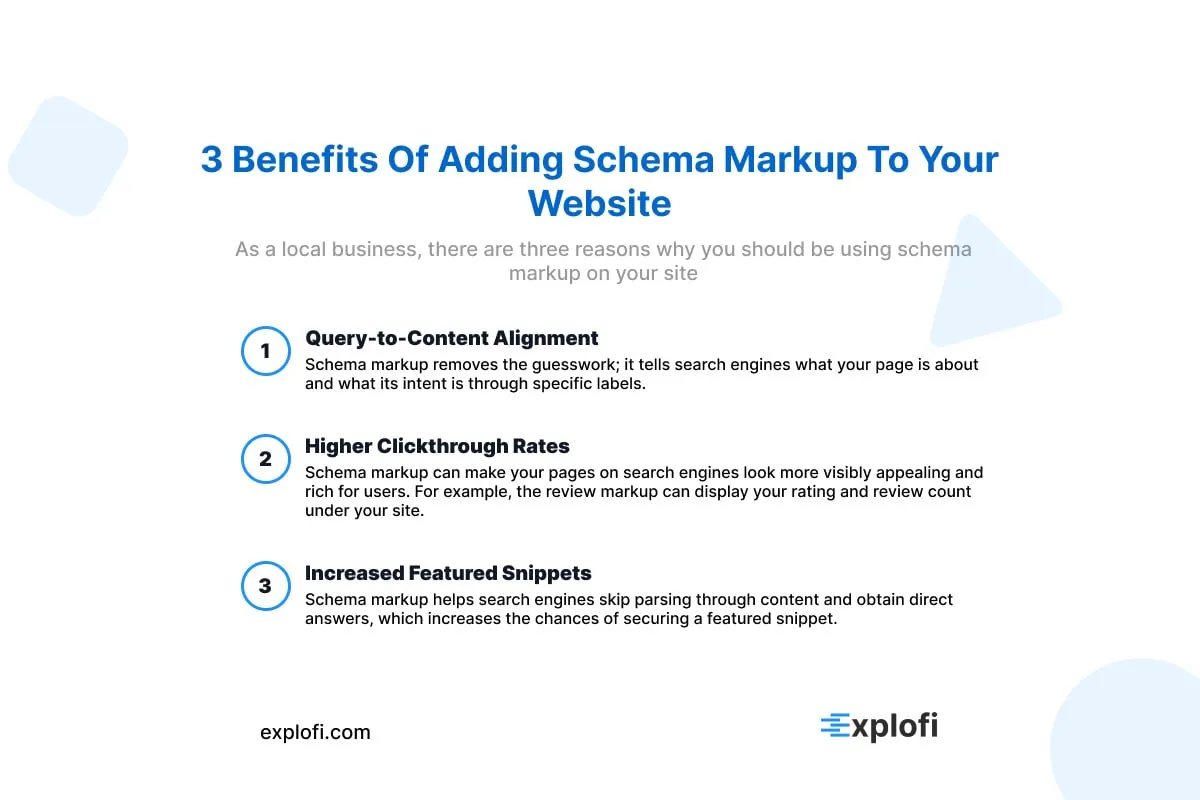
Adding schema markup to your website creates a direct pathway for search engines to interpret your content with structured precision. When search engines understand your content correctly, they can match it to queries with far greater accuracy, which directly impacts your ranking potential. The review markup schema type, for example, pulls verified ratings into search results, making your listing visually richer than competitors relying on plain text.
Similarly, FAQ markup allows businesses to display expanded question-and-answer content directly in search results, occupying more page real estate. Studies show rich results tied to structured data can produce the following measurable outcomes:
- Stronger query to content alignment
- Higher organic clickthrough rates
- Increased eligibility for featured snippets
How Schema Markup Improves Click-Through Rates
Star ratings, pricing, and availability pulled into a rich result visually separate a listing from plain competitors. Studies show structured data can boost click-through rates by up to 30%, since users search for immediate answers and gravitate toward results offering extra details upfront. FAQPage markup, for instance, expands listings with direct answers, naturally drawing more clicks than a standard meta description ever could.
Does Schema Markup Directly Improve Search Rankings?
Schema markup does not directly influence rankings as a confirmed Google ranking factor, yet its indirect impact is measurable. Google has publicly stated that structured data is not a ranking signal, but research from Milestone Inc. found that rich results drive a 20-25% increase in organic traffic.
That traffic gain stems from improved relevance signals, since enabling search engines to understand content context more precisely improves content-to-query matching. The ultimate goal of any SEO effort is earning qualified clicks, and schema markup consistently advances that outcome through enhanced search result presentation.
How Structured Data Supports Voice Search Optimization
Speakable schema, a markup type recognized by Google, directly signals which content is optimized for text-to-speech audio responses. Voice searches favor concise, structured answers, and speakable schema helps Google Assistant identify the most relevant content to read aloud, giving structured pages a measurable advantage over unformatted competitors.
How Schema Markup Improves Local SEO for Small Businesses
LocalBusiness schema is one of the most equally valuable schema types for small businesses competing in local search results. When properly implemented, it signals to search engines your business's name, address, phone number, hours, and service area, all in a structured format Google can directly parse.
Studies show that local searches lead 50% of mobile users to visit a store within a day, meaning accurate local schema directly influences foot traffic. Applying schema markup with `geo` and `openingHoursSpecification` properties gives search engines precise operational data, strengthening your local search result presence beyond what plain HTML ever could.
Common Types of Schema Markup Every Small Business Should Know
Beyond Local Business schema, several schema markup types directly impact how small businesses appear in search results. Product schema lets retailers display price, availability, and condition in a rich result, pulling shoppers in before they even click. Review schema surfaces star ratings tied to specific products or services, with Google's structured data documentation confirming ratings must reflect genuine user feedback.
FAQ schema expands a listing with clickable question-and-answer pairs directly on the results page. For service-based businesses, Service schema defines offerings with precise descriptions that help search engines understand the exact nature of each service. Event schema works specifically for businesses running workshops, pop-ups, or local events, displaying dates and locations inline.
LocalBusiness Schema Markup
LocalBusiness schema specifically maps `sameAs` properties to link social media profiles, reinforcing brand consistency across platforms that search engines cross-reference. Beyond basic contact details, the schema supports granular properties like `priceRange`, `currenciesAccepted`, and `paymentAccepted`.
These properties help search engines understand contextual business data without ambiguity. A well-structured LocalBusiness implementation typically includes:
- `@type` set to a specific business category
- `geo` coordinates for precise location mapping
- `aggregateRating` for inline star ratings
- `areaServed` to define service boundaries
Organization Schema Markup
Organization schema markup identifies a business as a distinct entity to search engines, separating it from loosely related content across the web. Using Schema.org's `Organization` type, it supports properties like `legalName`, `foundingDate`, `contactPoint`, and `sameAs`, giving search engines a structured profile of the business.
This specific schema type directly strengthens brand entity recognition, which Google's Knowledge Graph relies on to surface accurate business information in rich results.
Service Schema Markup
Service schema targets the `serviceType`, `provider`, `areaServed`, and `description` properties to give search engines a structured breakdown of what a business offers. For example, a plumbing company can specify emergency pipe repair as a distinct service, include pricing ranges, and define geographic coverage.
This precision helps search engines understand offerings beyond a generic business category, improving relevance in rich result appearances across both mobile and desktop search.
Review and AggregateRating Schema Markup
AggregateRating schema consolidates multiple user reviews into a single structured rating signal, using properties like `ratingValue`, `reviewCount`, and `bestRating`. Search engines use this data to display star ratings directly in the search result, making listings visually distinct. A `ratingValue` of 4.5 across 200+ reviews, for example, can meaningfully increase click-through rates compared to unstructured listings lacking visible credibility indicators.
FAQPage Schema Markup
FAQPage schema markup structures question-and-answer content so search engines understand it as a distinct content type, enabling rich results directly in search. When implemented correctly, it can trigger an expanded SERP feature where individual Q&A pairs appear beneath the main listing. Google's documentation confirms that FAQPage markup applies only to pages where the business controls the answers.
The structured data requires:
- A `Question` property for each query
- An `acceptedAnswer` property containing the corresponding response
Product Schema Markup
Product schema markup applies directly to physical or digital goods sold through a business's website, enabling search engines to display enhanced product details in search results. The structured data supports key properties including:
- `name`, `price`, `priceCurrency`, and `availability`
- `sku`, `brand`, and `aggregateRating`
These properties trigger rich results showing pricing and stock status, which Google confirms can visibly improve click-through performance for product listings.
Breadcrumb Schema Markup
Breadcrumb schema markup uses the `BreadcrumbList` item type to communicate a page's hierarchical position within a site's structure to search engines. Each `ListItem` property maps a page's navigational path, such as Home > Services > Plumbing, giving search engines a clear idea of site architecture.
Google can then display this path directly in the search result, replacing the raw URL with a cleaner, more readable trail that improves listing clarity.
How Explofi Helps Small Businesses Build Schema-Ready Content
Schema markup tells search engines and AI systems what your business does. But schema alone is not enough. You also need localized service pages, blog content, and FAQ sections that give AI systems something worth citing.
Explofi helps small businesses build that content layer. When you create a service page or blog post inside Explofi the content is structured around your business type, location, and competitors so it carries the specificity and depth that both Google and AI search systems reward. Pair that content with proper schema markup and you have the complete package that gets your business found in traditional search and cited in AI-generated answers.
Schema markup gets you eligible for rich results. Explofi builds the content that makes those results worth clicking. Start free and see what your competitors are ranking for that you are not.
Frequently Asked Questions About Schema Markup for Small Businesses
Does Schema Markup Guarantee a Rich Snippet in Search Results?
No, schema markup does not guarantee a rich snippet. Google states that structured data makes your content eligible for rich results, but appearance depends on relevance, quality, and compliance with its guidelines. Even perfectly implemented schema may not trigger enhanced search features, as Google reserves the right to display results in whatever format it deems most useful.
How Long Does It Take for Schema Markup to Show Up in Google?
After Google crawls and indexes your updated pages, schema markup can appear in search results within a few days to a few weeks. However, there's no guaranteed timeline. Google must first validate your structured data, which you can monitor using Google Search Console. Rich results may take longer to appear depending on crawl frequency and site authority.
Is Schema Markup a One-Time Setup or Does It Need Ongoing Maintenance?
Schema markup requires ongoing maintenance to stay effective. As your business evolves, your structured data must reflect those changes, including updated hours, services, or pricing. Google also periodically updates its structured data guidelines, meaning outdated markup can lose its effectiveness or trigger manual penalties in Search Console.
Can Schema Markup Hurt My Website if Implemented Incorrectly?
Incorrect schema markup can hurt your website's performance in search results. Google may ignore faulty structured data or, in severe cases, issue a manual penalty for misleading markup. Common mistakes include mismatched content, incorrect property values, or using markup to deceive users. Following Schema.org guidelines and Google's structured data policies helps ensure your implementation remains beneficial rather than harmful.
Do All Small Business Websites Need Schema Markup?
While not mandatory, schema markup is strongly recommended for small business websites. Google uses structured data to generate rich results, which can significantly boost click-through rates. Schema.org supports over 800 types of structured data, meaning nearly any business can benefit. Without it, your site may rank lower in competitive search results compared to competitors using schema markup.