Deep Dive with AI
What Retrieval-Augmented Generation Actually Means for AI Writing
Retrieval-Augmented Generation works by pulling from an external knowledge base before the generation step even begins. When a user asks a question, the RAG system queries relevant documents or external data sources, then injects that retrieved context directly into the LLM prompt. According to research from Meta AI, who originally developed RAG in 2020, this architecture reduces hallucination rates significantly compared to standard large language models relying solely on training data.
Rather than guessing, the model receives verified, retrieved data to generate from, making every output traceable to actual authoritative sources.
This is exactly how Explofi is built. When you use Explofi to generate a blog post, service page, or content refresh, the platform does not pull from a generic pool of internet training data. It retrieves verified, locally relevant information based on your business type, your location, and your competitors before a single word is written. The result is content that is grounded in what is actually ranking in your market rather than what a generic AI model assumes should rank.
How RAG Differs From Standard Large Language Model Generation
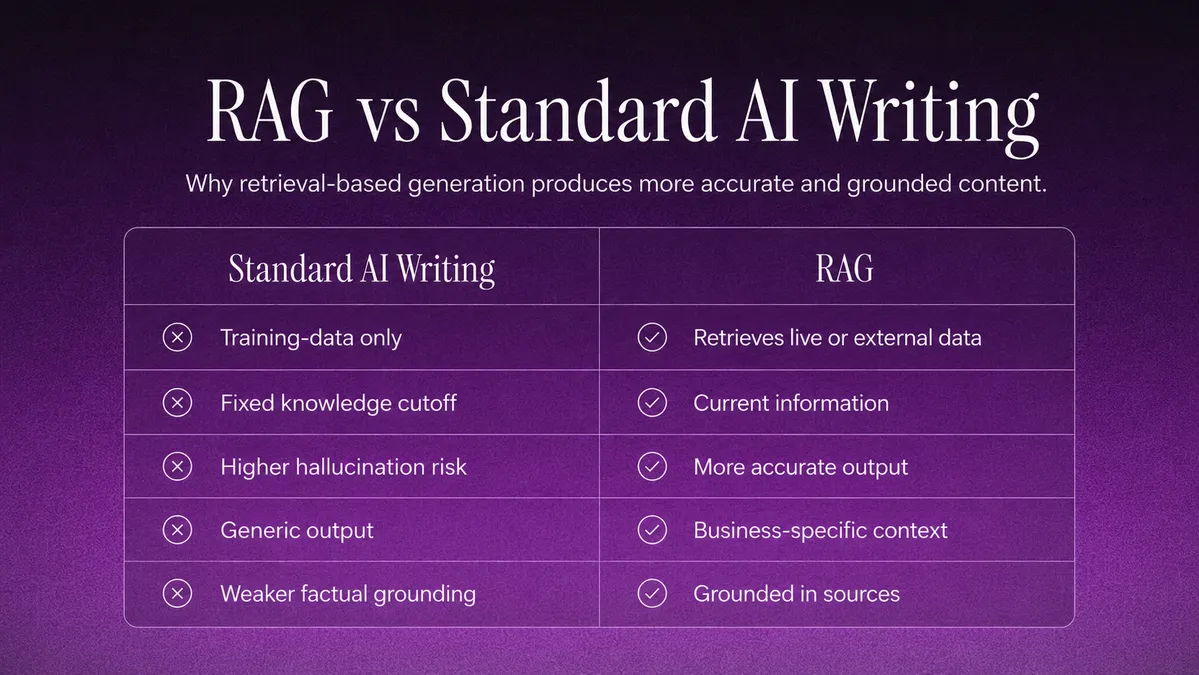
Standard large language models generate text purely from training data baked into their parameters during development, which means their knowledge is frozen at a cutoff date. A RAG model, by contrast, pulls from external sources at inference time, retrieving relevant data before producing a response.
This live retrieval step is what separates RAG architecturally from traditional foundation models. Where a standard LLM might confidently hallucinate an outdated or fabricated fact, RAG grounds its generated responses in retrieved source material, reducing hallucination rates by up to 43% according to research published by Meta AI on the original RAG framework.
The Core Mechanics Behind Retrieving and Augmenting Information
When a query is submitted, the retrieval system converts it into numerical representations called vector embeddings, then scans vector databases to surface the most semantically relevant content. That retrieved data is injected directly into the context window, forming an augmented prompt the model generates from.
This process keeps generated responses grounded in specific knowledge rather than outdated training data, cutting hallucination rates by up to 40%.
Why RAG Represents a Fundamental Shift in How AI Produces Content
Traditional AI writing pulls exclusively from static training data, meaning the model's knowledge is frozen at whatever cutoff date it was last updated. RAG breaks this pattern by dynamically retrieving information at the moment of generation, pulling from live knowledge bases, documents, or database records before producing a response.
A 2023 Meta AI study found RAG models reduced factual hallucinations by up to 38% compared to standard generative models, making generated responses measurably more accurate and grounded in verifiable, current information.
The Problem With Generic AI Writers That RAG Solves
Generic AI writers pull from static training data that cuts off at a fixed point in time, meaning the content generation they produce often lacks current information or business-specific context. A standard large language model, for instance, has no awareness of your pricing, your services, or your audience's specific questions.
This creates a measurable gap: generated responses from generic tools frequently contain hallucinated facts, outdated statistics, or surface-level claims that fail to carry real weight with readers. RAG solves this by pulling live, verified data into each output before generating a response. The result is content that reflects:
- Accurate, realtime business information
- Verified data points tied to your specific domain
- Contextually relevant answers to user queries
Why Standard AI Models Hallucinate Facts and Fabricate Information
Standard AI models generate text by predicting the next most probable word based on patterns learned from their training data, which is frozen at a specific cutoff point. Because these models have no mechanism to verify claims against live or authoritative sources, they produce confident-sounding text that is statistically plausible but factually wrong.
A 2023 Stanford study found that AI-generated legal documents contained hallucinated case citations at rates exceeding 88% in some tests. Unlike RAG implementation, which grounds responses in retrieved documents, standard generative AI fills knowledge gaps by interpolating between patterns, meaning fabricated statistics, misattributed quotes, and invented sources appear indistinguishable from accurate ones in the generated responses.
The Knowledge Cutoff Problem That Leaves Generic AI Writers Outdated
Generic AI writers are frozen in time. Most large language models, including GPT-4, have training data cutoffs that leave them months or even years behind current events, updated regulations, and shifting market trends. A machine learning model trained on data from early 2023, for instance, cannot accurately answer questions about 2024 algorithm changes affecting organic traffic or new industry benchmarks.
This gap makes generated responses unreliable for specific content that demands accuracy. Retrieval-augmented generation solves this directly by pulling live, sourced information rather than relying solely on static training data, ensuring the content reflects what is actually true right now.
How Generic AI Writers Produce One-Size-Fits-All Content That Fails Niche Audiences
Generic AI writers pull from broad training data that flattens industry-specific nuance into surface-level generalizations. A standard AI tool writing for a niche audience, say independent insurance brokers, produces the same structural content it would for a Fortune 500 firm, because it has no access to specific data about that market.
Research from Content Marketing Institute found that 71% of audiences disengage when content feels irrelevant to their context, making this one-size-fits-all output a measurable liability for small businesses targeting specialized segments.
Explofi solves this directly. Instead of generating the same surface level content for every business, Explofi uses retrieval to pull competitor data, local search signals, and profession-specific context before generating anything. A plumber in Las Vegas gets content built around what is ranking for plumbers in Las Vegas. A dentist in Phoenix gets content built around what local patients in Phoenix are actually searching for. The content is not generic because the retrieval is not generic.
How a RAG Model Works Step by Step
A RAG model operates through a precise three-phase process that separates it from standard generative AI. When a query enters the system, the retrieval phase pulls relevant documents from an external knowledge base rather than relying solely on static training data. That retrieved information then feeds directly into the generation phase, where the language model crafts an accurate response grounded in real, sourced content.
According to IBM Research, this architecture reduces hallucination rates significantly compared to standalone large language models. The augmented generation phase is what makes the output trustworthy, because the model must reconcile its response with the retrieved documents before producing a final answer, creating a built-in factual checkpoint.
Building and Indexing an External Knowledge Base
The external knowledge base in a RAG system is built by chunking documents into smaller text segments, typically between 256 and 512 tokens, then converting them into vector embeddings using models like text-embedding-ada-002. These embeddings are stored in a vector database such as Pinecone or FAISS, where each chunk is indexed for fast retrieval.
The knowledge base can pull from:
- Blog posts
- Product pages covering specific services
- Structured data from a knowledge graph
This allows precise, grounded generated responses.
Retrieving Only the Most Relevant Information for Each Query
Retrieval works by converting a user's query into a vector embedding, then scanning a knowledge base to find semantically similar content, typically returning the top three to five most relevant chunks. Unlike broad training data that covers everything loosely, this step filters with precision, so generated responses reflect only what directly answers the question.
For example, a query about local zoning laws pulls only zoning-related documents, not tangentially related legal material, giving the model exactly what it needs for a precise answer.
Augmenting the Language Model Prompt With Retrieved Context
Retrieved context gets injected directly into the language model's prompt before generation begins, effectively giving the model a curated knowledge base for that specific query. This technique, central to prompt engineering, means the model isn't relying solely on its training data but instead reasoning over freshly retrieved documents.
Research shows retrieval-augmented prompts can reduce hallucination rates by up to 38%, since the model generates responses grounded in sourced material rather than probabilistic pattern matching from potentially outdated information.
Generating a Response That Is Grounded in Real and Current Data
Once the retrieval step surfaces the most relevant documents, the generation phase uses that material as a factual anchor for its output. Unlike standard AI tools that rely solely on static training data, a RAG model conditions its response on live, retrieved content, which significantly reduces hallucination rates.
According to research from Gartner, RAG-based systems can cut AI hallucinations by up to 50%, making generated responses far more reliable for content that demands accuracy, like SEO execution or product descriptions.
For small businesses using Explofi this means every article, service page, and content refresh is generated from a foundation of real verified information rather than statistical guesses. When Explofi writes about your services it is pulling from what your competitors are ranking for, what your local market is searching for, and what AI search systems are already citing in your category. That is what separates Explofi from dropping a prompt into ChatGPT and hoping the output is accurate.
Why Retrieval-Augmented Generation Produces More Accurate Content Than Prompt Stuffing
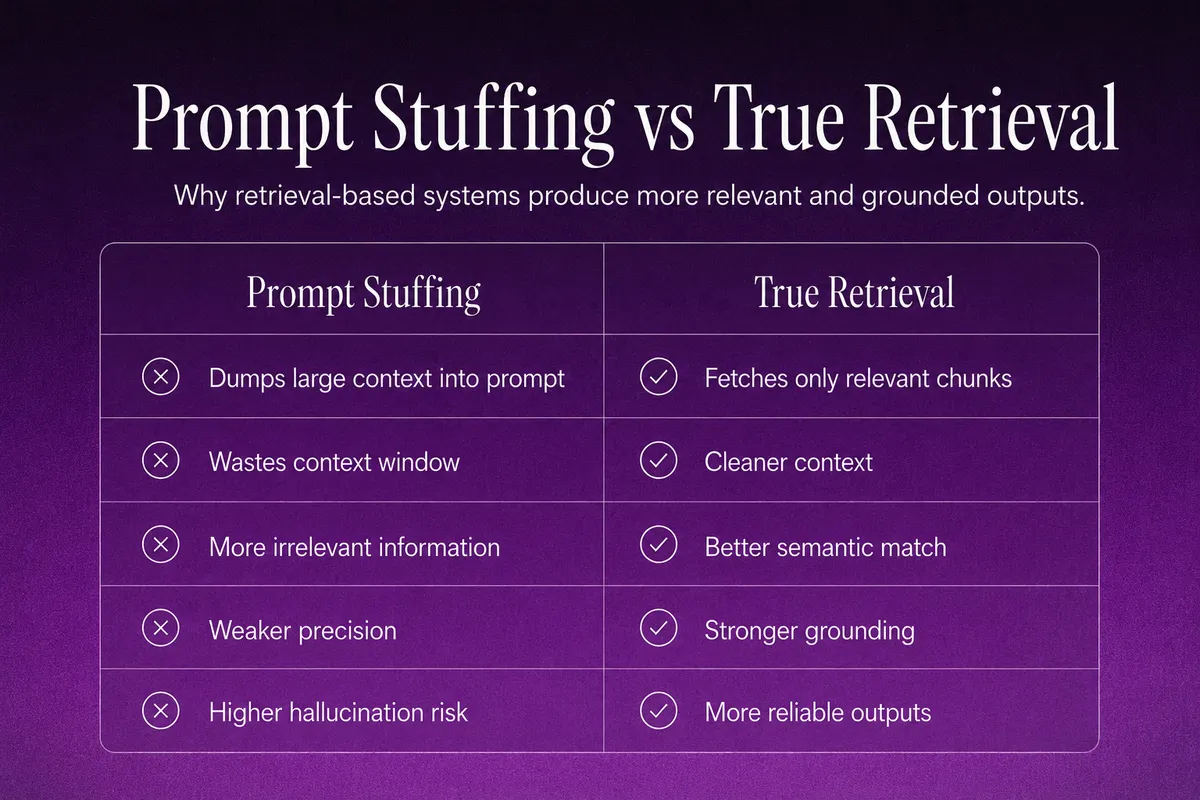
Prompt stuffing, which means cramming raw instructions into a single input window, forces the model to work entirely from its training data, which can be months or even years out of date. Retrieval-augmented generation, by contrast, pulls verified, real-time information before generating a response, grounding every output in actual source material rather than statistical guesses.
Research from Meta AI shows RAG reduces factual hallucinations by up to 38% compared to standard generative models. Because generated responses are anchored to retrieved documents, the content reflects genuine specificity rather than pattern-matched generalizations, which matters significantly when writing for generative engine optimization where accuracy directly influences whether AI platforms cite your content as a trusted reference.
The Critical Difference Between Stuffing a Context Window and True Retrieval
Stuffing a context window means pasting raw data directly into a prompt and hoping the model sorts it out, while true retrieval surgically fetches only the most relevant chunks before generation begins. Context windows in large language models are capped, with GPT-4 handling roughly 128,000 tokens, meaning indiscriminate stuffing wastes that space on irrelevant content.
True retrieval through augmented generation uses vector similarity scoring to rank source material, pulling only passages with the highest semantic relevance. This precision directly shapes generated responses, reducing hallucination rates that studies show can reach 27% in prompt-stuffed outputs compared to significantly lower rates in RAG-based systems.
- Vector embeddings measure semantic distance between query and source
- Only top ranked chunks enter the generation pipeline
- Irrelevant data never reaches the model
How Semantic Search Powers Smarter Information Retrieval in RAG Systems
Semantic search enables RAG systems to retrieve information based on meaning rather than exact keyword matches, making it far more precise than traditional retrieval methods. Unlike conventional search that matches literal strings, semantic search uses vector embeddings to measure conceptual similarity, allowing the system to surface contextually relevant documents even when phrasing differs.
This directly improves the quality of augmented generation outputs, since the retrieved passages align more closely with the actual intent of a query, reducing hallucinations and grounding generated responses in accurate, retrievable source material.
Why Targeted Retrieval Outperforms Feeding Entire Documents to a Model
Feeding an entire document into a language model forces it to process irrelevant content alongside the facts that actually matter, which dilutes output precision significantly. Targeted retrieval, by contrast, pulls only the specific chunks of information relevant to a query, reducing noise by as much as 40% according to benchmarks from retrieval system evaluations.
This directly strengthens generated responses because the model reasons over a focused evidence set rather than hundreds of competing tokens. The mechanism works by converting queries into vector embeddings, then matching them against indexed document segments using cosine similarity scoring, which surfaces only the highest-relevance passages.
That precision is exactly what separates reliable augmented generation from bloated, hallucination-prone prompt stuffing.
The Role of External Data in Making RAG-Powered AI More Reliable
RAG-powered AI pulls from external databases rather than relying solely on static training data, which cuts hallucination rates significantly. According to IBM research, retrieval-augmented generation reduces factual errors by up to 40% compared to standard large language models generating augmented generation responses.
What Counts as External Data in a Retrieval-Augmented Generation Pipeline
External data in a retrieval-augmented generation pipeline includes any information sourced outside a model's original training data. This spans structured databases, PDFs, internal documentation, live web content, and indexed knowledge bases that the system queries at runtime. Unlike static training data baked into a model before deployment, external sources are retrieved dynamically per query through natural language search, meaning the information can be current, domain-specific, and verifiable.
A wide range of source types qualify, from product catalogs to financial reports, giving generated responses a factual grounding that pure parametric models fundamentally cannot offer.
How External Data Sources Are Kept Fresh and Continuously Updated
RAG-powered systems stay current through automated pipelines that continuously pull from external databases, APIs, and indexed web sources. Unlike static training data, which freezes knowledge at a cutoff date, retrieval systems can update their document stores in near real-time. These updates typically follow a structured refresh cycle:
- Scheduled crawls of live web sources
- API syncs with structured data providers
- Event triggered document reindexing
This keeps generated responses grounded in the most current, verifiable information available.
Why the Quality of Your Knowledge Base Determines the Quality of AI Output
Garbage in, garbage out remains the core truth behind RAG-powered augmented generation. When your knowledge base contains outdated, vague, or poorly structured documents, the retrieval layer pulls that weak material directly into the generation process, and the AI compounds those errors into confident-sounding but inaccurate responses.
Research from MIT shows that AI accuracy drops by roughly 47% when retrieval sources contain inconsistent or low-quality data, making your knowledge base the single biggest variable in output reliability.
RAG vs. Fine-Tuning: Why Retrieval Is Often the Smarter Choice for Content Tools
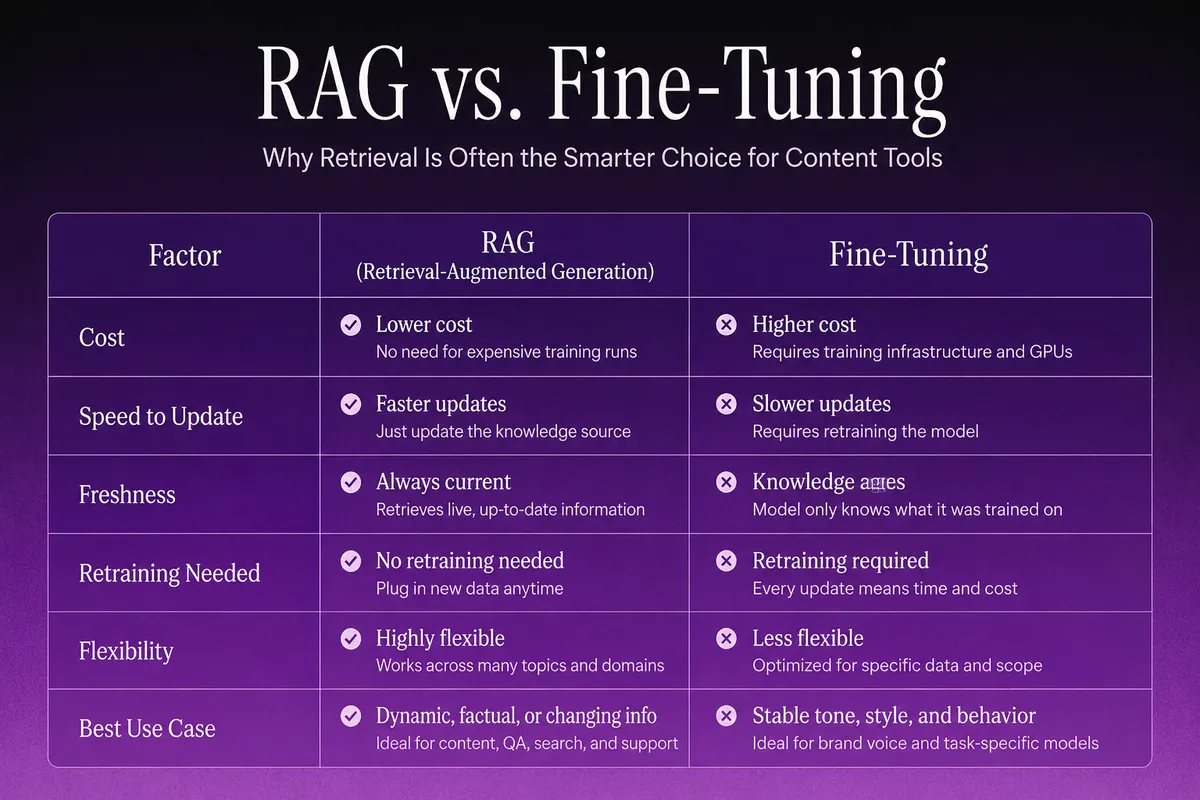
Fine-tuning retrains a model on a fixed dataset, meaning its knowledge freezes the moment training ends. For content tools, that creates a real problem, since search engines update ranking signals constantly and topic relevance shifts fast. Retrieval-augmented generation sidesteps this by pulling live, current information at inference time rather than baking static knowledge into weights.
The financial costs tell the story clearly: fine-tuning a large language model can run anywhere from $2,000 to over $100,000 depending on model size and compute, while RAG implementations typically require a fraction of that overhead. For AI tools built around content accuracy, retrieval wins on practicality because the generated responses stay grounded in real, retrievable sources rather than outdated training data.
What Fine-Tuning a Language Model Actually Requires in Time and Cost
Fine-tuning a language model demands substantial investment before a single useful output is generated. Updating model weights requires thousands of curated examples of training data, which alone can take weeks to prepare and validate. Compute costs for retraining even a mid-sized model like GPT-3 have been estimated at over $4.6 million per run, according to research published by Stanford.
Beyond raw compute, engineering time for hyperparameter tuning, evaluation cycles, and deployment infrastructure compounds those expenses. For small businesses or content teams, these barriers are practically insurmountable, especially since each meaningful update to the model's knowledge triggers the entire retraining cycle again.
Why RAG Allows for Greater Flexibility Without Retraining the Underlying Model
RAG's core advantage lies in its ability to pull from external knowledge sources at inference time, meaning the underlying model never needs retraining when information changes. Fine-tuning, by contrast, requires rewriting model weights with updated training data, a process that can cost thousands of dollars per run.
Through augmented generation, the retrieval layer handles knowledge updates independently, so ai tools built on RAG can adapt to new content, industries, or audiences without touching the base model's architecture.
When Fine-Tuning Makes Sense and When RAG Is the Better Solution
Fine-tuning works best when a model needs to adopt a consistent tone, follow domain-specific formatting, or internalize specialized vocabulary permanently into its weights. However, it struggles with factual accuracy over time because training data has a fixed cutoff, meaning the model cannot reflect new information without retraining.
RAG sidesteps this entirely by pulling live, relevant data at inference time. For content tools specifically, this distinction matters because:
- Accuracy degrades in fine tuned models as source material ages
- Augmented generation keeps generated responses grounded in current context
Why RAG-Generated Content Ranks Better and Gets Cited in AI Search
Content that is accurate, sourced, and locally specific is exactly what Google and AI search systems like ChatGPT and Perplexity are designed to surface and cite. Generic AI content that pulls from static training data fails both tests. It is not specific enough to rank locally and not accurate enough to be cited by AI systems that cross-reference claims against authoritative sources.
Explofi's RAG-based content generation is built for this reality. Every piece of content it produces is grounded in real retrieved data which means it carries the specificity and accuracy that both Google and AI search systems reward. For small businesses trying to rank in local search and show up in AI-generated answers, the quality of the underlying content generation architecture is not a technical detail. It is the difference between content that gets found and content that sits unread.
Generic AI writers guess. Explofi uses a RAG model to generate content built around real verified data, your competitors, your location, and your business type. Start free and see the difference.