
Article Summary: Off-page SEO is everything that happens outside your website that tells Google your business is credible, authoritative, and worth ranking. Backlinks from authoritative sites are the strongest signal but brand mentions, social media engagement, online reviews, and directory citations all contribute to how search engines evaluate your site's trustworthiness. This guide covers what off-page SEO is, why it matters, the most effective link building strategies for small businesses, and how to build external authority without an agency retainer.
Deep Dive with AI
What Is Off-Page SEO?
Off-page SEO refers to all optimization activities that happen outside your website to improve search engine rankings. Unlike on-page tactics, it focuses on building authority through external signals that search engines use to evaluate credibility. These signals include:
- Quality backlinks from authoritative websites
- Earning brand mentions across the web
- Social media engagement
- Online listings and review profiles
If you don't know what SEO is and want to read up on it, click here.
On-Page SEO vs. Off-Page SEO: Key Differences Explained
On-page SEO targets elements within your site, like content and internal linking, while off-page SEO focuses on external trust signals. Specifically:
- On-page controls structure
- Off-page builds domain authority
Building backlinks and search engine rankings depend heavily on which strategy you prioritize.
How On-Page SEO Focuses on Internal Optimization
On-page SEO optimizes internal elements that search engines crawl directly, including title tags, meta descriptions, header structure, and keyword placement within relevant content. Google's ranking systems evaluate these signals to determine topical relevance, with studies showing that pages with properly optimized title tags see up to 20% higher click-through rates, directly influencing organic traffic and search visibility.
How Off-Page SEO Builds External Authority
Earning backlinks from authoritative sources is one of the most direct ways to build external authority, with studies showing that pages ranking in Google's top three positions have 3.8 times more backlinks than lower-ranking pages. Tactics like guest blogging, broken link building, and unlinked mentions convert existing references into quality links that pass link juice to your domain.
Each of these methods targets relevant sites, strengthening your backlink profile through credible, external validation.
Why Both Are Necessary for a Complete SEO Strategy
Neglecting either discipline creates measurable gaps in performance. Strong on-page optimization without off-page signals leaves your site structurally sound but unrecognized by search engines. Without on-page clarity, even high-authority backlinks lose conversion potential. A complete strategy requires:
- Technical precision On-Page
- External trust through backlinks and domain authority
A complete strategy requires: technical precision on-page, external trust through backlinks and domain authority, and a technically sound foundation covered in what is technical SEO.
Why Off-Page SEO Matters for Search Engine Rankings
Search engines weigh off-page signals heavily when determining search rankings, with Google's algorithm factoring domain authority as a core ranking metric. Sites with stronger external validation consistently outrank competitors, since roughly 91% of pages never rank simply due to lacking credible backlinks.
How Links and Brand Mentions Influence Search Rankings
Brand mentions, even without a hyperlink, act as implied links that search engines recognize as trust signals. Tools like Google Alerts let you monitor brand mentions across the web, helping you convert unlinked mentions into backlinks. Paired with links from high-domain authority sources, these signals collectively:
- Strengthen domain authority
- Improve search rankings
How Off-Page SEO Strengthens Domain and Page Authority
Domain authority (DA) is a score from 1 to 100 that predicts how well a site ranks, and off-page SEO directly drives that score upward. Search engines calculate DA by evaluating the quality and quantity of external sites linking back to your domain. A single backlink from a site with a DA of 70 or higher carries significantly more weight than dozens from low-authority sources.
Through guest blogging and earning backlinks from industry experts, your domain accumulates trust signals that compound over time, steadily pushing both DA and individual page authority higher.
How Off-Page SEO Improves E-E-A-T Signals
E-E-A-T, which stands for Experience, Expertise, Authoritativeness, and Trustworthiness, is a framework Google uses to evaluate content quality. Off-page SEO directly strengthens each pillar by generating external validation that search engines can measure. When authoritative news sites and industry publications reference your domain, those signals confirm your site's credibility.
Pairing guest blogging with influencer marketing amplifies this effect, as both tactics earn backlinks while placing your brand in front of audiences that already trust those external sources.
Backlinks: The Foundation of Off-Page SEO
Backlinks with high domain authority signal credibility, but link relevance matters equally. A backlink from a topically aligned site, even at DA 50, can outperform an unrelated DA 80 source, directly influencing search engine rankings through contextual trust signals search algorithms prioritize.
For businesses that need visibility faster than traditional link building allows, parasite SEO offers a different route to the same borrowed-authority effect.
What Qualifies as a High-Quality Backlink
Anchor text placement within the linking page's body content signals relevance far more than footer or sidebar links. Links embedded naturally within editorial content, where surrounding text aligns topically, carry the strongest weight. Dofollow links pass link equity directly, while a balanced ratio of referring domains signals an organic, trustworthy backlink profile to search engines.
Dofollow vs. Nofollow Links and Their SEO Impact
Dofollow links pass link equity directly to your site, actively contributing to search engine rankings by signaling trust and authority. Nofollow links, introduced by Google in 2005, use a `rel="nofollow"` tag that traditionally blocked equity transfer. Google shifted this in 2019, reclassifying nofollow as a "hint" rather than a directive, meaning some nofollow links now influence rankings.
A balanced backlink profile includes:
- High authority dofollow links for equity transfer
- Nofollow links from credible sources for profile diversity
Why Link Quality Matters More Than Link Quantity
Spam links from low-authority directories can actively trigger Google's Penguin algorithm, which penalizes manipulative link patterns and tanks search engine rankings overnight. A single toxic backlink from a penalized domain transfers negative equity to your site, making link audits through tools like Ahrefs or SEMrush essential.
Quality signals include:
- Editorial placement within body content
- Topical alignment between linking and linked domains
- Organic anchor text variation
Link Building Strategies That Drive Real Results
Broken link building converts dead website resources into backlink opportunities by identifying expired links on high-authority pages and offering your content as a replacement. Studies show this strategy yields an average response rate of 5-10%, making it one of the more efficient outreach methods.
Guest posting on topically relevant sites with DA 50+ simultaneously helps build authority and gain backlinks through contextual editorial placement.
Using Broken Link Building to Earn Valuable Backlinks
Broken link building targets dead links on authoritative pages, replacing them with your working content. The process involves:
- Finding a broken link on a relevant page
- Creating or matching valuable content to that URL
- Contacting the site owner with a replacement suggestion
Studies show outreach response rates average 5-10%, meaning volume matters. This strategy builds relationships with content creators while earning backlinks that improve rankings through genuine editorial placement rather than manipulation.
Leveraging Data and Original Research to Attract Links
Original research and proprietary data are among the most powerful ways to build links organically. Publishing a study with specific statistics gives other sites a citable source, which naturally attracts backlinks. Consider these high-performing data formats:
- Industry surveys with percentage based findings
- Year over year trend reports
- Original case studies with measurable outcomes
How Strategic Guest Posting Builds Authority and Referral Traffic
Guest posting on high-authority sites within your niche consistently drives both referral traffic and domain authority gains. When a published guest post includes a contextual dofollow backlink, it passes direct link equity while placing your content in front of a highly targeted audience. Sites accepting guest posts typically see contributor articles generating referral traffic for months, with some posts averaging 200-400 visits per placement depending on the host site's readership.
Participating in Expert Roundup Posts to Gain Exposure
Expert roundup posts compile insights from multiple industry voices, making them a reliable strategy to increase brand awareness and earn backlinks from high-authority sites. When featured, your quote typically links back to your site. These posts often attract:
- Hundreds of shares across social media
- Backlinks from domains with 50+ domain authority scores
Content Marketing as an Off-Page SEO Technique
Publishing great content drives off-page SEO by earning organic backlinks when other sites reference your work. For example, a detailed case study citing conversion rate improvements, like a 47% lift, naturally attracts citations from industry blogs, building domain authority through genuine editorial endorsements rather than manufactured link schemes.
Creating Link-Worthy Assets That Other Sites Want to Reference
Link-worthy assets earn citations because they offer something irreplaceable to a target audience. Formats that consistently attract editorial backlinks include:
- Interactive tools (calculators, generators)
- Original datasets with percentage based findings
- Visual content like infographics
These resources build trust naturally, as sites reference them to support claims, strengthening your domain authority through genuine editorial placement.
Developing Visual Content That Earns Organic Backlinks
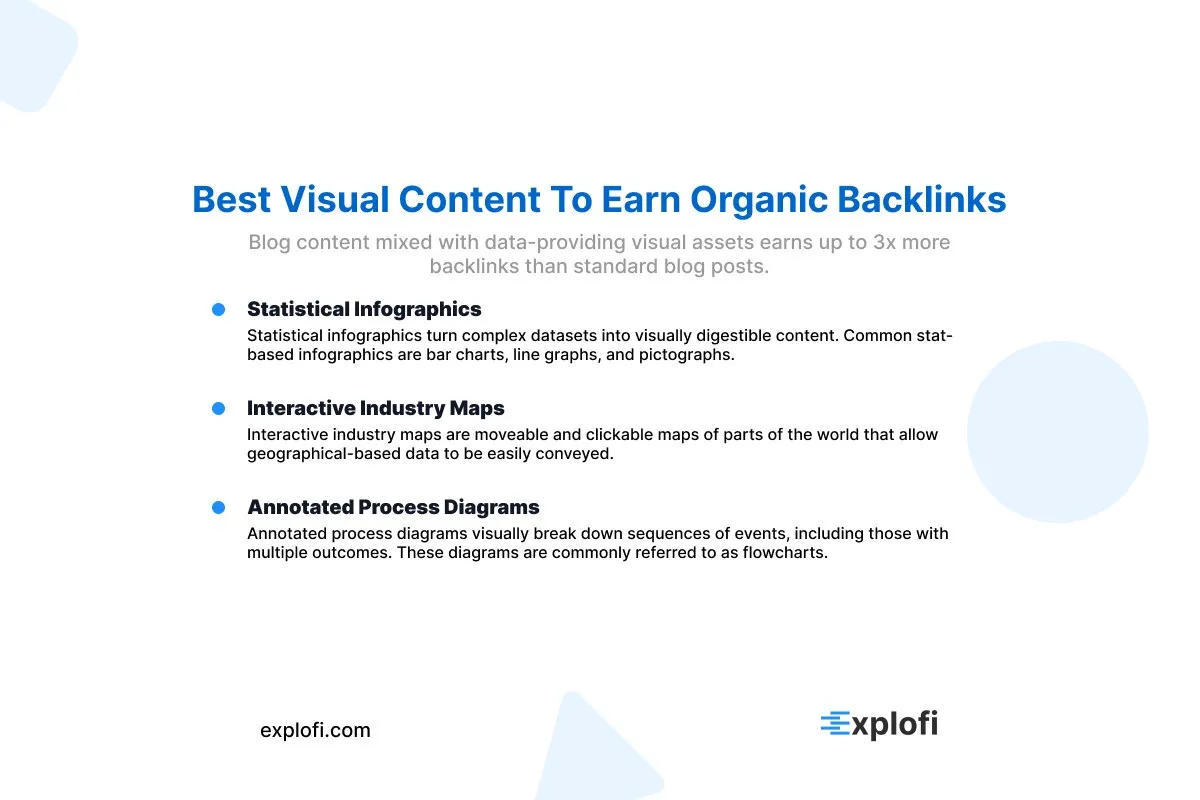
Infographics, data visualizations, and interactive maps are among the most linkable visual assets in content marketing, with infographics earning 3x more backlinks than standard blog posts. Visuals work because they condense complex data into shareable formats that publishers embed directly, linking back to the source.
Formats proven to increase traffic through earned backlinks include:
- Statistical infographics
- Interactive industry maps
- Annotated process diagrams
Distributing Long-Form Content Through Syndication Channels
Syndication platforms like Medium, LinkedIn Articles, and Business2Community redistribute long-form content to audiences already segmented by industry interest, directly strengthening your online presence and domain authority without requiring new content creation. Syndicated pieces consistently use canonical tags to credit the original source, protecting search engine rankings while expanding reach.
Pieces exceeding 1,500 words perform measurably better in syndication, generating up to 68% more referral traffic than shorter formats distributed through the same channels.
Brand Signals and Their Role in Off-Page SEO
Brand signals are measurable indicators that search engines use to verify a business's legitimacy and authority across the web. These signals include consistent mentions, social media engagement, and unlinked brand citations. Google has confirmed that brand strength influences how sites are evaluated in search, particularly in competitive spaces.
Structured citations with accurate name, address, and phone number data across specific directories directly reinforce these signals.
Structured citations with accurate name, address, and phone number data across specific directories directly reinforce these signals, the same structured data principle covered in what is schema markup.
How Branded Search Volume Reflects Online Reputation
Branded search volume, the rate at which people search a business by name, directly signals reputation strength to search engines. When that volume spikes, it tells Google the brand is generating real-world interest. A consistent rise in branded queries can improve search engine rankings by reinforcing trust signals.
Consider what drives these spikes:
- Viral content
- Press coverage
- Word of mouth referrals
Setting Up Brand Tracking to Monitor Mentions Across the Web
Tools like Google Alerts, Mention, and Brand24 track unlinked brand mentions across blogs, forums, and news sites. Setting alerts for your brand name, key products, and common misspellings helps capture every reference. Unlinked mentions are conversion opportunities since outreach can turn them into backlinks, directly strengthening domain authority and search engine rankings.
Publishing Research-Backed Content to Strengthen Brand Authority
Publishing original studies, surveys, or data reports gives search engines concrete proof of topical authority. When a brand's research gets cited by journalists or industry blogs, it generates high-quality backlinks that directly strengthen domain authority. For example, a B2B company that publishes proprietary survey data often sees:
- Citation based backlinks from authoritative domains
- Increased branded mentions across trade publications
- Higher trust signals recognized by search engines
Social Media's Impact on Off-Page SEO Performance
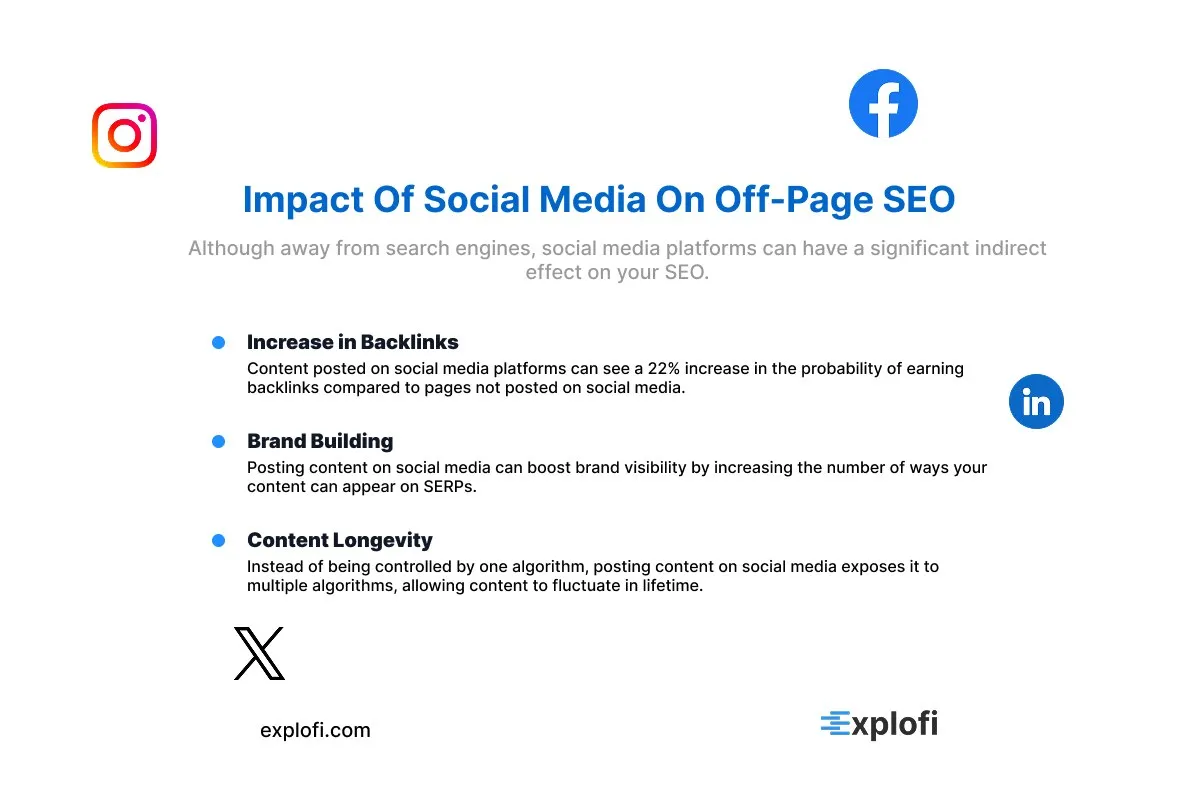
Social media sharing drives referral traffic that search engines interpret as engagement signals, which indirectly strengthens domain authority. Platforms like LinkedIn and Twitter amplify content reach, increasing backlink acquisition probability by up to 22%. Search engines track these patterns through:
- Shares
- Mentions
- Clickthrough rates
How Social Sharing Amplifies Content Reach and Visibility
Viral posts on platforms like LinkedIn generate compounding visibility, where each share exposes content to an entirely new network. This amplification directly increases the probability of earning backlinks, with studies showing socially shared content attracts 3x more inbound links. Search engines track this engagement, using it to reinforce a page's relevance and strengthen domain authority over time.
- Broader audience exposure
- Higher backlink acquisition rates
Building an Engaged Social Media Presence to Support SEO Goals
Consistency across platforms directly shapes how search engines evaluate authority. Building an engaged presence means focusing on:
- Posting frequency aligned with audience activity windows
- Reply rates that signal active community management
- Content formats proven to generate saves and shares
Profiles with high engagement rates see up to 40% stronger referral traffic, which search engines interpret as a reliable domain authority signal.
Using Social Platforms to Earn Indirect Link Opportunities
Sharing content on social platforms creates pathways for journalists, bloggers, and editors to discover your work organically. When a well-crafted post circulates widely, it often lands in front of someone with the domain authority to link back to the source. This is especially true on LinkedIn and X, where industry professionals actively scout content.
Consistent social exposure builds the kind of credibility that turns passive viewers into active linkers, naturally strengthening your overall content marketing strategy.
How Explofi Helps Small Businesses Build the Content That Earns Off-Page Authority
Off-page SEO is built on one foundational truth. Nobody links to a website with no content worth linking to. The businesses that earn backlinks, brand mentions, and citations consistently are the ones publishing localized service pages, in-depth blog content, and topical resources that other sites actually want to reference.
The businesses that earn backlinks, brand mentions, and citations consistently are the ones publishing localized service pages, in-depth blog content, and topical resources that other sites actually want to reference.
That is the content layer Explofi builds. When you create content inside Explofi it is generated around your specific business type, location, and competitors so every page carries the specificity and depth that earns real editorial attention. A plumber in Las Vegas with ten localized service pages, a topical map covering every relevant query in their market, and consistent blog content built around what local customers are searching for is infinitely more linkable than a competitor with a generic five-page website.
Explofi handles the content execution so your off-page SEO efforts have something worth pointing to.
Frequently Asked Questions
What is off-page SEO in simple terms?
Off-page SEO is everything you do outside your own website to improve your search engine rankings. The most important off-page signal is backlinks which are links from other websites pointing to yours. When authoritative websites link to your content Google treats it as a vote of confidence and rewards your pages with higher rankings. Off-page SEO also includes brand mentions, social media signals, online reviews, and directory listings that collectively tell search engines your business is credible and trustworthy.
How long does off-page SEO take to show results?
Off-page SEO typically takes 3 to 6 months before you see meaningful ranking movement from backlink building efforts. This is because Google needs time to crawl and process new links, evaluate their quality, and factor them into its ranking calculations. High authority backlinks from established publications can show results faster sometimes within weeks while links from newer or lower authority sites take longer to influence rankings. Consistency matters more than speed in off-page SEO because a steady stream of quality links over time outperforms a single burst of low quality link building.
Is off-page SEO more important than on-page SEO?
Neither is more important than the other. They work together and you need both to rank competitively. On-page SEO ensures your content is structured correctly and matches search intent so Google can understand and rank your pages. Off-page SEO builds the authority and credibility that tells Google your pages are worth ranking above competitors. A technically perfect page with no backlinks will struggle in competitive markets. A page with strong backlinks but poor on-page optimization will convert poorly even if it ranks. The most effective SEO strategies treat both as equally critical and build them simultaneously.
Can social media improve my off-page SEO?
Social media does not directly influence search rankings as a confirmed ranking signal but it indirectly supports off-page SEO in meaningful ways. When your content gets shared widely on platforms like LinkedIn and X it gets in front of journalists, bloggers, and editors who may link to it from their own sites. Social sharing also drives referral traffic which search engines interpret as an engagement signal. Building an active social presence that consistently distributes your content increases the probability of earning organic backlinks over time without requiring direct outreach.
What is the difference between a dofollow and nofollow link?
A dofollow link passes link equity directly from the linking site to yours which strengthens your domain authority and contributes to improved search rankings. A nofollow link includes a tag that traditionally told Google not to pass equity through the link. In 2019 Google updated its stance and now treats nofollow as a hint rather than a hard directive meaning some nofollow links may still influence rankings. A healthy backlink profile includes both dofollow links from high authority sources for direct equity transfer and nofollow links from credible platforms for profile diversity and natural appearance.
How do I get backlinks for my small business website?
The most effective backlink strategies for small businesses are publishing content worth linking to, getting listed in local and industry-specific directories, claiming and optimizing your Google Business Profile and other citation sources, and reaching out to local news outlets or industry blogs with original data or insights. Guest posting on relevant websites in your industry is another reliable method that earns both backlinks and referral traffic simultaneously. The fastest path to earning backlinks as a small business is consistently publishing localized service pages and blog content that covers topics your target audience and other websites in your market actually care about.