Deep Dive with AI
Why AI Search Has Become the New Front Door for Local Customers
Local customers are no longer scrolling through ten blue links to find a plumber or HVAC company near them. AI-driven search features now influence over 58% of all search queries, meaning AI overviews and AI answers have fundamentally restructured how local businesses get discovered.
When someone asks an AI assistant "who replaces water heaters near me," the AI surfaces one or two businesses confidently, not a list of ten. That single recommendation functions as the new front door, and if your business details are not structured properly across platforms like Google Business Profile and Bing Places, your local search visibility simply will not register where it matters most.
How AI Overviews Differ from Traditional Search Results
Unlike traditional search results, which display a list of ranked links, AI overviews synthesize information from multiple sources into a single, direct answer. Google's AI Overviews appear at the very top of the search result page, above organic listings, capturing attention before a user scrolls.
For local businesses, this shift is critical because the AI selects which sources it cites, meaning your online presence either gets featured or completely bypassed in local search.
Why Local Businesses Cannot Afford to Ignore AI Visibility
AI search visibility is no longer optional for local businesses. According to BrightEdge, AI-driven search features now influence over 57% of all search queries, meaning a business that doesn't appear in AI overviews is effectively invisible to more than half its potential customers. Google's AI Mode actively pulls structured, location-specific answers, so local service businesses without optimized content lose ground daily.
A plumber in Dallas without FAQ content or schema markup, for example, will consistently lose inquiries to competitors who do.
How ChatGPT and Google AI Actually Choose Which Local Businesses to Recommend
Both ChatGPT and Google's AI overviews pull recommendations from sources they already trust, and for local businesses, that trust is built through signals like structured data, customer reviews, and a fully optimized Google Business Profile. 98% of people in 2024 used the internet to find local businesses, meaning AI systems are trained on an enormous pool of local search behavior.
These AI tools prioritize businesses that clearly answer questions about service areas, pricing ranges, and specific details like hours and phone numbers. A business that uses schema markup, specifically FAQPage schema, gives AI models machine-readable context that makes recommending that business far more precise and confident.
AI Tools Need to Understand Exactly Who and What You Are
AI systems pull business recommendations from sources that clearly define what a business does, where it operates, and who it serves. Schema markup, specifically `LocalBusiness` structured data, tells AI tools your exact service area, hours, and categories. Without this clarity, even well-established local businesses get overlooked in AI overviews for searches their ideal customers are actively making.
AI Tools Look for Verifiable Proof Across Multiple Sources
AI systems cross-reference business information against multiple independent sources before surfacing a recommendation. For local businesses, verifiable proof typically means consistent data appearing across:
- Your Google Business Profile
- Structured data and schema markup on your website
- Third party directories like Yelp or Apple Maps
When AI tools detect matching NAP (name, address, phone) details across these sources, confidence in your business's legitimacy increases significantly.
How User Feedback and Interaction Data Influence AI Recommendations
Interaction signals carry real weight in how AI systems rank and surface local businesses. When users consistently click on a business, leave detailed reviews, or engage with its Google Business Profile, those behavioral patterns feed directly into recommendation algorithms. Google's own documentation confirms that review quality, response time, and engagement frequency influence local search visibility.
Specifically, businesses that respond to reviews within 24 hours see stronger profile engagement, which compounds into higher placement across AI overviews.
Why the Majority of Local Businesses Remain Invisible to AI Search
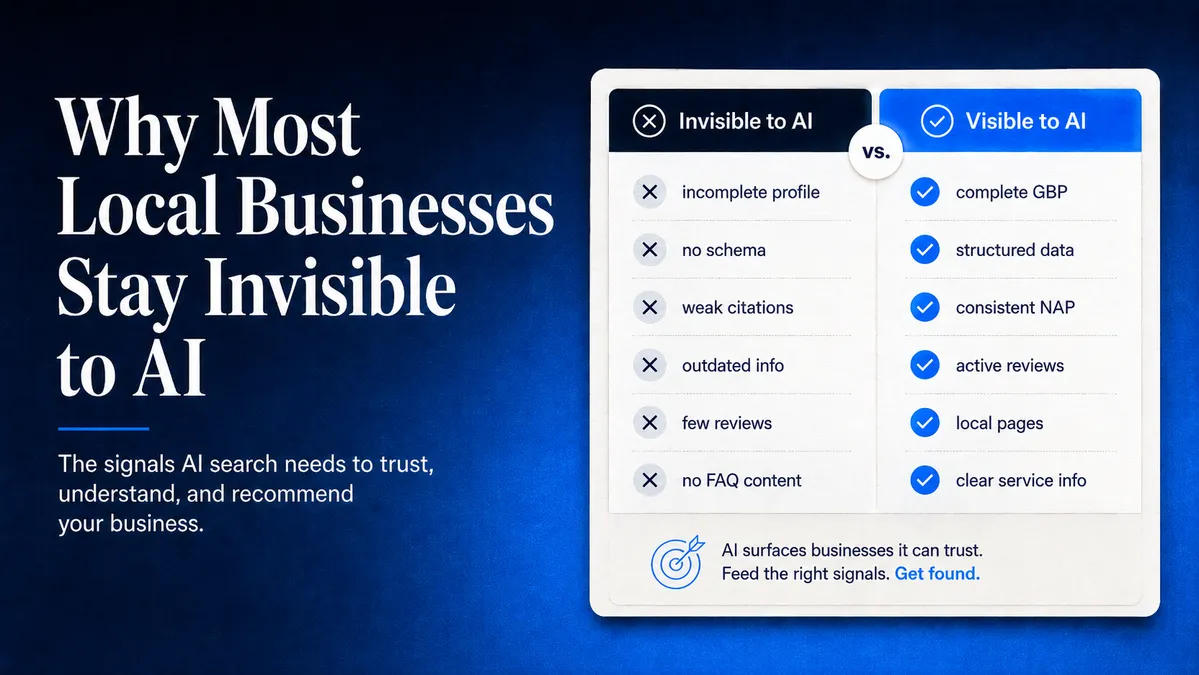
Most local businesses remain invisible to AI search for one precise reason: AI systems like ChatGPT and Google's AI Overviews pull from structured, crawlable data, and the majority of small businesses simply don't provide it. A 2023 BrightLocal study found that 56% of local businesses haven't claimed or optimized their Google Business Profile, which is one of the primary signals AI tools reference when surfacing local results.
Beyond that, missing schema markup means search engines cannot interpret a business's location, hours, or services with confidence. Without structured data embedded in their website, local businesses essentially become unreadable to the machine-learning models that generate AI Overviews, leaving them buried regardless of how strong their actual reputation is.
The Core Reason AI Cannot Recommend What It Cannot Understand
AI systems like ChatGPT and Google's AI Overviews pull recommendations from structured, crawlable data. When a business lacks schema markup, clear structured data, or a fully optimized Google Business Profile, AI tools simply cannot parse what that business does, where it operates, or who it serves.
A 2023 BrightLocal study found that 56% of local businesses have incomplete online profiles, making them effectively invisible to AI-driven local search.
Common Gaps That Keep Local Businesses Out of AI Results
Missing or incomplete schema markup is one of the most consistent reasons local businesses get skipped by AI systems. Without structured data, search engines cannot clearly interpret what a business offers, where it operates, or who it serves. Google's own documentation confirms that schema markup helps its systems understand page context more precisely.
Beyond that, incomplete google business profiles, missing alt text on images, and no FAQ-style content leave AI overviews with nothing structured to pull from when generating local results.
If you want to know how to close those gaps, read about how to rank your website without an agency.
How Google AI Overviews Work Differently from ChatGPT Recommendations
Google AI Overviews pull directly from indexed web content, prioritizing pages that use structured data and clear topical authority, while ChatGPT recommendations rely on training data rather than live google search indexing. This distinction matters deeply for local businesses because AI Overviews can surface your content in real time when someone searches a local query, whereas ChatGPT draws from patterns baked in before its knowledge cutoff.
Google's own documentation confirms that AI overviews favor sources with strong E-E-A-T signals, meaning:
- Pages with schema markup
- Verified google business profile data
- High authority backlinks
- Consistent NAP (name, address, phone) citations
The Role of Real-Time Indexing in Google AI Overviews
Unlike ChatGPT, which relies on training data with a knowledge cutoff, Google AI Overviews pull from real-time indexing, meaning your content can appear in an AI summary within hours of being published. Google's crawling infrastructure processes billions of pages daily, so freshness directly influences which local businesses surface in AI-generated responses.
Keeping your Google Business Profile updated and publishing timely blog posts signals relevance to this live system.
How ChatGPT Pulls Business Information from Aggregated Data
ChatGPT builds its business knowledge by pulling from aggregated sources like Yelp, TripAdvisor, industry directories, and publicly indexed websites rather than live search engines. Unlike Google AI Overviews, which cite real-time indexed pages, ChatGPT's training data has a knowledge cutoff, meaning outdated or inconsistent listings across platforms directly hurt how a business appears in responses.
Structured data embedded in a website's code helps reinforce accurate details, since ChatGPT weighs machine-readable signals when synthesizing information about local businesses from multiple sources.
Google Business Profile: The Most Important Entity Signal for Local AI Visibility
Your Google Business Profile (GBP) is the single most critical entity signal that AI systems like ChatGPT and Google AI Overviews use to verify a local business exists. Google's own documentation confirms that GBP data directly feeds into local search results, including AI-generated responses. Specifically, your business name, category, address, phone number, and hours form a structured data footprint that AI systems cross-reference when surfacing local recommendations.
Businesses with fully completed profiles, meaning 100% profile completion, receive 7x more clicks than incomplete ones, according to Google. For local businesses, this means every attribute field matters, particularly your primary category selection, which carries more algorithmic weight than secondary categories.
The Non-Negotiable Elements of a Fully Optimized Google Business Profile
A fully optimized Google Business Profile requires accurate NAP data (name, address, phone number), a keyword-rich business description, and correctly selected primary and secondary categories. Google's own documentation confirms that category selection directly influences local search ranking, with primary category carrying the most weight.
Beyond categories, uploading geotagged photos regularly, maintaining updated business hours, and enabling messaging features signal to AI systems that your profile is actively managed, which strengthens your local AI visibility.
How Consistent Business Categories and Attributes Influence AI Recommendations
Selecting the right primary and secondary categories on your google business profile directly shapes how AI systems interpret and recommend your business. Mismatched or vague categories reduce recommendation accuracy. Attributes like "women-owned," "outdoor seating," or "wheelchair accessible" add critical qualifying signals.
Studies show profiles with complete attributes receive 29% more clicks, making attribute consistency a measurable ranking factor in ai overviews.
Why Regular Posts and Photo Updates Are Non-Negotiable Activity Signals
Google Business Profile posts and photo updates directly influence how AI systems evaluate your business's relevance and activity. Profiles that post weekly receive 5x more views than inactive ones, according to Google's own data. The signals AI tools read include:
- Recency of posts
- Photo upload frequency
- Engagement patterns over time
Local businesses that update photos monthly see measurably stronger visibility in local search, as fresh visual content confirms operational activity to search engines.
NAP Consistency: Why AI Cross-References Your Business Across Dozens of Platforms
AI systems like ChatGPT and Google's AI Overviews don't just pull from one source; they cross-reference your business name, address, and phone number across dozens of platforms simultaneously. When that data conflicts, even by something as minor as "St." versus "Street," AI systems flag your business as unreliable.
Research from BrightLocal found that 80% of consumers lose trust in local businesses when they spot inconsistent listings. For local businesses, this means your Google Business Profile, Yelp page, Apple Maps listing, and data aggregators like Factual and Foursquare must carry identical NAP data, because AI mode tools actively reconcile these sources before surfacing any recommendation.
How Inconsistent Name, Address, and Phone Data Undermines AI Trust
When AI systems like ChatGPT or Google's AI Overviews cross-reference your business data, a single mismatch between platforms signals unreliability. Research shows businesses with inconsistent NAP data rank 41% lower in local search results. For example, listing "Ave." on your Google Business Profile but "Avenue" on Yelp creates conflicting structured data that AI tools flag as untrustworthy.
The Citation Audit Process Every Local Business Should Run Regularly
Running a citation audit quarterly catches the inconsistencies that silently tank your local search visibility. Tools like Moz Local and BrightLocal scan 70-plus directories simultaneously, flagging mismatched addresses or phone numbers across platforms. Since AI systems cross-reference these sources when surfacing businesses, even a suite number formatted differently on Yelp versus your Google Business Profile can reduce your chances of appearing in AI-generated results.
Reviews: The Multiplier Most Local Businesses Are Under-Investing In
Reviews are one of the most under leveraged signals in local search, with studies showing that businesses with 50 or more reviews earn 4.6% more revenue than those with fewer. Beyond google rankings, AI systems like ChatGPT pull structured sentiment data from review platforms to determine which local businesses appear in AI overviews.
Specifically, reviews mentioning your service type, city, and outcome carry the most weight. A plumber in Austin with 80 reviews citing "fast water heater repair" will surface in AI-generated results far more reliably than a competitor with 20 vague reviews, making consistent review requests a non-negotiable growth lever.
Why Review Volume, Freshness, and Specificity All Matter to AI Systems
AI systems evaluate reviews across three distinct signals: volume, freshness, and specificity. A business with 200 reviews outperforms one with 50, but recency matters just as much, since AI overviews weight recent activity heavily. Specificity is where local businesses consistently fall short. Generic praise like "great service" carries little weight, while reviews mentioning:
- Specific services performed
- Locations or neighborhoods served
- Concrete outcomes or results
These give AI systems structured, contextual data to surface your business confidently.
What AI Actually Reads and Extracts from Customer Reviews
AI systems don't just scan star ratings; they extract specific language patterns, service mentions, and sentiment clusters from review text. When a reviewer writes "they fixed my AC unit same-day in August," that phrase signals service type, speed, and seasonal relevance simultaneously. For local businesses, this specificity is what gets surfaced in AI overviews.
Reviews mentioning clear outcomes, named services, and real people experiences carry significantly more extractable signal than vague praise like "great service."
Where to Focus Your Review-Building Investment for Maximum AI Impact
Google Business Profile reviews carry the most weight for local search visibility, particularly within AI Overviews, which actively pull star ratings and review text as credibility signals. Businesses averaging 4.5 stars with over 200 reviews consistently appear in AI-generated local recommendations.
Beyond Google, Yelp and industry-specific platforms like Healthgrades or Avvo contribute structured sentiment data that AI systems cross-reference, making a multi-platform review strategy far more effective than concentrating solely on one source.
How to Ask Customers for Reviews Without Creating Compliance Risk
Under the FTC's guidelines on endorsements, businesses cannot offer incentives in exchange for reviews, as this constitutes a material connection that must be disclosed. Instead, asking happy customers at the right moment, like immediately after a positive service experience, yields authentic responses.
Timing your request within 24 hours increases response rates by up to 35%, keeping honest feedback natural and legally sound.
Local Citations and Directory Building for the AI Era
AI systems like ChatGPT and Google's AI Overviews pull local business data from structured, consistent sources across the web. Research shows that businesses with citations on 10+ authoritative directories are significantly more likely to appear in AI-generated local responses. Beyond your Google Business Profile, platforms like Yelp, Apple Maps, and industry-specific directories feed structured data directly into the models these AI tools reference.
Each citation must carry identical NAP (Name, Address, Phone) information, since even minor inconsistencies cause AI systems to deprioritize your business as an unreliable source. Local businesses targeting specific markets should treat directory accuracy as a technical requirement, not a marketing task, because AI overviews rely on data confidence scores when surfacing local recommendations.
The Citation Hierarchy That Carries the Most Weight for AI Visibility
Not all citations carry equal weight with AI systems. The hierarchy that matters most:
- Google Business Profile (highest trust signal)
- Data aggregators like Data Axle and Neustar
- Industry specific directories
- General directories like Yelp
Structured data markup on your website amplifies every tier above it.
Which Third-Party Platforms AI Tools Trust Most When Recommending Businesses
AI tools like ChatGPT and Google AI Overviews consistently pull business recommendations from a specific cluster of third-party platforms. Google Business Profile carries the most weight, as AI systems cross-reference it heavily during local search queries. Beyond that, Yelp, TripAdvisor, and the Better Business Bureau rank among the most cited sources.
Structured data from these platforms signals credibility, making consistent NAP (name, address, phone) information across all three a clear priority for local businesses.
FAQ Content That Matches Real Local Search Queries
The Query Patterns Local Customers Use That AI Is Trained to Recognize
Local customers often search using conversational, intent-driven phrases like "best plumber near me open now" or "most trusted dentist in my area." AI systems are trained to recognize proximity signals, service specificity, and urgency qualifiers. Natural language queries containing "near me," "open now," or "best rated" trigger location-based AI responses, making these patterns critical for local business visibility optimization.
The Most Important FAQ Categories Every Local Business Should Cover
Local businesses should prioritize FAQs covering services offered, pricing, hours, location, and accepted payment methods. Questions about appointment booking, service areas, and response times also matter. Reviews and guarantees are equally important, as roughly 93% of consumers read online reviews before visiting a business.
Addressing these categories builds trust and improves visibility in AI-generated search results.
Using Question-Based Headings to Align with Natural Language Search
Question-based headings mirror how users naturally phrase searches, which aligns with how AI systems like ChatGPT process queries. Using phrases like "how," "what," and "where" in your headings improves content relevance for conversational search. Google notes that natural language queries have grown significantly, making this structure essential for appearing in AI-generated overviews and local search results.
Why Local Businesses Use Explofi to Execute Everything You Just Read
Understanding AI search visibility is one thing. Actually executing it is where most local businesses fall behind.
You now know that AI systems pull from structured content, optimized service pages, consistent citations, and localized FAQ content. You know that showing up in ChatGPT and Google AI Overviews requires more than a website. It requires a steady flow of structured, location-specific content that AI tools can read, trust, and recommend.
That is exactly what Explofi is built to help you do.
Explofi is an AI SEO execution platform built for small businesses. Instead of figuring out what to create and how to structure it, Explofi uses your business type, location, and competitor data to help you build the content that gets you found in both Google and AI search.
With Explofi you can create localized service pages and blog content built around the exact queries your customers are searching. You can build topical maps that show you what content to produce next. You can refresh older pages so they stay competitive. You can internally link your content so search engines and AI systems understand your site structure. And you can track your local keyword rankings by city so you know whether any of it is working.
Most small businesses know they need to show up in AI search. Very few have a system to actually make it happen.
Explofi is that system.
Start free and see what your competitors are ranking for that you are not.