Deep Dive with AI
What Is Search Engine Optimization (SEO)?
Search engine optimization is the practice of improving a website's visibility in search engines like Google, where 93% of all online experiences begin, according to Search Engine Journal. SEO techniques include building backlinks, optimizing meta descriptions, and targeting keyword rankings to push pages higher in results.
Organic traffic driven by these traditional SEO metrics remains the core measure of success.
How Traditional Search Engines Crawl and Index Content
Bots like Googlebot crawl billions of pages daily, following internal linking structures to discover indexed content. Once found, pages enter Google's index, where algorithms assess content quality, backlinks, and structured content to determine visibility and organic traffic potential through ranked links.
Core Components of an SEO Strategy
Keyword research, on-page optimization, technical SEO, and link building form the backbone of any effective strategy. On-page factors alone account for roughly 40% of ranking signals, according to Moz. Quality content paired with structured data helps pages achieve featured snippets, directly improving organic traffic and overall site presence.
How Search Engine Results Pages (SERPs) Work
SERPs display ranked web pages based on Google's algorithm, which evaluates over 200 ranking factors. Organic results appear below paid ads, with the top three positions capturing roughly 54.4% of all clicks, according to Backlinko, making higher rank placements critical for driving organic traffic.
What Is Generative Engine Optimization (GEO)?
Generative engine optimization is the practice of structuring content so generative engines like Google AI Overviews cite it within AI-generated responses. Unlike traditional ranking, GEO targets visibility inside generated answers rather than blue-link positions. Key structural signals GEO rewards include:
- Authoritative content backed by data
- Direct answers to specific questions
- Structured FAQ sections
How AI-Powered Search Engines Generate Answers
AI-powered search engines like ChatGPT, Perplexity, and Google's AI Overviews rely on large language model architecture to synthesize generated answers from vast training data rather than returning a list of links. When a user asks a question, the AI engine scans indexed content, identifies trusted sources, and constructs direct answers in natural language.
Perplexity, for instance, processes conversational prompts by pulling cited passages in real time.
Key Platforms That Use Generative AI Search
ChatGPT, Google's AI Overviews, and Microsoft's Copilot are the dominant platforms driving generative AI search. Google's AI Overviews alone appear in roughly 47% of searches, pulling generated responses directly from indexed content rather than routing users through traditional organic traffic pathways.
Why GEO Is Becoming a Critical Digital Marketing Strategy
AI-generated answers now appear in roughly 19% of all Google searches, according to BrightEdge research, pulling users away from traditional organic traffic. As AI systems deliver direct answers without requiring a click, brands not optimized for generative engine optimization lose visibility before a user ever reaches their site.
How Do Web Crawlers and AI Crawlers Differ From Each Other?
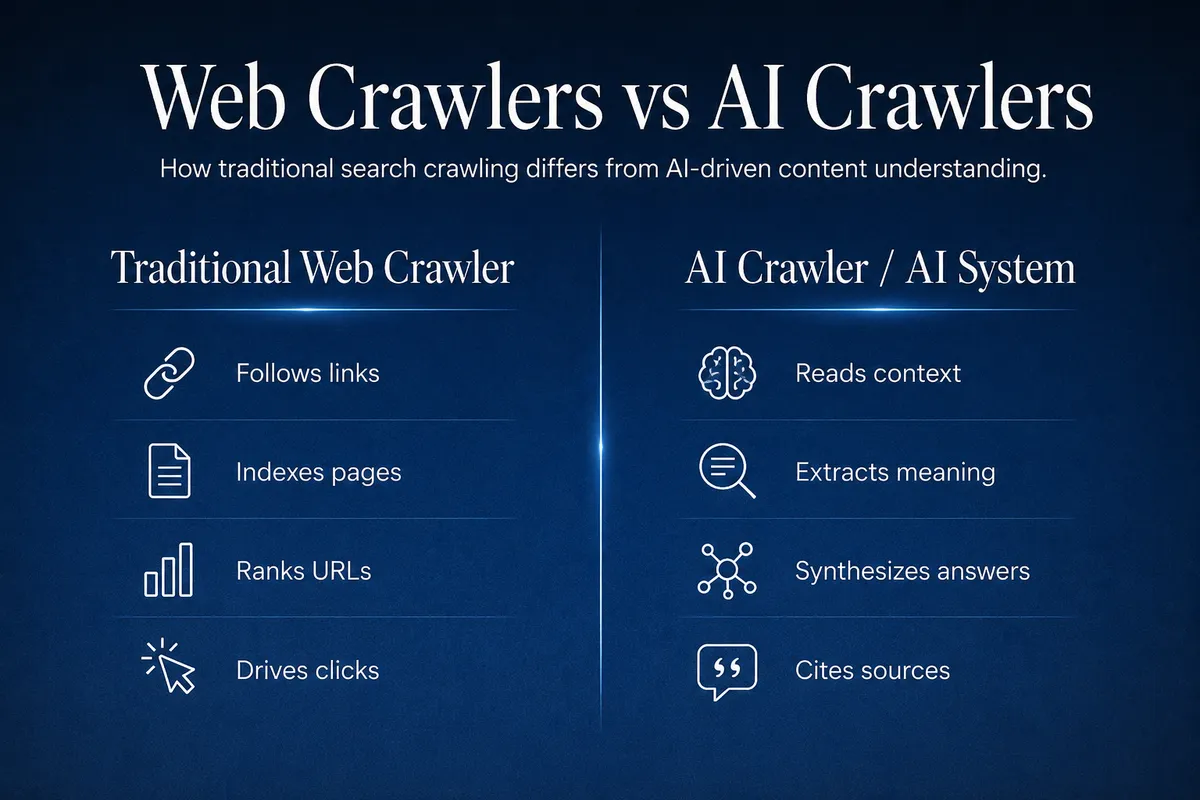
Web crawlers index pages for ranked results, while AI crawlers extract content to generate direct answers. Traditional crawlers follow links and store URLs, but AI systems like those powering ChatGPT process semantic meaning, pulling context to fuel generated responses. Notably, AI crawlers prioritize structured, citable content, which is why generative engine optimization focuses on clarity and authority rather than keyword density alone.
How Traditional Web Crawlers Index Pages
Traditional web crawlers follow a systematic process to discover and index pages across the internet. Search engines like Google deploy bots that:
- Follow hyperlinks from page to page
- Read HTML, metadata, and structured data
- Store content in massive indexes for retrieval
This process prioritizes organic traffic signals like backlinks and keyword relevance to determine content rank.
How AI Crawlers Process and Extract Information
AI crawlers go beyond indexing links, they semantically parse content to generate direct answers. Using large language models, these systems extract contextual meaning from text, prioritizing well-structured, authoritative sources. Unlike traditional crawlers, AI systems synthesize multiple sources simultaneously to produce generated responses with cited references.
Why the Distinction Matters for Your Optimization Strategy
Treating web crawlers and AI crawlers as interchangeable is a costly mistake that directly impacts your visibility across both search and generative platforms. Web crawlers index pages for ranked results where users still click through, meaning organic traffic and bounce rate remain your core success metrics.
AI crawlers, by contrast, extract content to fuel generated answers, so the relevant measure shifts to how often AI systems cite sources like yours within their ai summaries.
GEO vs. SEO: Core Similarities Between Both Strategies
Both GEO and SEO share a foundation in high-quality, authoritative content. Structured formatting, like bullet points and clear headings, benefits both strategies, as AI systems and search engines prioritize well-organized information. Evergreen content also strengthens visibility across both, since fresh, accurate material drives organic traffic and citation frequency.
Shared Goal of Satisfying User Intent
Both GEO and SEO are built around one shared foundation: satisfying user intent. SEO structures content to match search queries, while GEO optimizes for generated responses that directly resolve what users need. Studies show 68% of online experiences begin with a search, making intent-driven optimization critical across both traditional and AI-powered channels.
Content Quality as a Non-Negotiable Factor
Both GEO and SEO treat content quality as foundational, not optional. Research from Search Engine Journal confirms that AI systems consistently surface content that demonstrates:
- Depth and specificity
- Authoritative sourcing
- Clear structural formatting
Thin or vague content loses visibility across both organic traffic rankings and generated responses from AI engines.
The Role of Structured Data in Both Approaches
When you add schema markup to your pages, you're feeding both search engines and AI systems the clearest possible signal about your content's meaning. Schema markup uses vocabulary from Schema.org, with over 800 defined types, to label entities, relationships, and facts precisely. That structured clarity is exactly what AI systems draw from when generating responses, making schema a shared foundation where GEO overlap with traditional SEO becomes most visible.
Ongoing Optimization and Iteration Are Required for Both
Both GEO and SEO demand continuous refinement rather than one-time setup. SEO requires regular content updates as Google's algorithm shifts, while GEO needs ongoing structural adjustments to improve how AI systems surface generated responses. Tracking brand mentions and citation frequency helps measure whether your optimization efforts are actually gaining visibility over time.
GEO vs. SEO: Key Differences That Impact Your Digital Strategy
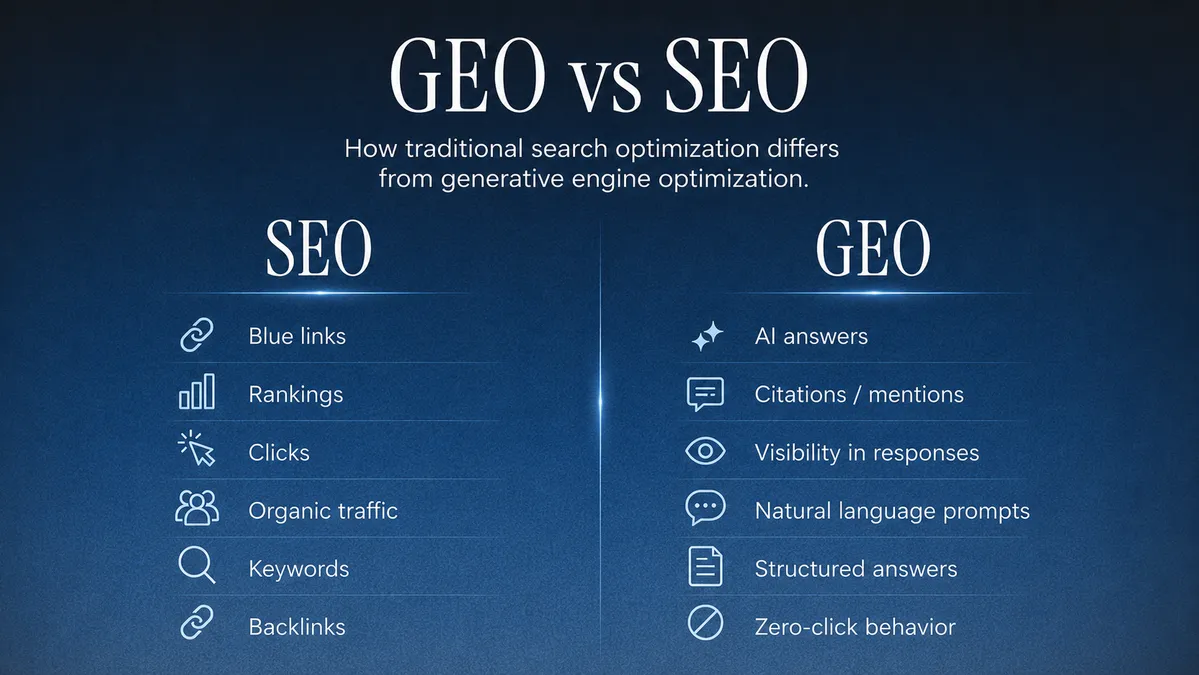
While SEO drives organic traffic through ranked links, generative engine optimization targets visibility within AI-generated responses, where no link click occurs. Studies show AI answers resolve queries directly 40% more often than traditional search, fundamentally shifting how generated responses deliver value to users.
Target Platforms and Search Environments
SEO targets traditional search engines like Google and Bing, where ranked web pages generate organic traffic through clicks. GEO, by contrast, targets AI systems like ChatGPT, Perplexity, and Google's AI Overviews, which deliver direct answers without redirecting users. These platforms differ fundamentally in how they surface and cite information.
Type of Results Delivered to the End User
SEO delivers ranked blue links requiring a click to reach content, while generative engine optimization provides direct answers synthesized into conversational responses. Users receive:
- SEO: A list of ranked URLs
- GEO: Fully generated answers with cited sources
This fundamental difference shapes how visibility is measured and pursued.
Context Focus and How Each Interprets Queries
SEO interprets queries by matching keywords to indexed pages, prioritizing relevance signals like backlinks and on-page optimization. GEO, by contrast, focuses on contextual understanding, where generative AI tools synthesize intent, pulling from structured data to deliver direct answers rather than a list of links.
This shift means geo content must reflect conversational depth, since AI systems weigh context density over keyword frequency when generating responses.
Content Formats Favored by Each Approach
SEO thrives on long-form blog posts, pillar pages, and keyword-rich articles designed to rank on search engine results pages. Generative engine optimization, by contrast, favors structured data, concise factual summaries, and authoritative sources that ai systems can pull into direct answers, making structured content formats like FAQs and definition-based copy far more effective.
Indexing and Ranking Factors Compared
Search engines like Google index pages by crawling links and evaluating hundreds of ranking signals, including backlinks, page speed, and keyword relevance. AI systems, by contrast, don't index in the traditional sense; they pull from pre-trained data and retrieval-augmented sources, ranking content by how well it answers queries directly.
Generative engine optimization prioritizes structured, citation-worthy content, while SEO rewards domain authority, with Google weighing over 200 confirmed ranking factors.
Visibility vs. Authority: How GEO and SEO Define Success Differently
SEO defines success through rankings and organic traffic, measuring how well a page climbs Google's index to earn clicks. GEO, or generative engine optimization, defines success entirely differently, measuring how often your brand appears within AI-generated answers rather than how high it ranks. According to a 2024 study from Princeton, Georgia Tech, and Allen AI, GEO-optimized content saw up to a 40% increase in citation frequency within AI-generated responses.
Where SEO builds authority through backlinks and domain metrics, GEO builds visibility through source credibility that AI systems recognize when constructing direct answers. Tracking brand mentions inside generated outputs becomes the core performance metric, replacing the click-through rates that have long defined traditional SEO success.
Input Signals: Keywords vs. Natural Language Prompts
SEO relies on keyword density and placement, where Google's algorithm scans for exact or near-exact match terms. Generative engine optimization works differently, as AI systems process full conversational queries like "what software tracks invoices automatically." This shift changes how you structure content:
- SEO targets indexed keywords
- GEO targets intentdriven natural language patterns that AI models interpret contextually
How Traditional SEO Relies on Keyword Matching
Traditional SEO operates on exact and phrase-match logic, where Google's algorithm cross-references query terms against indexed page content. Studies show keyword placement in title tags can boost organic traffic by up to 20%. Visibility depends heavily on matching search intent through specific, strategically placed terms.
How GEO Interprets Conversational and Intent-Driven Prompts
GEO interprets prompts by analyzing conversational intent rather than isolated keywords, pulling context from the full structure of a question. When a user asks, "What's the best way to reduce taxable income as a freelancer?" an AI engine doesn't scan for "reduce taxable income," it maps the intent behind the query.
Generative engine optimization targets this layer, structuring content to match how AI systems synthesize direct answers, which directly shapes your content's visibility in generated answers.
What Are Query Fan-Outs and Why Do They Matter for GEO?
When an AI engine receives a natural language prompt, it doesn't process one query; it fans out into dozens of related sub-queries simultaneously. This multi-path retrieval directly shapes which sources get cited in generated answers, making visibility across semantically varied phrasings essential for generative engine optimization.
Ranking Logic: SERPs vs. Generative AI Answers
SERPs rank pages through backlinks, authority scores, and keyword density, while generative AI answers pull from semantic relevance and source credibility. Unlike traditional search, AI systems don't serve ranked blue links; they synthesize direct answers from trusted content. Studies show AI-generated responses cite sources with high topical depth, meaning generative engine optimization targets comprehensiveness over keyword matching, which fundamentally changes how visibility is measured and pursued.
How Search Engines Rank Pages Through Algorithms
Google's algorithm evaluates pages using over 200 ranking factors, prioritizing expertise, authoritativeness, and trustworthiness (E-E-A-T). Key signals include:
- Backlink quality
- Page speed
- Keyword relevance
- User engagement metrics like clickthrough rates
These factors collectively determine organic traffic distribution across search results.
How Large Language Models Select and Surface Content
LLMs surface content by scanning pre-trained datasets and real-time retrieval indexes, prioritizing sources with high citation frequency, semantic authority, and structured clarity. Generated answers favor content that directly answers a query without requiring a click, meaning visibility depends on how clearly your content is framed as a definitive, citable source across AI systems.
Links vs. Mentions as Fundamental Output Differences
Backlinks drive SEO rankings, while generative engine optimization relies on brand mentions and citations within generated answers. AI systems don't link out the same way search engines do, making visibility dependent on how frequently sources get referenced, which you can track citation frequency to measure GEO efforts effectively.
Click-Through Journey vs. Zero-Click Answers
Unlike SEO's click-through journey, where users browse ranked pages, generative engine optimization targets zero-click answers delivered directly in AI-generated responses. Studies show nearly 60% of Google searches now end without a single click. This shift means organic traffic patterns are fundamentally changing, as AI systems surface direct answers that satisfy user intent before any webpage visit occurs.
The Rise of Zero-Click Searches and Its Impact on Traffic
Zero-click searches now account for nearly 65% of all Google searches, according to a 2024 Semrush study, meaning organic traffic never reaches a website. As AI-generated answers surface directly on search results pages, users get direct answers without ever clicking through. This shift fundamentally changes how visibility is measured, since ranking on page one no longer guarantees a visit, forcing marketers to rethink what "winning" a search result actually means.
How AI Answers Change the Traditional Search Funnel
AI-generated answers are collapsing the traditional search funnel by resolving queries at the top, bypassing click-through entirely. Studies show nearly 60% of searches now end without a click, directly reducing organic traffic.
Conclusion
Traditional search is slowly being replaced by AI-generated answers. The way to combat this is by implementing SEO strategies that favor answers that will be cited by chatbots.
Use Explofi in order to close that gap with industry trusted tools.