Deep Dive with AI
Defining a Topical Map in the Context of Local SEO
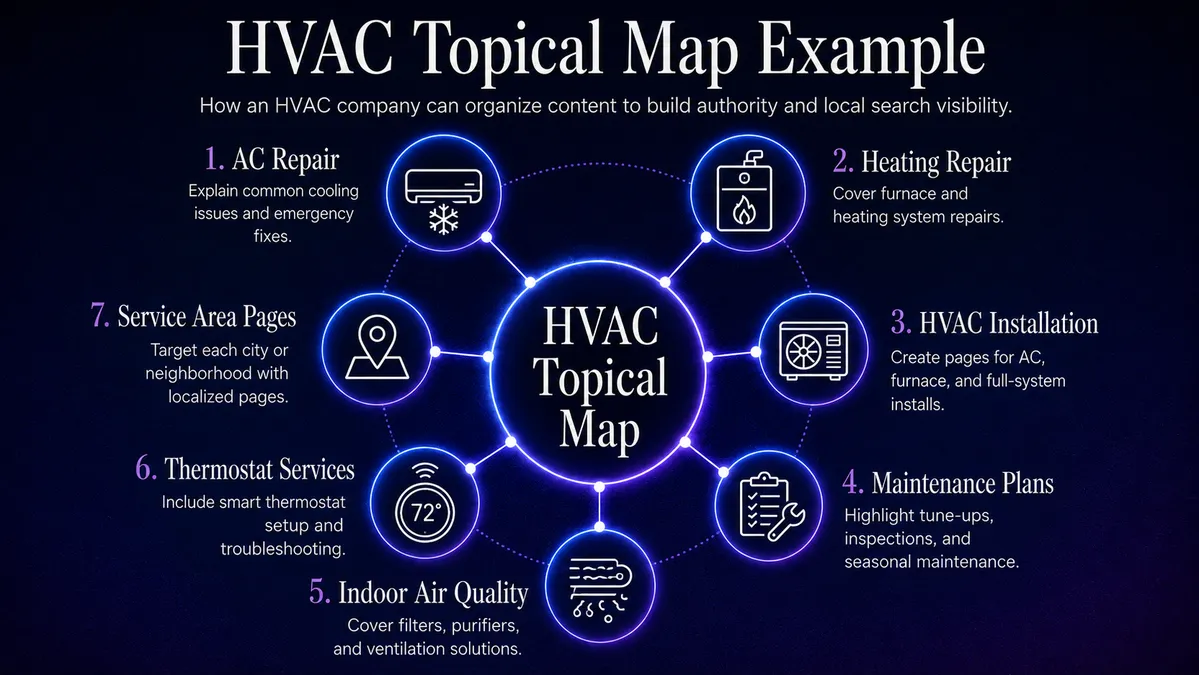
A topical map organizes your website's content into a structured web of interconnected pages, each reinforcing a central subject with supporting content built around it. For local SEO specifically, this means grouping pages by geographic relevance and specific services so search engines can clearly interpret what your business covers and where.
Websites with a clear content hierarchy see up to 30% more organic traffic than those without one. The internal linking structure within a topical map signals to Google that your site holds depth on a subject, which directly strengthens topical authority. Rather than scattered blog posts, a complete topical map creates a clear hierarchy that connects your core topic to every relevant piece of supporting content beneath it.
The Core Concept of Topical Relevance in Search
Topical relevance measures how thoroughly a website covers a specific subject rather than just targeting isolated keywords. Google's algorithms evaluate content depth across an entire domain, rewarding sites that demonstrate expertise through comprehensive coverage. Research shows that topically authoritative sites rank 30% higher on average than those optimizing for search intent alone.
How Search Engines Use Topic Relationships to Rank Content
Search engines analyze topic relationships through a process called semantic indexing, where algorithms map how closely connected pieces of content are to a core topic. Google's systems reward sites demonstrating topical authority by ranking them higher, as interconnected internal links signal comprehensive coverage, making your content a trusted resource for both crawlers and potential customers.
The Difference Between a Topical Map and a Traditional Keyword List
A traditional keyword list groups terms purely by search volume and keyword difficulty, with no regard for how topics connect. A topical map, by contrast, organizes content around a core topic with supporting subtopics, signaling search intent and helping search engines understand your site's full subject matter expertise.
The Strategic Advantages of Topical Maps for Local Businesses
Implementing topical maps gives local businesses a measurable competitive edge, particularly since 46% of all Google searches carry local intent. Rather than creating isolated content pieces, a topical map lets you build topic clusters that signal comprehensive expertise to search engines. This approach directly builds topical authority, which Google's algorithms weigh heavily when ranking local results.
The strategic advantages include:
- Eliminating keyword cannibalization across locationbased pages
- Strengthening internal links between related service content
- Aligning every content piece with precise search intent
- Targeting low competition queries competitors overlook
Organizing content this way creates a clear structure that search engines love, making each page reinforce the next with purposeful anchor text and relevant content throughout.
Establishing Topical Authority in Your Local Market
Covering every angle of your service through interconnected content signals topical authority to search engines. For local searches, this matters significantly, as Google's algorithms reward businesses that consistently create content addressing specific keywords tied to a geographic area, pushing them above competitors in local rankings.
How Topical Maps Support Semantic Search and Modern Algorithms
Semantic search prioritizes context over exact keywords, with Google's BERT and MUM algorithms processing over 3 billion daily searches by understanding relationships between topics. An effective topical map mirrors this structure, organizing content around a core topic so algorithms recognize genuine topical authority within your niche.
Improving Content Visibility Across Local Search Queries
Topical maps improve local search visibility by organizing content around search intent, helping Google match your pages to hyper-specific queries. Businesses using structured content strategies see up to 55% more organic traffic. By aligning your topical authority with local search queries, your content surfaces across a wider range of relevant results.
Strengthening Internal Link Structures for Better Crawlability
Topical maps create a logical internal link structure, connecting related pages so Google's crawlers can efficiently index your site. Studies show that well-linked sites get crawled up to 30% more thoroughly, directly strengthening your topical authority and core topic relevance signals.
The Architecture Behind an Effective Local Business Topical Map
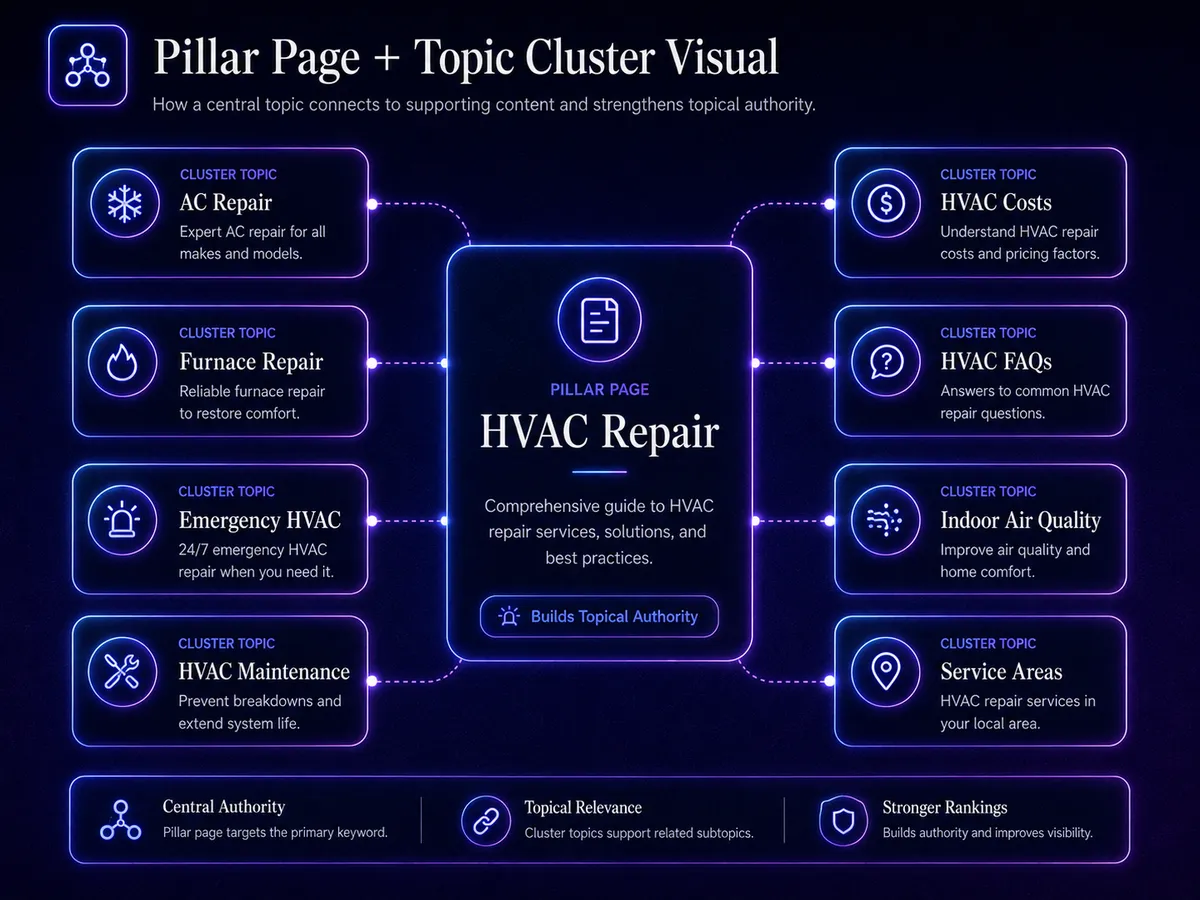
A well-structured local business topical map follows a deliberate hierarchy that organizes content from broad to specific. The core topic sits at the top, such as "plumbing services," branching into subtopics like emergency repairs, pipe installations, and water heater services. Each subtopic then feeds into supporting content clusters.
Internal links connect these clusters, which Semrush research shows can increase crawl efficiency by up to 40%. Topical authority is built layer by layer through this structure, with Google's own documentation confirming that content depth signals expertise to ranking algorithms. A strong strategic blueprint includes:
- Pillar pages targeting highvolume primary topics
- Cluster pages addressing specific service questions
- Locationbased pages tying services to geographic relevance
- Supporting FAQ content resolving hyperspecific search intent
The Core Section: High-Intent Service and Product Pages
Service and product pages sit at the core of any topical map because they directly match search intent with buyer-ready queries. These pages target high-intent keywords averaging 1,000 to 10,000 monthly searches, where conversion rates run 2-5x higher than informational content. Strong internal links from supporting blog posts funnel that traffic directly into these revenue-generating pages.
The Outer Section: Supporting Blog and Resource Content
Supporting blog and resource content sits in the outer layer of a topical map, branching from core topic pages to address specific questions with lower keyword volume. These posts target long-tail secondary keywords, capturing niche search intent that pillar pages overlook. Internal links connect this content back to main topics, strengthening topical authority while signaling content relevance to search engines.
How Core and Outer Sections Work Together to Build Authority
Internal links connecting core topics to outer supporting pages signal to Google that your content ecosystem is cohesive and authoritative. Studies show that sites with strong internal linking structures see up to 40% better crawl coverage. Each outer page reinforces the core topic, passing link equity inward while topical authority compounds across the entire map over time.
How a Topical Map Differs From a Content Calendar
A content calendar tells you when to publish, while a topical map tells you what to publish and why it matters structurally. A content calendar is purely a scheduling tool, organizing publishing dates and deadlines across channels like social media or email marketing. A topical map, by contrast, is a living document that maps every piece of content to a specific search intent, ensuring each article strengthens your topical authority.
Research shows that websites covering topics comprehensively rank 78% more often than those publishing randomly scheduled content. Rather than chasing publishing frequency, a topical map prioritizes internal links between related pages, building a solid foundation that signals subject expertise to Google's algorithms as they evolve.
Why a Content Calendar Alone Is Not Enough for Local SEO
A content calendar schedules when to publish, but never maps why topics connect. Without topical authority, Google struggles to classify your business as relevant locally. Studies show structured topic clusters improve organic rankings by 30%, something a calendar's linear scheduling cannot achieve through isolated content creation alone.
- No search intent alignment
- Missing internal links between related topics
- Zero competitor analysis integration
Using Both Tools Together for Maximum Impact
A topical map structures what to cover, while a content calendar schedules when to publish it. Pairing both builds topical authority systematically, ensuring internal links connect related content published across weeks, reinforcing search intent signals Google's algorithms reward.
Types of Topical Maps Local Businesses Can Use
Local businesses can build topical maps in several distinct formats depending on their content goals. A pillar-cluster model organizes content around one primary keyword, with supporting cluster pages linking back through internal links to establish authority. A service-area map structures content around specific geographic locations, helping businesses cover neighborhood-level search intent.
For example, a plumber might create pages targeting individual ZIP codes within a city. A FAQ-based topic map addresses user behavior by answering hyper-specific questions tied to a core service. According to Semrush, websites with structured topical coverage see up to 30% stronger rankings, making the format you choose critical to long-term SEO success.
Service-Based Topical Maps for Contractors and Professionals
Contractors structuring content around specific services see measurable ranking gains, with studies showing topical authority improves organic traffic by up to 30%. A plumber, for instance, can cover drain repair, pipe installation, and water heater services as individual content clusters, each strengthening internal links across the site.
Product-Based Topical Maps for Local Retailers and Shops
For local retailers, a product-based topical map organizes content around specific inventory categories to build topical authority with search engines. A hardware store, for example, can map content across tools, fasteners, and lumber, with internal links connecting each subcategory. This structure directly aligns with search intent, since shoppers search by product type.
Google rewards this depth, as stores covering product topics thoroughly see stronger organic visibility.
Hybrid Topical Maps for Businesses With Multiple Offerings
Hybrid topical maps blend service-based and location-based content clusters, giving businesses with multiple offerings a structured way to build topical authority across every category. Effective structures include:
- Separate clusters per service
- Geotargeted supporting pages
- Crosslinked internal links
Step-by-Step Guide to Building a Topical Map for Your Local Business
Building a topical map starts with identifying your primary subject, which is the core service or product your local business offers. From there, you branch out into subtopics that answer every question a potential customer might have. Research using Google Trends to validate which subtopics have real search demand in your area.
Once your subtopics are mapped, write content that targets specific search intent, whether informational, navigational, or transactional. A well-structured topical map also depends on strong internal links connecting each piece, which Google's own documentation confirms helps crawlers understand content hierarchy.
This interconnected structure builds topical authority, signaling to search engines that your site comprehensively covers a subject rather than touching it surface-level.
Step 1: Identify Your Business's Core Topic and Niche
Your business's core topic is the single subject your entire content strategy revolves around, such as "plumbing services" or "family dentistry." Pinpointing this niche builds topical authority, signaling to search algorithms that your small business owns a specific subject area.
Step 2: Research Subtopics and Related Search Queries
Keyword research tools like Ahrefs and SEMrush help uncover subtopics tied to specific search intent, revealing what potential customers actually search for. For example, a local plumber might discover that "emergency pipe repair" generates 1,200 monthly searches alongside related queries like "burst pipe cost."
Mapping these subtopics builds topical authority by showing search algorithms your content covers a subject comprehensively.
Step 3: Assess Each Subtopic's Business Value and Traffic Potential
Scoring subtopics by business value and traffic potential prevents wasted content efforts. A subtopic earns high business value when it directly connects to a service you sell, while traffic potential reflects monthly search volume data from tools like Ahrefs or Semrush. Prioritize subtopics scoring well on both metrics, as they strengthen your topical authority and attract converting visitors.
Step 4: Define Pillar Pages and Topic Clusters
Pillar pages serve as the foundation of your topical map, covering broad topics like "Plumbing Services in Austin," while topic clusters branch into specific subtopics. Structuring your content this way builds topical authority by signaling expertise to search engines through internal links connecting related pages.
Each cluster should target a distinct search intent, whether informational, navigational, or transactional.
Step 5: Map Subtopics to Existing and New Website Pages
With your subtopics identified, assign each one to either an existing page or a new page to create. Audit your current site to avoid duplicate content, which Google penalizes through ranking drops. Each page should target one specific search intent, covering one subtopic thoroughly. Use internal links to connect related pages, as sites with strong internal linking structures see up to 40% better crawlability:
- Service pages
- Location pages
- Blog posts
- FAQ pages
Step 6: Build Out Internal Linking Between Related Content
Internal links connect related content across your site, reinforcing topical authority with search engines. Linking a "roof repair" page to a "roof inspection" guide, for example, signals content relationships, with studies showing strong internal linking improves crawl efficiency by up to 40%.
Step 7: Monitor Performance and Update Your Map Regularly
Performance metrics like organic traffic, keyword rankings, and click-through rates reveal gaps in your topical authority over time. As algorithms evolve, outdated content loses relevance, so quarterly audits keep your map aligned with shifting search intent and user experience expectations.
Frequently Asked Questions About Topical Maps for Local Businesses
How Many Topics Should a Local Business Topical Map Include?
A local business topical map should typically include 10 to 20 core topics, each supported by 3 to 5 subtopics. This structure ensures comprehensive coverage without overwhelming your content strategy. Covering too few topics risks leaving gaps in authority, while exceeding this range can dilute focus, making it harder for search engines to recognize your site's relevance to a specific niche.
How Long Does It Take to See Results From a Topical Map Strategy?
Results from a topical map strategy typically take 3 to 6 months to become measurable, though some sites report improvements in organic rankings within 8 to 12 weeks. Consistency matters, as Google's algorithms reward sustained content coverage over time. Highly competitive niches may require 12 months or more before significant traffic gains are visible.
Can a Small Local Business Build a Topical Map Without Paid Tools?
Yes, a small local business can build a topical map using free tools like Google Search Console, Google Trends, and keyword research from platforms with free tiers. Manually analyzing search intent and grouping related topics by theme is an effective no-cost approach. It requires more time than paid tools, but the strategic outcome can be equally valuable for local SEO growth.
What Is the Difference Between Topical Authority and Domain Authority?
Topical authority refers to how much expertise a website demonstrates on a specific subject through comprehensive, relevant content. Domain authority, a metric developed by Moz, scores a site's overall ranking strength on a scale of 1 to 100 based on backlinks. A site can have high domain authority but low topical authority if its content lacks depth and focus on a particular subject.
Do I Need to Hire an SEO Professional to Build a Topical Map?
Hiring an SEO professional isn't strictly necessary to build a topical map, but it can accelerate results. Many business owners successfully create topical maps using free tools like Google Search Console and keyword research platforms. However, if your niche is competitive or technical, professional expertise can help you structure content more strategically and avoid common pitfalls that dilute topical authority.