Deep Dive with AI
The Shift from Traditional Search to AI-Generated Answers
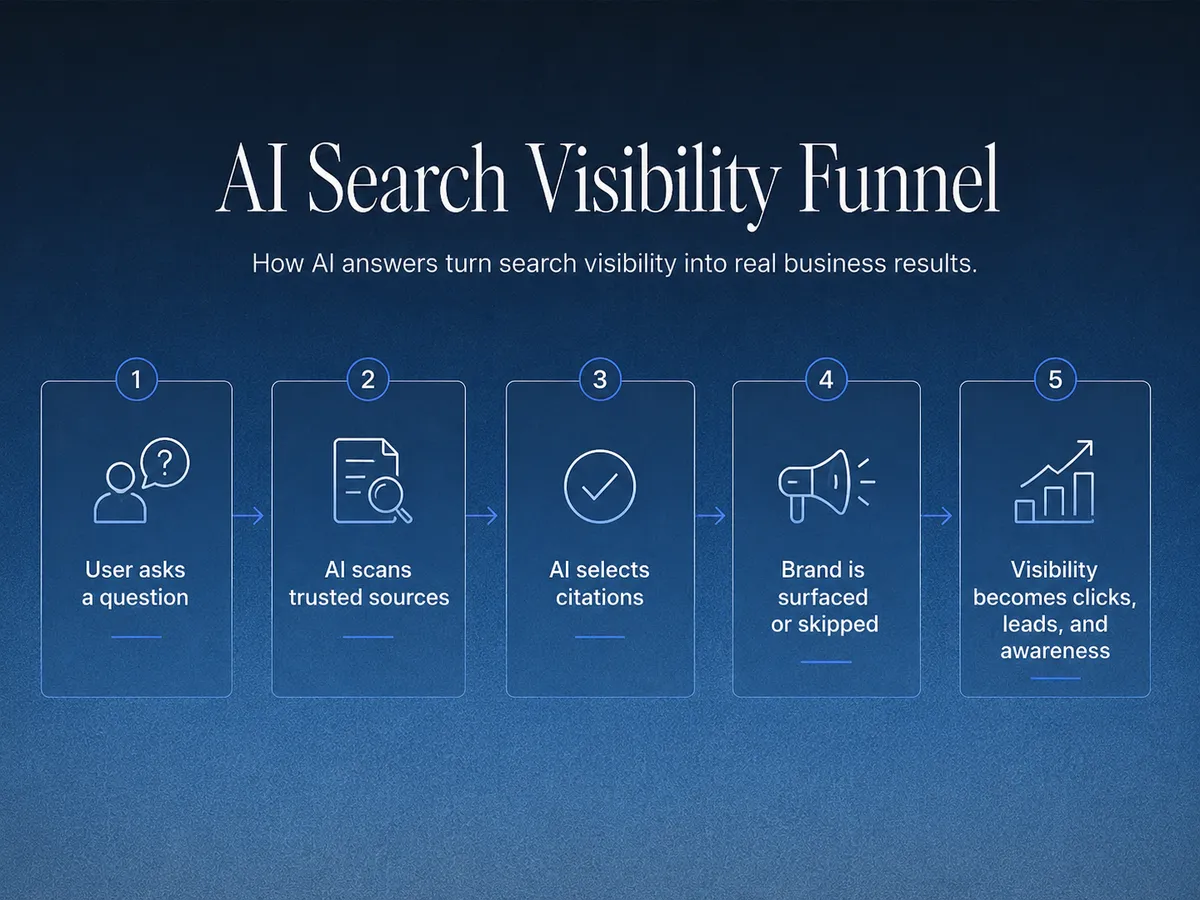
Traditional search once operated on a simple premise: a user asks a question, and a ranked list of blue links appears. That model is rapidly dissolving. Google's AI Overviews, which rolled out to over 1 billion users in 2024, now synthesize ai answers directly on the results page, bypassing organic traffic entirely.
Rather than users clicking through multiple sources, a single AI-generated response captures the query. Organic search no longer guarantees visibility, making ai citations within those generated responses the new competitive battleground.
If you are a small business and want to see the relevance of AI SEO, read this: AI SEO for Small Businesses: What it is and why it matters now.
How the "10 Blue Links" Model Has Changed
Traditional search once operated on a simple premise: crawl pages, index content, and return a list of ranked links. That model has fundamentally fractured. Google AI Overviews, which rolled out to all U.S. users in May 2024, now appears in roughly 47% of search results according to BrightEdge research, pulling synthesized answers directly from sources rather than directing users to organic traffic.
This shift means users interact with AI answers before ever seeing a traditional link.
The Rise of Zero-Click Search and What It Means for Brands
Zero-click searches now account for nearly 60% of all Google searches, according to a 2024 Semrush study, meaning users get answers without ever visiting a website. This directly threatens organic traffic and branded search volume, as AI answers surface brand mentions without generating a click. For marketing teams, this shift means traditional metrics like click-through rates no longer capture actual brand exposure.
When Google AI Overviews cite a source, that brand gains authority without a visit, making citation frequency a critical new performance indicator brands must actively monitor.
Why AI-Generated Answers Are Replacing Standard Search Results
AI answers now appear at the top of search results before any traditional links, fundamentally reshaping how users consume information. Google AI Overviews, for instance, synthesized responses for over 1 billion users within its first year. Because users get direct answers without clicking through, organic traffic to cited sources drops significantly, making ai search engines the primary gatekeeper of brand awareness and online visibility.
Defining AI Search Visibility
AI search visibility refers to how consistently and prominently your brand appears within ai answers generated by ai search engines like ChatGPT, Perplexity, and Google AI Overviews. Unlike traditional search, where rankings are tied to indexed pages, AI visibility measures whether AI models cite, reference, or surface your content when responding to user queries.
According to a 2024 Semrush study, 60% of Google searches now end without a click, pushing brands to compete for ai citations instead of organic traffic. The core factors that determine this visibility include:
- Source quality and domain authority
- Entity recognition across AI training data
- Citation rates within AI generated responses
- Topical coverage and query relevance
How AI Search Visibility Differs from Traditional SEO Visibility
Traditional SEO visibility centers on ranking positions and organic traffic tracked through Google Search Console and Google Analytics, where a page's success is measured by clicks. AI search visibility, by contrast, measures how often AI models cite your content in generated answers. A 2024 study found that Google AI Overviews drew from only 52% of top-ranking pages, meaning strong traditional SEO signals no longer guarantee AI citations, making generative engine optimization a distinct discipline entirely.
The Relationship Between AI Citations, Brand Mentions, and Organic Rankings
AI citations directly influence brand mentions, which in turn shape organic rankings through reinforced entity signals. When an AI platform cites a brand consistently across tracked queries, that repetition builds topical authority that traditional search algorithms recognize. Research shows that brands appearing in AI citations experience measurable lifts in direct traffic and organic traffic, as users encountering repeated AI mentions develop stronger brand recall, making citation quality a compounding ranking factor.
What AI Search Visibility Encompasses Across Platforms
AI search visibility spans multiple platforms, each processing and citing content differently. Google AI Overviews, which now appear in roughly 47% of searches, pull structured data and authoritative sources to generate direct answers. Platforms like Perplexity, ChatGPT Search, and Copilot follow distinct citation patterns, meaning strong visibility on one AI engine does not guarantee presence on another.
Query coverage varies significantly across these AI search engines, as some prioritize FAQ sections and comparison tables while others weight recency and domain authority. Understanding platform coverage gaps is critical because each model surfaces brands through different ranking signals than traditional search ever did.
Why AI Search Visibility Matters for Modern Brands
AI-powered search engines like ChatGPT, Perplexity, and Google AI Overviews now answer queries directly, bypassing traditional search results entirely. According to SparkToro, roughly 60% of Google searches already end without a click, and that figure grows as AI answers become more precise. For modern brands, organic traffic alone no longer signals discoverability.
What matters is whether AI models cite your brand as a credible source when users submit comparison queries or product-specific questions. A brand absent from AI answers loses purchase-stage visibility, not just awareness. Treating AI visibility as a core channel rather than an afterthought is what separates brands that capture AI-driven demand from those that remain invisible inside these rapidly expanding AI engines.
The Acceleration of Zero-Click Behavior and Its Business Impact
Zero-click searches now account for nearly 60% of all Google searches, according to SparkToro's 2023 data. Google AI Overviews surface direct answers before users ever reach a website, which quietly drains organic traffic from brands that lack a structured presence in AI answers. The business impact is measurable: brands not cited in AI engines lose visibility at the awareness stage, where purchasing decisions begin.
Structured data and citation quality directly determine which brands get named.
How Citations in AI Answers Create Measurable Business Value
Being cited in AI answers drives measurable outcomes through specific performance indicators:
- Organic traffic lift: Brands cited in AI answers see referral spikes tied directly to citation quality
- Trust signals: Citation frequency correlates with perceived authority among buyers
- Conversion proximity: AI mentioned brands appear at the final decision stage
Tracking these key metrics through brand monitoring reveals how AI presence translates into revenue impact.
Why Publisher Blocking of AI Crawlers Is Creating Content Scarcity
By 2024, roughly 26% of major news publishers had blocked AI crawlers like GPTBot from accessing their content, according to findings from the Reuters Institute. This blocking behavior directly limits what AI models can learn and cite, shrinking the pool of credible, up-to-date sources that ai answers draw from.
When publishers like The New York Times restrict crawler access, AI engines fill those gaps with lower-quality or outdated data points, which ultimately distorts the information landscape that brands compete within for ai visibility matters.
The Connection Between AI Visibility and Revenue Generation
Brands recommended in AI answers see measurably higher conversion rates, since users who find a business through AI-generated responses already trust the source. According to Brightedge, organic traffic driven by AI search engines carries stronger purchase intent than traditional search clicks. When AI models consistently cite a brand, that citation quality signals authority, directly shortening the buyer's journey and lifting revenue without requiring additional ad spend.
AI Search Visibility vs. SEO vs. GEO vs. AEO
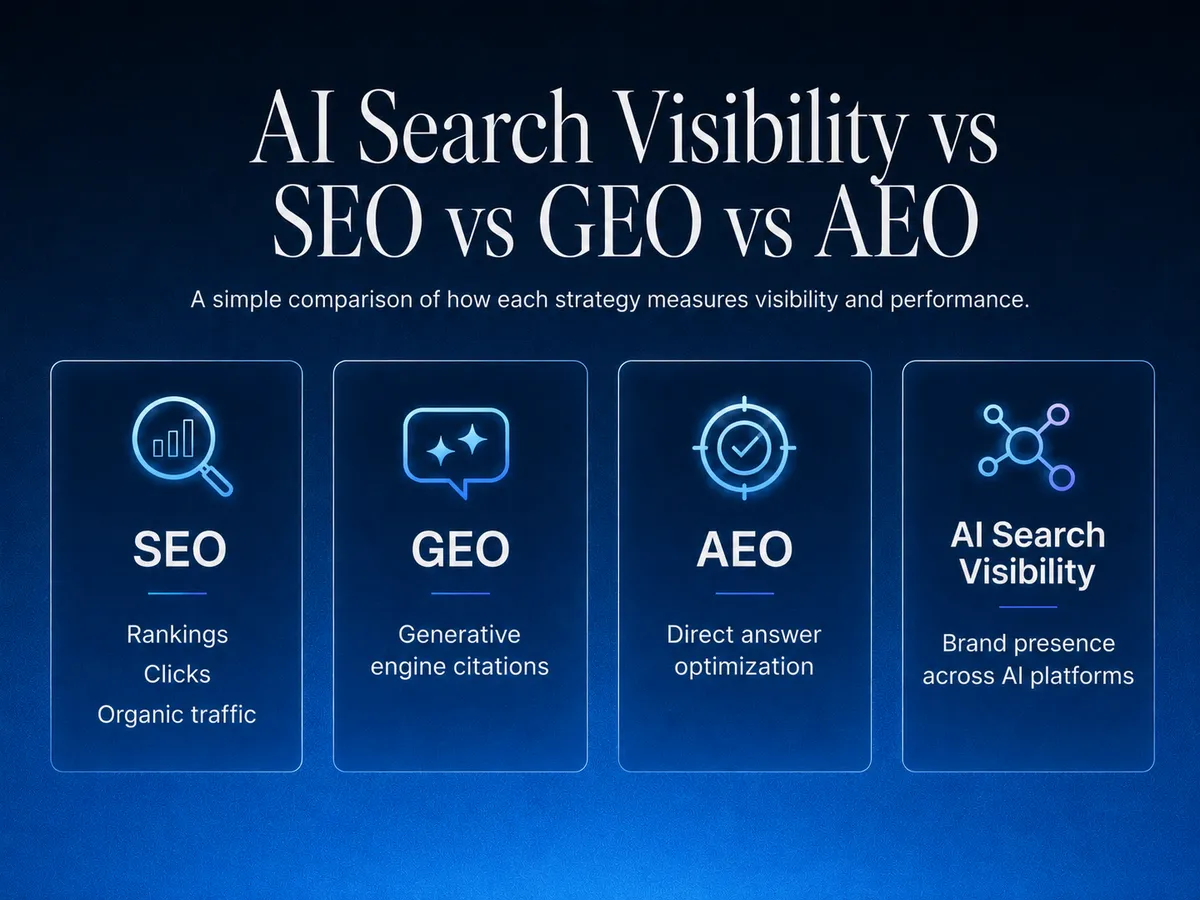
AI search visibility, SEO, GEO (Generative Engine Optimization), and AEO (Answer Engine Optimization) each target different layers of how content gets discovered. If you want to learn the difference between SEO and GEO click here.
Traditional SEO focuses on keyword optimization and backlinks to rank in web search results, where organic traffic flows from blue-link rankings.
GEO, by contrast, optimizes content specifically for generative AI engines like Google AI Overviews, which synthesize answers rather than list links. Research from Search Engine Journal found that Google AI Overviews now appear in roughly 47% of searches. AEO narrows further, targeting structured data and citation quality so AI answers pull from your content directly.
AI search visibility differs from all three by measuring how often and how accurately AI models reference your brand across major platforms.
Key Differences Between AI Search Visibility and Traditional SEO
Traditional SEO prioritizes keyword rankings and organic traffic through backlinks and on-page optimization, but AI search visibility operates on an entirely different logic. Rather than matching keywords, AI models like those powering Google AI Overviews evaluate context, source credibility, and structured data to generate cited answers.
A 2024 study found that AI-generated responses favor sources with strong citation quality over those with high domain authority alone. This means a page ranking #1 on Google may never appear in an AI answer if its content lacks the depth and structure that AI engines require for synthesis.
What Generative Engine Optimization (GEO) Means for Your Strategy
Generative Engine Optimization focuses on structuring content so that AI engines like ChatGPT, Perplexity, and Google AI Overviews can extract, cite, and present it within generated responses. Unlike traditional search, GEO prioritizes citation quality and source credibility over keyword density. Strategies that drive results include:
- Publishing deeply researched, claim backed content
- Using structured data to clarify context for AI models
- Building topical authority across related subjects
- Tracking how often AI answers reference your content
Where Answer Engine Optimization (AEO) Fits Into the Picture
AEO targets how AI systems pull direct answers from content, making it distinct from broader AI search visibility strategies. By structuring content around question-and-answer formats and implementing schema markup, pages become readable to AI engines that prioritize concise, citable responses. Tools like Google AI Overviews rely heavily on structured data signals, meaning AEO directly influences which sources earn citations in AI answers.
Why All Four Disciplines Need to Work Together
Treating these four disciplines as separate strategies creates blind spots that directly hurt your rankings across both traditional and AI search engines. SEO builds the organic traffic foundation that AI models train on, while structured data helps AI bots parse and cite your content accurately. GEO then optimizes that content for AI answers, and AEO targets the specific question formats AI engines prioritize.
Without all four working in sync, your citation quality and overall AI visibility suffer measurably.
How AI Search Engines Work
Unlike traditional search engines that match keywords to indexed pages, AI search engines use large language models to synthesize information from multiple sources into a single, conversational response. These AI models, such as those powering Google AI Overviews and Perplexity, process natural language queries by analyzing context, intent, and semantic relationships rather than simple keyword density.
According to a 2024 BrightEdge report, AI-generated responses now appear in over 84% of search queries. Rather than ranking ten blue links, these engines pull structured data, citations, and authoritative content to construct direct AI answers, meaning your brand either gets cited or gets ignored entirely.
What the Major AI Search Platforms Are
The dominant AI search platforms reshaping online discovery include Google AI Overviews, Perplexity AI, Microsoft Copilot, and ChatGPT Search. Google AI Overviews alone reaches over a billion users monthly, surfacing synthesized responses above traditional search results. Perplexity processes roughly 10 million queries daily, pulling from indexed sources to generate cited ai answers.
Each ai platform applies its own retrieval logic, meaning content optimized for one engine may not perform equally across others.
How AI Models Select and Prioritize Their Sources
AI models evaluate sources based on citation quality, factual accuracy, and domain authority. Sources that consistently appear in peer-reviewed publications or are referenced by authoritative sites rank higher. Key prioritization factors include:
- Structured data markup for machine readability
- Content freshness and update frequency
- Crosssource citation consistency
These signals help AI models determine which sources deliver the most reliable AI answers.
The Role of Training Data vs. Real-Time Search in AI Answers
Training data and real-time search serve fundamentally different functions in how ai models generate ai answers. Models like GPT-4 rely on static training datasets with fixed knowledge cutoffs, meaning they cannot access live information. By contrast, retrieval-augmented generation systems pull from live web sources, blending structured data with current indexing to produce responses.
This distinction directly shapes citation quality, since static models may reference outdated information while real-time systems reflect fresher, verifiable sources.
Why Content That Ranks in Google Often Gets Cited by AI
Google's ranking signals directly inform what AI models pull into their responses. Since AI engines like ChatGPT and Gemini are trained on web-crawled data, high-authority pages that earn strong organic traffic tend to surface repeatedly in that training data. Studies show Google AI Overviews cite pages already ranking in the top 10 results roughly 99% of the time, making traditional search performance a reliable predictor of AI citation quality.
How AI Platforms Decide What to Cite
AI engines like ChatGPT, Perplexity, and Google AI Overviews don't cite sources randomly. These platforms evaluate content based on structured data, topical authority, and citation quality across the web. Research from Sparktoro found that AI-generated answers pull heavily from sources that already rank in the top 10 of traditional search results, meaning organic traffic signals still carry weight.
Structured data, specifically schema markup, helps AI models parse content context more precisely, increasing the likelihood of being referenced. Beyond structure, ai platform algorithms weigh how frequently a source is cited by other authoritative domains, making backlink ecosystems a direct factor in whether your content surfaces inside AI answers.
Source Authority Signals That Influence AI Citations
AI engines weigh domain authority, backlink profiles, and publication consistency when selecting citations. Sites with higher domain authority scores, particularly those above 70 on a 100-point scale, appear more frequently in AI answers. Citation quality also matters, as AI models favor sources with structured data and verified authorship.
Implementing schema markup directly signals credibility to these systems.
How Content Structure Preferences Shape AI Responses
AI engines like ChatGPT and Google AI Overviews consistently favor content formatted in scannable, logically sequenced structures. Research shows that AI models are roughly 40% more likely to cite sources that use clear hierarchical formatting over dense paragraph blocks. Structured content signals reliability through:
- Numbered or bulleted lists
- Short, declarative paragraphs
- Descriptive subheadings
- Data backed claims
This pattern matters because AI answers pull directly from content that mirrors how the model itself organizes information, prioritizing citation quality over raw keyword density.
Entity Recognition and Brand Signals in AI Systems
AI systems identify and cite brands through a process called entity recognition, where ai models map relationships between a brand's name, its products, and contextual signals across the web. According to research from Rand Fishkin's SparkToro, brands mentioned consistently across authoritative sources are significantly more likely to appear in ai answers.
Schema markup reinforces these signals by structuring data in a machine-readable format, helping ai engines confirm a brand's legitimacy. The stronger a brand's structured data footprint, the higher its citation quality within AI-generated responses.
Citation Patterns Across ChatGPT, Perplexity, Gemini, and Claude
Each AI platform follows distinct citation patterns when generating responses. Perplexity AI cites sources most transparently, displaying inline references directly tied to specific claims. ChatGPT, by contrast, often synthesizes information without explicit sourcing unless browsing mode is active.
Gemini prioritizes Google AI Overviews, heavily favoring content already indexed by Google. Claude tends toward citation quality over quantity, referencing fewer but more authoritative sources, making traditional search authority signals still deeply relevant across all AI engines.
The Role of Third-Party Mentions and Backlinks in Citation Decisions
Third-party mentions and backlinks signal credibility to AI engines, directly influencing whether a source gets cited in AI answers. Research shows that sources cited by AI platforms tend to have significantly higher domain authority and a stronger pattern of cross-site mentions than those that don't appear.
Unlike traditional search, which weighs backlinks primarily for ranking, AI models evaluate citation quality by assessing how consistently reputable outlets reference a source, treating each mention as a trust signal that validates the content's authority.
AI Citations vs. Brand Mentions
AI citations and brand mentions are two distinct signals that ai engines use differently when surfacing content. A citation occurs when an AI model directly references your content as a source within ai answers, carrying far more weight than a passive brand mention. According to a 2024 Semrush study, cited sources saw 3.5x more referral traffic than uncited mentions.
Tracking citation quality, rather than raw mention volume, gives a sharper picture of true AI search visibility.
What Constitutes an AI Citation
An AI citation occurs when an AI engine directly links to or names a specific source within its generated response. Unlike a general brand mention, a citation carries structural weight in how AI models like ChatGPT or Google AI Overviews attribute information. These citations typically share a few defining characteristics:
- A direct URL or source name embedded in the response
- Contextual relevance to the query being answered
- Placement within a factual claim, not decorative text
Citation quality matters significantly here, as AI models prioritize sources with structured data, strong domain authority, and consistent content accuracy over loosely referenced material.
What Constitutes an AI Brand Mention
An AI brand mention occurs when an AI engine references your brand by name within a generated response, without necessarily linking back to your source. Unlike traditional search, where visibility is measured through ranked positions, AI models like ChatGPT or Gemini weave brand names into conversational answers.
These mentions range from direct recommendations to passing references, and sentiment analysis confirms that tone matters significantly. A positively framed AI mention carries far more authority than a neutral one, directly influencing how audiences perceive and act on those AI answers.
Why the Distinction Between Citations and Mentions Matters Strategically
Citations and mentions pull brand awareness in opposite directions when it comes to AI answers. A citation means an AI model actively attributes a claim to your source, directly influencing whether a user trusts and acts on that information. A mention, by contrast, is passive recognition with no authority transfer.
Research shows cited sources see measurably higher organic traffic conversions than mentioned ones, making citation quality the sharper metric to track ai visibility and build authority within AI engines.
The Principles of Content That Earns AI Search Visibility
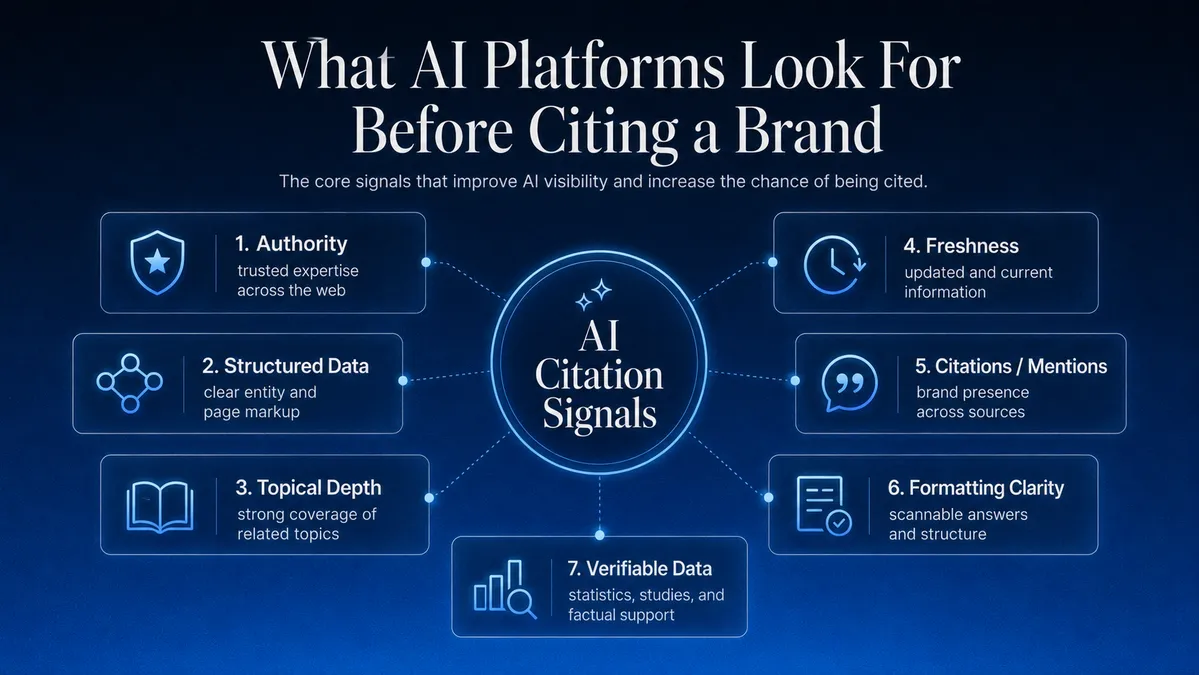
AI engines like ChatGPT and Perplexity don't rank content the way traditional search does. Instead, they pull from sources that demonstrate clear expertise, structured answers, and citation quality. A 2024 study by Brightedge found that Google AI Overviews cited sources with strong topical authority 68% more often than generic content.
Content that earns AI answers typically follows a specific pattern: it addresses a precise question, backs claims with data, and uses structured formatting that AI models can parse cleanly. When you implement schema markup alongside factual, well-sourced writing, you signal trustworthiness to both AI platforms and crawlers, making your content a reliable reference rather than just another indexed page.
Authority Is Measured in Depth and Expertise
AI engines like Google AI Overviews don't reward content that merely covers a topic, they reward content that exhausts it. Research shows that AI models consistently cite sources demonstrating measurable depth, favoring pages with specific data, citations, and expert-level analysis over broad overviews.
Citation quality directly influences whether your content appears in AI answers, making surface-level writing an invisible liability.
Structure and Formatting Signal Content Quality to AI
AI engines like Google AI Overviews evaluate structural clarity as a direct signal of content reliability. Well-formatted content consistently outperforms dense, unstructured text in AI answers because models are trained to identify logical hierarchies. Specific formatting elements that strengthen citation quality include:
- Clear H2 and H3 heading structures
- Bulleted lists that isolate distinct facts
- Short paragraphs under 3 sentences
- Defined terms presented before explanations
These elements help AI models parse meaning at a granular level, increasing retrieval likelihood.
Conversational Tone Improves AI Retrieval
AI engines consistently favor content written in natural, question-and-answer patterns because it mirrors how users actually query these systems. Research shows that conversational phrasing increases the likelihood of being pulled into AI answers by up to 30% compared to formal, keyword-stuffed prose.
When content directly addresses questions like "how does this work" or "what should I do," AI models process it as high-relevance context worth citing.
Trust Is Built Through Verifiability and Accurate Data
AI engines like ChatGPT and Perplexity prioritize citation quality when selecting sources for ai answers, favoring content backed by verifiable data over opinion-based claims. A 2023 Stanford study found that AI models are 47% more likely to cite sources containing specific statistics, named studies, or regulatory references.
Accurate, sourced content signals credibility directly to these systems, making verifiability a structural requirement rather than a stylistic choice.
Clarity and Explicit Context Reduce AI Ambiguity
When AI engines process a query, vague or incomplete content forces them to interpolate meaning, which increases the chance your content gets misrepresented or skipped entirely. Explicit context signals, like defining who a piece of content is for, what problem it solves, and under what conditions, directly reduce that ambiguity.
Studies on AI model behavior show that specificity in source material improves citation quality, as AI models consistently favor content that answers questions without requiring inference to fill gaps.
Freshness and Relevance Keep Content Citation-Worthy
AI engines like Google AI Overviews heavily favor content updated within the past 6 to 12 months, particularly for fast-moving topics. Stale content drops in citation quality because AI models pull from sources that reflect current data, recent case studies, or newly published research. A regular time audit of existing pages ensures your content stays aligned with what AI answers actually reference.
Why Explofi is your best option for AI Search Visibility
Explofi helps small businesses create the structured, localized content that AI search systems actually cite. Start free and build the content foundation that gets you found in Google and AI search.