Article Summary: HVAC companies live and die by local search. When a homeowner needs emergency AC repair or a furnace installation they go to Google first and almost never scroll past the first page. This guide covers everything an HVAC company needs to rank in local search including Google Business Profile optimization, location-specific service pages, seasonal keyword research, on-page SEO, local citations, review management, and content strategy. If you are an HVAC company paying for leads that should be coming in organically this is the playbook to fix that.
Deep Dive with AI
Why HVAC Companies Cannot Afford to Ignore Search Engine Optimization
87% of consumers use Google to find local businesses, making search engine optimization a non-negotiable investment for HVAC companies competing for service calls. When potential customers search for "emergency AC repair" or "furnace installation," they rarely scroll past the first page of results.
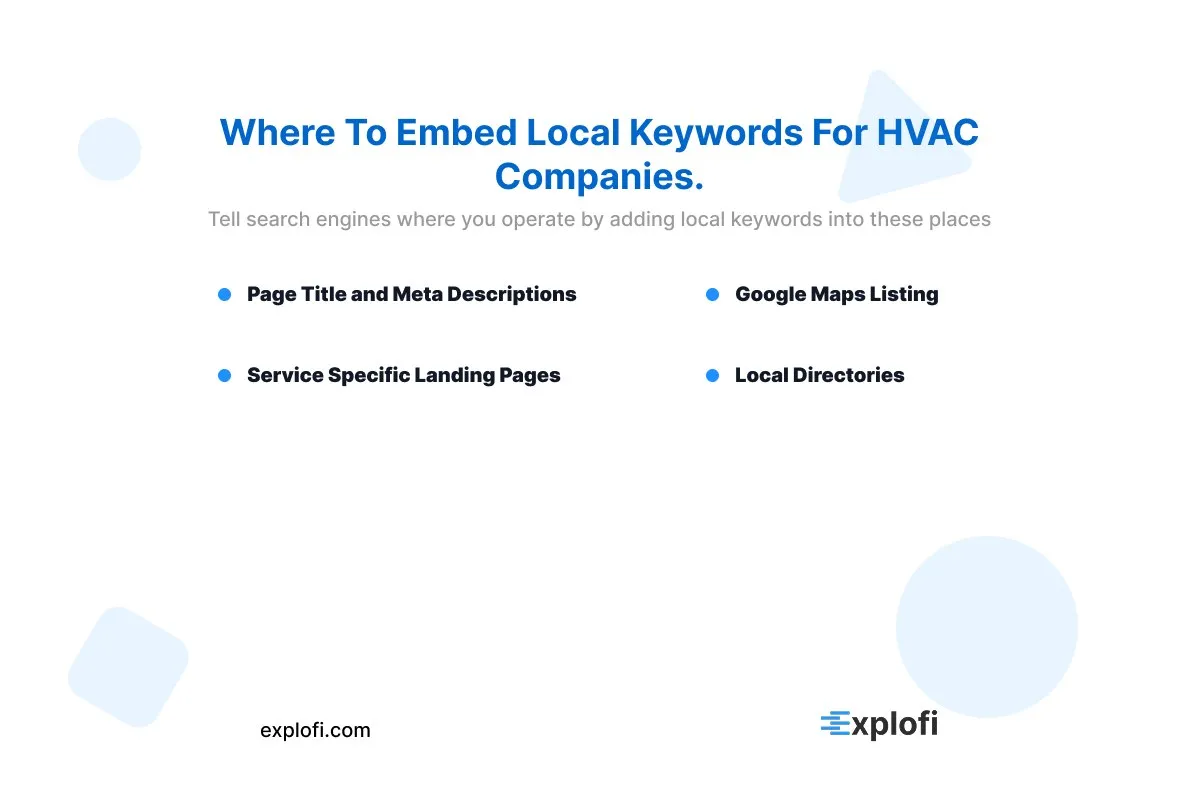
HVAC companies that rank higher capture those clicks, while those without a strong online presence lose leads to competitors. Effective local SEO efforts target specific geographic areas by embedding city and neighborhood keywords into:
- Page titles and meta descriptions
- Service specific landing pages
- Google Maps listings with accurate NAP data
- Local directories like Yelp and Angi
Consistent NAP information across these platforms directly strengthens local authority signals.
How Homeowners Search for Heating and Cooling Services Online
Homeowners searching for HVAC services online tend to exhibit high-intent behavior, with 50-70% of leads in many markets originating from local searches. They typically search using phrases like:
- "Emergency AC repair near me"
- "Furnace installation in [City]"
- "AC maintenance [Neighborhood]"
These searches signal immediate need, meaning HVAC companies must target keywords that match this intent precisely to attract potential customers at the exact moment they're ready to book.
The Difference Between HVAC Companies That Rank and Those That Don't
HVAC companies that rank share one key trait: complete, optimized Google Business Profiles. A 3-location HVAC contractor in Denver saw a 28% increase in local click-throughs after updating service areas and FAQs, proving how precision directly impacts ranking higher in local search.
How Organic Search Results Drive Consistent Lead Generation
Organic search consistently outperforms paid ads in long-term lead generation, with studies showing organic results capture 53% of all website traffic compared to paid search's 15%. For HVAC companies, ranking higher through quality content and quality backlinks creates a compounding effect where leads accumulate without per-click costs.
The most effective organic lead drivers include:
- Service pages targeting high intent keywords
- Location specific landing pages
- Blog content addressing seasonal HVAC concerns
Refreshing older service pages and blog posts with updated seasonal content and stronger local keywords compounds your rankings over time without starting from scratch every season.
What HVAC SEO Actually Means for Your Business
For HVAC companies, local search visibility operates on a few precise ranking signals that most business owners overlook. A successful HVAC SEO strategy centers on technical foundations that help search engines understand your business location, service scope, and credibility. Specifically, these signals include:
- Structured LocalBusiness schema markup
- Location embedded title tags on service pages
- Consistent NAP data across every business listing
- Mobile optimization for onsite user behavior
Technical SEO directly impacts how Google indexes your pages, and a fast loading time reduces bounce rates, which feeds back into ranking performance. Building local citations across directories like Yelp and Angi builds domain authority over time, while local reviews influence click-through rates by signaling trustworthiness to both algorithms and potential clients.
How Search Engines Evaluate and Rank HVAC Websites
Google evaluates HVAC websites using over 200 ranking factors, weighting relevant keywords, backlink profiles, and Core Web Vitals scores heavily. Technical SEO signals like page speed directly affect rankings, as pages loading under 2.5 seconds retain significantly more users. Link building from local industry directories further strengthens domain authority, signaling credibility to search algorithms ranking HVAC companies.
The Connection Between Search Visibility and Local Customer Acquisition
Local search visibility directly drives customer acquisition for HVAC companies, with 92% of consumers selecting a service provider from the first page of local results. Paired with this, 78% of local searches convert into a store visit or service call within 24 hours. Key signals that push rankings and pull in local customers include:
- High quality photos on business listings
- Consistent phone number across directories
- Weekly Google Maps post updates
The Three Pillars of a Strong HVAC SEO Foundation
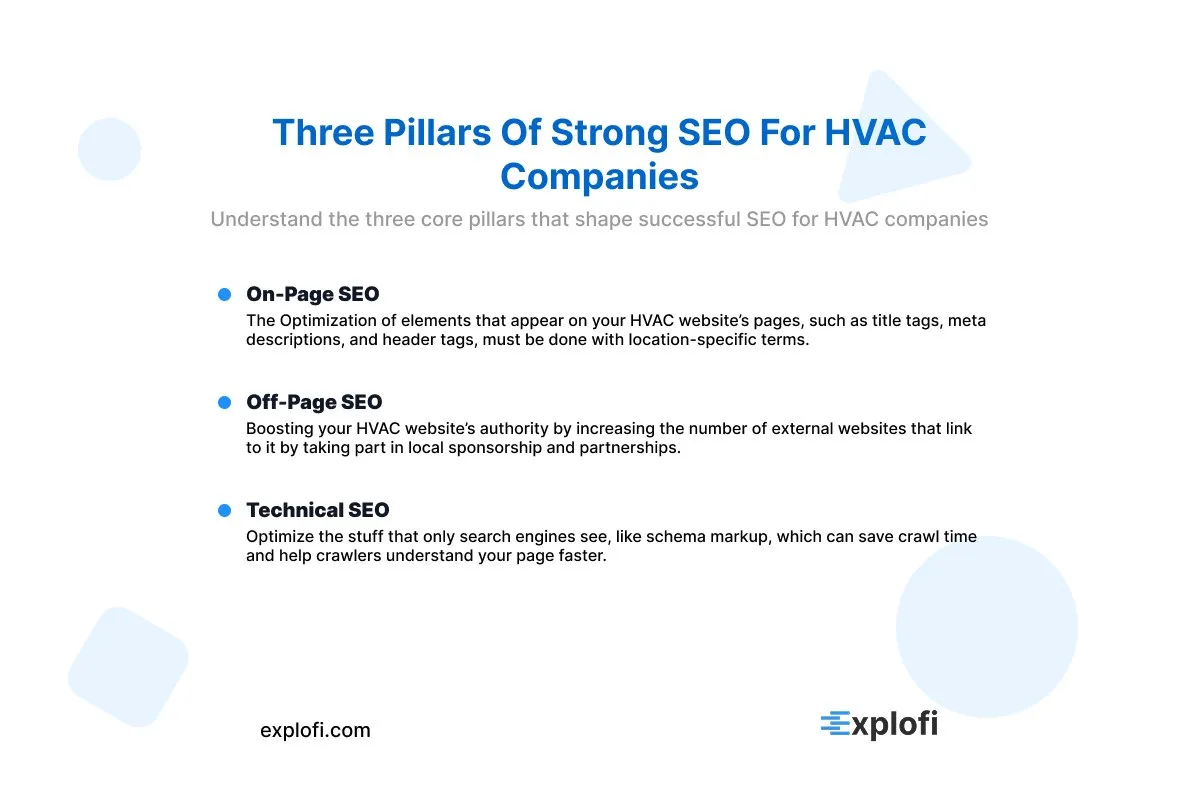
A strong HVAC SEO foundation rests on three distinct pillars: technical SEO, local search optimization, and quality content. Technical SEO handles the structural integrity of your site, covering mobile devices compatibility, page speed, and crawlability that helps search engines understand your service pages.
Research shows that 53% of mobile users abandon sites that take longer than three seconds to load, making site speed a non-negotiable factor. Local SEO focuses on NAP consistency, meaning your business name, address, and phone number must match exactly across every directory. Rounding out the foundation, creating high-quality content tied to specific HVAC services, like furnace repair guides or AC maintenance tips, signals topical authority to Google and directly supports rankings.
On-Page SEO for HVAC Websites
On-page SEO directly shapes how Google reads and ranks each service page on an HVAC website. Optimizing title tags, meta descriptions, and header tags with location-specific terms helps search engines connect your pages to local search queries. Key on-page elements to optimize include:
- Title tags with city and service type
- Header tags (H1, H2) with targeted HVAC services
- Image alt text describing equipment or service areas
Off-Page SEO and Authority Building
Earning local backlinks through neighborhood event sponsorships and local partnerships directly strengthens domain authority. Key off-page tactics include:
- Consistent NAP across directories
- Earning 4.5+ star reviews
- Local partnership backlinks
\These signals help HVAC companies rank higher in map pack results.
Technical SEO for Heating and Cooling Companies
Structured data markup, crawlability, and page speed form the backbone of technical SEO for HVAC companies. Specifically, implementing local business schema helps search engines index service pages 20-40% more effectively, while keeping load times under three seconds prevents losing mobile users before engaging potential customers.
How Local SEO Differs from Traditional SEO for HVAC Contractors
Unlike traditional SEO, which targets broad national audiences, local SEO for HVAC contractors zeroes in on geography-specific intent signals that drive same-day service calls. With 76% of smartphone users who search locally visiting a business within a day, ranking in the Google Map Pack becomes a direct revenue lever.
The approach targets:
- City and neighborhood level keywords like "HVAC repair in Denver"
- Google Maps visibility through a fully optimized GMB profile
- Local citations across directories like Yelp and Angi
- Review velocity, meaning consistently earning new reviews monthly
Traditional search engine optimization prioritizes domain authority across broad topics, while local search rewards hyper-specific signals like verified business hours, accurate service-area pages, and NAP consistency across every directory touchpoint.
Why Geographic Relevance Determines HVAC Search Rankings
Geographic relevance signals tell Google exactly which service areas an HVAC company covers, directly influencing local search rankings. Key proximity factors include:
- Service area radius
- City specific landing pages
- Google Maps pin accuracy
Tighter geographic targeting consistently helps HVAC companies rank higher for high-intent queries.
How the Google Local Pack Impacts HVAC Lead Generation
Businesses with complete Google Business Profile listings see up to 5x more local traffic and 20% higher conversion rates, making GBP optimization a direct driver for HVAC lead generation. Roughly 60% of local searches for home services result in a phone call within 24 hours. To generate leads effectively, optimize your listing with:
- Accurate hours and service areas
- Weekly posts and promotions
- Job photos and before/after shots
Conducting Effective Keyword Research for HVAC Companies
Keyword research for HVAC companies starts with mapping service-area phrases to dedicated pages on your website. Targeting queries like "emergency furnace repair" or "AC installation" paired with your city locks in geographic intent, helping your HVAC company rank higher in local search results. The most effective keywords for HVAC businesses fall into three categories:
- Emergency service terms ("sameday AC repair")
- Seasonal maintenance phrases ("spring HVAC tuneup")
- Equipment specific queries ("heat pump installation cost")
These categories reflect actual buyer intent at different stages. From experience building HVAC marketing tools, I've seen that mapping each keyword cluster to a unique service-area page consistently improves online visibility and drives more qualified website traffic from local customers.
Identifying High-Intent Commercial and Transactional Keywords
Phrases like "emergency AC service" or "furnace installation" paired with a city name signal strong purchase intent, driving 88% of local mobile searches toward a call or visit within 24 hours, per recent data.
Targeting Long-Tail Keywords That Drive HVAC Service Calls
Phrases like "AC installation near me" or "furnace repair tonight" carry 3x higher conversion rates than broad terms, according to hvac seo marketing data, because they signal immediate purchase intent from local customers actively seeking service.
How to Analyze Competitor Keywords in the HVAC Industry
Tools like Ahrefs or SEMrush reveal competitor keyword gaps, showing which HVAC terms rivals rank for that you don't. Focus on:
- Service specific terms ("duct cleaning," "heat pump installation")
- Location paired phrases targeting your city
- Seasonal queries driving website traffic
Competitors ranking for 20+ local keywords typically capture 3x more leads.
Using Seasonal Search Trends to Plan HVAC Content
Local intent searches for HVAC spike sharply during spring and fall seasons, with emergency repair queries surging after extreme weather events. Planning content around these windows means targeting seasonal terms like "summer cooling tips" or "furnace tune-up" alongside service-area keywords. Relevant content timed to peak demand periods captures local customers actively searching for hvac services.
Claiming and Optimizing Your Google Business Profile for HVAC Services
Claiming your Google Business Profile is the starting point for HVAC companies serious about ranking in local search. Google's own data confirms that verified listings receive 7x more clicks than unverified ones. Once claimed, optimizing your profile means covering these specifics:
- Select "Heating & Air Conditioning/HVAC" as your primary category
- Add your exact service area by zip code rather than broad radius
- Upload geotagged photos of your vans, equipment, and completed jobs
- Keep your phone number and business hours consistent with your website
Your business listing on Google Maps directly influences your Local Pack placement, where 44% of users click before visiting any website. Profiles with 10+ photos receive 35% more click-throughs than those with fewer images.
How to Properly Verify Your HVAC Company on Google
Google verifies HVAC businesses through postcard, phone, or video call methods. The postcard option, most common for HVAC companies, delivers a 5-digit PIN to your business address within 14 days. Verification unlocks full profile controls, including:
- Editing your phone number
- Managing Google Maps pin placement
- Responding to reviews
Adding Accurate and Complete Business Information
Accurate business information on your Google Business Profile directly impacts your ranking in local search results. Your profile's NAP (Name, Address, Phone Number) must stay consistent across every listing. Key details to include are:
- Service categories like "HVAC contractor"
- Phone number and service hours
- Specific service areas by neighborhood
Selecting the Right Service Categories for HVAC Companies
Choosing the right primary category, like "HVAC Contractor," directly shapes which searches trigger your profile. Beyond that, secondary categories such as "Air Conditioning Repair Service" or "Furnace Repair Service" expand your reach across:
- Heating and cooling repair
- Installation services
- Maintenance and tuneups
Using Google Business Posts to Promote Seasonal HVAC Offers
Google Business Posts expire after 7 days, making consistent seasonal scheduling critical for HVAC businesses pushing time-sensitive offers. Posting a "spring AC tune-up special" in late March with a direct offer tied to a specific discount, like 15% off, captures local customers actively searching for HVAC services before peak demand hits.
Google's data shows posted profiles see significantly stronger engagement than static listings.
How Photos and Virtual Tours Influence Local HVAC Rankings
Businesses with a 4.5-4.7 star average and 30+ reviews tend to outperform competitors in local rankings by 20-30%, and photos play a comparable role. Google's own data shows that profiles with photos receive 42% more requests for directions and 35% more click-throughs. For HVAC businesses, uploading images of:
- Installed equipment
- Service vehicles
- Before and after repairs
Cohesively paired with a virtual tour, signals credibility and boosts online visibility in local search results.
Building Location-Specific Service Pages That Rank
Each location page should target one service area with unique, service-specific content. Structuring them this way means:
- Canonical keywords like "HVAC contractor in Denver" in titles and headers
- Schema markup for local business and service areas
- Meta descriptions with direct service area mentions
What Elements Make HVAC Location Pages Perform Well in Search
Well-structured location pages consistently rank higher when they hit 1,200-1,600 words with clear H1s, FAQs, and location-based keywords woven naturally throughout. For HVAC companies targeting local customers, each page should include:
- A primary CTA like "Get an in home diagnosis within 2 hours"
- Embedded Google reviews as trust signals
- A mobile friendly phone contact option
- Core Web Vitals under 2.5 seconds LCP
How to Structure Service Area Pages Without Duplicating Content
Avoiding duplicate content across service area pages starts with treating each city as its own unique context. A city-tailored intro of 50-120 words referencing local landmarks or climate conditions immediately differentiates each page. Structure each location page around these distinct content layers:
- Neighborhood specific case studies
- Climate relevant FAQs (6-12 per page)
- Local permit questions like "Do I need a permit for furnace replacement?"
This approach helps HVAC companies rank higher without triggering Google's duplicate content filters.
Creating Dedicated Pages for Each Major HVAC Service Offered
Dedicated service pages give HVAC companies a measurable edge in local search, with Google favoring structured content using clear H2/H3 headings. Build separate pages for core hvac services like:
- Emergency repair
- AC installation
- Heating maintenance
Each page should include pricing ranges, typical job durations, and warranty details, giving users the specifics that drive qualified leads and improve online visibility.
Developing High-Quality Content That Attracts HVAC Customers
High-quality content is one of the most direct ways HVAC companies can convert search traffic into paying customers. According to HubSpot, businesses that blog consistently generate 67% more leads than those that don't, and for HVAC businesses, that translates to service calls. Content marketing works best when it targets specific pain points, like explaining why a heat pump loses efficiency below 35°F or detailing what an AC refrigerant recharge actually costs.
This level of specificity builds trust with your target audience while signaling topical authority to search engines, helping your pages rank higher in local search results for high-intent queries like "emergency furnace repair."
How to Write Blog Posts That Answer Common HVAC Questions
Blog posts targeting questions like "why is my AC not cooling?" or "how often should I replace my HVAC filter?" consistently drive strong website traffic from local customers. Structure each post around one specific question, target 1,000-1,500 words, and include:
- A direct answer within the first 100 words
- Seasonal relevance tied to local climate
Building a Seasonal Content Calendar for HVAC Businesses
Mapping content to HVAC seasonal demand cycles directly improves online visibility and keeps your pipeline full year-round. A structured calendar targets:
- AC tuneup content published in March, capturing pre summer search spikes
- Furnace maintenance articles released in September, ahead of heating season
- Filter replacement guides timed to spring and fall temperature shifts
Publishing seasonal content 6-8 weeks before peak demand gives HVAC businesses enough time to rank higher in local search before competitors flood the same keywords.
Using Educational Content to Establish HVAC Industry Authority
Detailed how-to guides, seasonal maintenance checklists, and explainer videos position HVAC companies as trusted experts. Educational content earns 3x more backlinks than promotional material, directly strengthening link building efforts. Prioritize these formats:
- Troubleshooting guides
- Energy efficiency breakdowns
- System lifespan comparisons
How FAQ Pages Capture Voice Search Traffic for HVAC Queries
FAQ pages structured around conversational queries capture voice search traffic, since 58% of consumers use voice search to find local businesses. Formatting questions like "Why is my AC blowing warm air?" mirrors natural speech patterns, triggering featured snippets. Implementing FAQ schema markup helps HVAC businesses:
- Appear in rich results
- Boost clickthrough rates by 30%
On-Page Optimization Techniques for HVAC Websites
On-page optimization for HVAC websites requires precise technical alignment across several elements. A clean URL structure, such as `/ac-repair-denver` or `/furnace-installation-boulder`, signals location relevance directly to search engines. Targeting long-tail local keywords in H1 tags, meta descriptions, and body text strengthens local search performance significantly.
From a technical standpoint, site speed under 3 seconds on both desktop and mobile devices is a measurable benchmark that directly affects rankings. Key on-page components that improve user experience include:
- Clear phone number placement above the fold
- Easy navigation across service pages
- Mobile friendly website design
- Structured local business markup
Google prioritizes pages where these signals work together cohesively, rewarding HVAC businesses with stronger online visibility in competitive local markets.
Writing Title Tags and Meta Descriptions That Improve Click-Through Rates
Title tags with city names and service terms consistently drive higher click-through rates, as location-specific titles align directly with local search intent. For HVAC businesses, a title like "AC Repair in Austin | Same-Day Service" outperforms generic alternatives by signaling immediacy and relevance.
How to Use Header Tags Effectively Across HVAC Service Pages
Structuring H2 and H3 tags around common homeowner questions directly supports how search engines interpret HVAC service pages. Using H2s for primary services like "AC Installation" and H3s for supporting topics like "How Long Does Installation Take?" mirrors the question-based language that local customers type into search.
This hierarchy helps HVAC businesses rank higher by signaling clear topical relevance, particularly when headers include location-specific phrases tied to local search intent.
- Use H2s for core services
- Use H3s for location specific FAQs
- Use H4s for supporting details like pricing or timelines
Incorporating Local Keywords Naturally Into HVAC Website Copy
Weaving local keywords into HVAC website copy requires precision, not repetition. Phrases like "emergency AC repair in [Neighborhood]" or "furnace replacement in [City]" should appear in:
- Page titles and meta descriptions
- Opening paragraphs of service pages
- Image alt text tied to local projects
Targeting neighborhood-level language directly matches homeowner search intent, helping HVAC businesses rank higher for high-converting, location-specific queries.
Internal Linking Strategies That Strengthen HVAC Website Structure
Linking service pages to related blog content, like connecting "AC Installation" to "How to Prepare for AC Installation Day," passes PageRank between pages while reducing bounce rates. Strategic internal links help HVAC businesses:
- Guide crawlers through service hierarchies
- Strengthen topical authority across location pages
Are you an HVAC company tired of paying for leads that should be coming in organically?
Most HVAC companies are either paying agencies thousands per month for SEO they do not fully understand or paying per lead to platforms like Angi and HomeAdvisor indefinitely. Neither builds anything you own.
Explofi helps HVAC companies build the localized service pages, blog content, and local keyword rankings that bring in organic leads consistently without a retainer and without paying per click. You enter your business type, location, and competitors and Explofi generates the content your HVAC website needs to rank in your city and show up when homeowners search for the exact services you offer.
Stop renting leads. Start owning your rankings.
Start Free Today and See What Your HVAC Competitors Are Ranking For
Frequently Asked Questions
What Is SEO and Why Is It Important for HVAC Companies?
SEO, or search engine optimization, is the process of improving a website's visibility in search results. For HVAC companies, it's important because most customers search online before hiring a contractor. According to Google, 76% of people who search for something nearby on a smartphone visit a related business within a day, making strong local search visibility essential for attracting customers.
How Long Does It Take for HVAC SEO Strategies to Show Results?
HVAC SEO strategies typically take 3 to 6 months to show meaningful results, though timelines vary based on competition and existing site authority. Initial improvements in local pack visibility can appear within weeks of optimizing your Google Business Profile. Long-term gains, including consistent lead generation, generally solidify after 6 to 12 months of sustained effort.
What Are the Most Effective Local SEO Tactics for HVAC Businesses?
Completing a Google Business Profile with accurate service categories, hours, and real photos is a strong starting point. Maintaining consistent name, address, and phone number across directories builds trust and local prominence. Google confirms positive reviews support local rankings, so requesting feedback after each job matters.
Mobile optimization is equally critical, with Google recommending Largest Contentful Paint within 2.5 seconds.
How Does Google Business Profile Help HVAC Companies Attract More Customers?
A verified Google Business Profile lets HVAC companies appear in local map pack results, which capture a significant portion of nearby search clicks. It displays your services, hours, and customer reviews directly in search results, making it easier for potential clients to choose you. Profiles with complete information and consistent reviews tend to rank higher in location-based searches.
Should HVAC Companies Hire an SEO Agency or Handle Optimization In-House?
Both options have merit. Agencies bring specialized expertise and proven strategies, often delivering faster results, but come at a higher cost. In-house teams offer more control and brand familiarity. Since 76% of nearby mobile searches lead to a business visit within a day, HVAC companies with tighter budgets may prioritize local SEO tools first before committing to full agency retainers.
How Much Should an HVAC Company Budget for SEO Services?
HVAC companies typically budget between $500 and $5,000 per month for SEO services, depending on business size and competition. Considering that 76% of people who search for something nearby on a smartphone visit a related business within a day, investing in local SEO can yield strong returns. Smaller companies may start lower, while larger operations benefit from more comprehensive strategies.