Article Summary: E-E-A-T stands for Experience, Expertise, Authoritativeness, and Trustworthiness and it is the framework Google uses to evaluate whether your content genuinely serves users or just exists to rank. For small businesses it is one of the most controllable trust signals in search because it rewards real knowledge, verified credentials, consistent reviews, and locally specific content over generic output. This guide breaks down every component of E-E-A-T, how Google's quality raters assess it, why it matters even more for YMYL industries like healthcare and legal services, and exactly how to audit and improve your own site's E-E-A-T signals in 2026.
Deep Dive with AI
What E-E-A-T Stands For and How It Works
E-E-A-T stands for Experience, Expertise, Authoritativeness, and Trustworthiness, and Google's Search Quality Rater Guidelines use it to evaluate whether content genuinely serves users. The first "E," Experience, was added in December 2022, reflecting Google's shift toward valuing personal experience alongside expertise.
While E-E-A-T is not a direct ranking factor in the traditional sense, it shapes how Google's quality raters assess content, which directly influences algorithm updates. For small businesses, this distinction matters because search engines reward content that demonstrates real, lived knowledge rather than surface-level information.
A local contractor writing from hands-on experience, for instance, signals far greater authoritativeness and trustworthiness than generated content that lacks that depth.
The Four Core Components of E-E-A-T
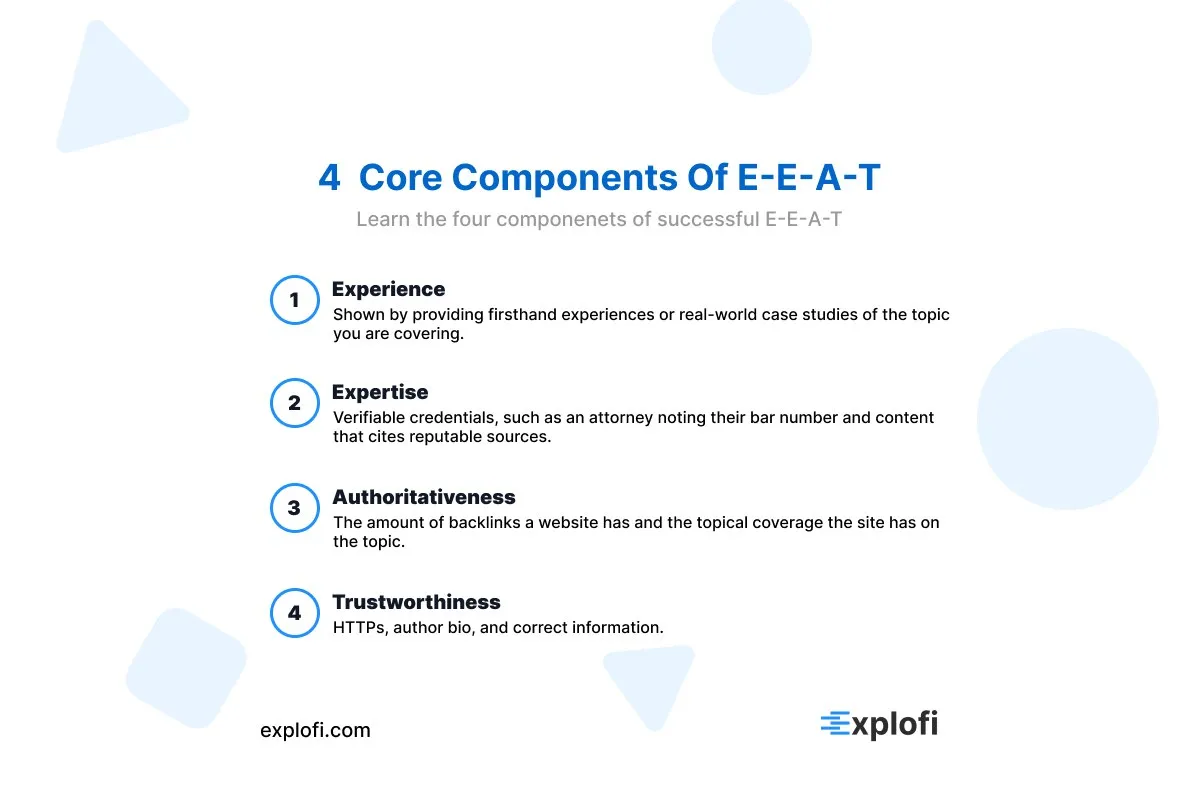
Each component targets a distinct trust layer:
- Experience: firsthand case studies or realworld results
- Expertise: verifiable credentials and sourced content
- Authoritativeness: backlinks from reputable domains
- Trustworthiness: HTTPS, author bios, and accurate information
What Changed When Google Added the Second "E" for Experience
Before December 2022, Google's guidelines evaluated content on just three signals. Adding "Experience" specifically distinguished between *knowing* a topic and *living* it, rewarding content backed by real-world usage over theoretical knowledge, which directly shapes how quality raters score pages during algorithm update cycles.
The Difference Between E-E-A-T and the Original E-A-T Framework
The original E-A-T framework, established in Google's Search Quality Rater Guidelines, covered Expertise, Authoritativeness, and Trustworthiness. Google expanded it by adding a second "E" for Experience in December 2022, recognizing that:
- Credentials alone don't prove realworld knowledge
- Firsthand exposure strengthens content trustworthiness
- Algorithmic updates now reward demonstrating real, lived interaction with a topic
Why E-E-A-T Is Not Just a Buzzword for Big Brands
Many assume E-E-A-T only matters for large enterprises with dedicated content teams, but Google's Quality Raters assess these signals across every site, regardless of size. For small businesses, this creates a genuine competitive advantage, particularly in niches like financial advice where trust signals carry extra algorithmic weight.
The practical signals raters look for include:
- Linked author bios with verifiable credentials
- Cited industry reports with quantified results
- Transparent business practices like privacy policies
- User reviews tied to real people
Google's guidelines confirm that trustworthiness is the most critical of the four pillars, meaning even a local business publishing content with cited sources and credible author bylines can rank higher than larger competitors with thinner, unverified pages.
How Google Uses E-E-A-T to Evaluate Your Website
Google's quality raters evaluate your site by looking for specific, verifiable trust signals across every page. For data-heavy written content, the guidelines recommend citing 2 to 5 high-quality external sources per claim. Raters also check for:
- Author bios of 100 to 200 words with credentials
- Secure HTTPS connections
- Third party customer reviews
- Transparent contact details
The Role of Quality Raters in Assessing E-E-A-T
Google's Quality Raters use the Search Quality Evaluator Guidelines to score E-E-A-T signals across every page they review. They specifically look for:
- A strong author bio (150-250 words with 2-3 credential bullets)
- Minimum of 3-5 external high authority sources per long form article
- Clear publication dates and contact information
These signals directly influence how real authors and trustworthiness are scored.
How E-E-A-T Influences Search Rankings Without Being a Direct Ranking Factor
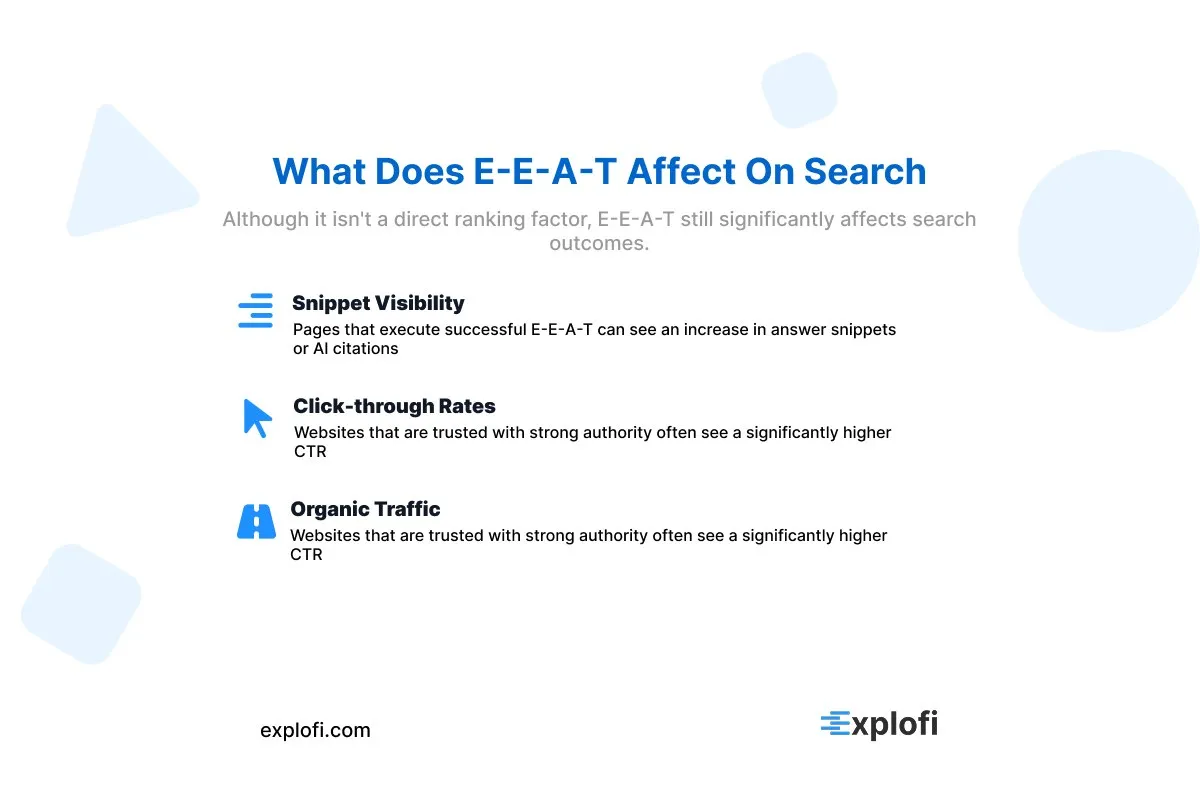
Google's quality raters assess E-E-A-T signals, which indirectly shape rankings through these measurable outcomes:
- Higher clickthrough rates
- Stronger organic traffic
- Improved snippet visibility
While not a direct ranking factor, trustworthiness and authoritativeness consistently correlate with stronger search performance.
Breaking Down Experience as an E-E-A-T Signal for Small Businesses
Experience, as a component of E-E-A-T, signals that the person or business behind the content has real, verifiable involvement with the subject. For small businesses, this plays out in concrete ways, including:
- Publishing documented case studies with measurable outcomes
- Using team photos and bios that reflect hands on industry roles
- Featuring customer service scenarios with actual resolution examples
Unlike credentials, which only prove theoretical knowledge, Google's framework specifically rewards demonstrated, lived interaction. A local plumbing company writing about pipe corrosion from years of fieldwork carries more weight than a generalist content creator covering the same topic. This distinction matters because Google's Quality Raters actively look for proof of direct involvement when scoring content quality.
How First-Hand Experience Separates Your Content from Competitors
- Specific client outcomes
- Documented case studies
- Firsthand industry insights
These content types signal direct involvement, giving small businesses a measurable edge. Google's framework rewards demonstrated experience over theoretical knowledge, making lived expertise a critical trust signal for improved SEO performance.
Ways to Document and Display Real-World Experience on Your Website
Detailed author bios, case studies, and timestamped content updates are three concrete ways to document real-world experience. Author bios should include verifiable credentials like "10+ years in [industry]" or specific qualifications. Case studies, backed by measurable outcomes, show search engines demonstrated involvement rather than theoretical knowledge.
Pairing these with structured data like schema markup reinforces experience signals directly to crawlers.
Demonstrating Expertise Through Your Website Content
Author bios that highlight credentials, years of experience, and relevant licenses directly strengthen expertise signals. Specifically, Google recommends bios of 150-250 words, quantifying real outcomes like reducing repair time from 2 hours to 45 minutes across 30 documented projects to demonstrate real field knowledge.
Why Subject Matter Depth Matters More Than Word Count
Depth of coverage is a stronger expertise signal than article length alone. Search engines reward content that fully addresses a topic through:
- Real world data and case studies
- Verifiable credentials tied to specific outcomes
- Cited, high quality sources per claim
A 600-word piece that covers these elements outperforms a 2,000-word generic overview, as content strategy built around subject-matter depth directly strengthens expertise signals Google's quality raters actively measure.
How to Structure Content That Reflects Genuine Industry Knowledge
Structuring content around specific process breakdowns, case-specific outcomes, and step-by-step methodologies signals genuine expertise to search engines. Effective structures include:
- Problem solution frameworks tied to real scenarios
- Data backed outcome sections
- Process walkthroughs with industry specific terminology
This approach reinforces authoritativeness by showing depth rather than surface-level coverage that quality raters immediately recognize as thin content.
Building Authoritativeness as a Small Business Owner
Authoritativeness is built through external validation, not self-declaration. For small businesses, this means earning mentions from credible industry sources, getting listed in relevant directories, and accumulating a strong review count on your Google Business Profile. Studies show that businesses with 50+ reviews rank noticeably higher in local results.
Guest posting on niche publications and being cited by third-party sources signals to search engines that your business holds real authority within its field, which directly strengthens your E-E-A-T profile.
Earning Backlinks and Mentions from Reputable Industry Sources
Backlinks from reputable industry sources remain one of the strongest authoritativeness signals for small businesses. Earning these links typically involves:
- Publishing cited, data driven content
- Contributing expert quotes to trade publications
- Getting listed in industry directories
Studies show sites with high-authority backlinks rank significantly better, as search engines treat third-party validation as measurable credibility proof.
Why Your Google Business Profile Contributes to Authority Signals
A fully optimized Google Business Profile reinforces authoritativeness by maintaining consistent NAP (name, address, phone) data across all listings. Search engines treat NAP consistency as a measurable trust signal, directly validating your business's legitimacy. Prioritize these profile elements:
- Accurate business categories
- Updated service descriptions
- Verified contact details
Reviews on reputable platforms further strengthen authority signals that quality raters evaluate.
Community Involvement and Local Recognition as Authority Builders
Sponsoring local events, joining chambers of commerce, and earning features in regional publications directly strengthen authoritativeness signals that *search engines* actively evaluate. A business recognized by a local outlet or awarded by a trade *industry* group generates third-party validation, which Google weights as credible proof of authority, much like reputable backlinks from high-domain sources.
Establishing Trustworthiness Across Every Page of Your Site
Trust signals like a transparent privacy policy, clear contact information, and accessible return policies directly impact trustworthiness scores. Consider placing these across every page:
- Privacy policy links in footers
- Visible contact details in headers
- Dated content updates (quarterly minimum)
Visible Contact Information, Addresses, and Business Credentials
A physical address, working phone number, and verified business credentials placed in your site's footer or contact page directly strengthen trustworthiness signals that search engines evaluate. Schema markup, specifically `LocalBusiness` or `organization schema`, lets Google read these details programmatically.
Verified credentials should include:
- State business registration numbers
- Active professional licenses
- Industry certifications with issuing body names
Privacy Policies, Terms of Service, and Secure Site Setup
HTTPS is a non-negotiable trust signal, with Google confirming secure sites as a direct ranking factor since 2014. Beyond SSL certificates, your site needs:
- A clearly dated privacy policy compliant with regulations like GDPR or CCPA
- Accessible terms of service outlining user rights
- Verified contact details cross referenced with your schema markup
How Online Reviews Directly Strengthen Trust Signals
Reviews function as quantifiable trust signals, with 88% of consumers trusting them as much as personal recommendations. Platforms like Google Business Profile aggregate ratings that search engines read as third-party credibility proof. Small businesses actively seeking verified reviews build measurable trustworthiness, particularly when responses address specific service complaints or outcomes directly.
Why E-E-A-T Matters Even More for YMYL Small Businesses
For small businesses operating in Your Money or Your Life (YMYL) categories, such as legal services, healthcare, or financial advising, Google's quality raters apply significantly stricter scrutiny to expertise, authoritativeness, and trustworthiness signals. YMYL content directly impacts a person's health, finances, or safety, which is why search engines hold these pages to a higher standard than general content.
Google's Search Quality Evaluator Guidelines explicitly state that low-quality YMYL pages pose a greater potential risk to users. This makes trustworthiness less of a bonus and more of a baseline requirement for ranking higher. Consider what people searching for a local tax advisor or urgent care clinic need:
- Verified professional credentials
- Transparent pricing or service details
- Accurate, regularly updated medical or legal information
What YMYL Means and Which Small Business Industries It Covers
YMYL, or "Your Money or Your Life," covers content that can significantly affect a user's financial stability, health, or safety. For small businesses, this spans several high-stakes industries:
- Medical and mental health services
- Legal and financial advising
- Insurance and tax preparation
- Home safety and structural contracting
Search engines treat these categories with measurably stricter quality standards. A tax preparation firm or urgent care clinic, for example, must demonstrate far deeper expertise and trustworthiness than a general retail site to compete in search rankings.
The Higher Standard Google Applies to Health, Finance, and Legal Content
Google's Search Quality Evaluator Guidelines explicitly require that health, finance, and legal content meet higher trustworthiness and expertise thresholds. For these YMYL pages, lacking verified credentials, cited sources, or author bios can directly suppress rankings.
How to Conduct an E-E-A-T Audit on Your Own Website
Start by reviewing author bios across every page, checking that each includes a professional title, relevant certifications, and publication dates. From there, cross-check your:
- Backlink sources for domain authority
- Content update timestamps
- Cited sources for credibility
Evaluating Your Author and Team Pages for Credibility Gaps
Team pages with missing credentials are a measurable trustworthiness gap, since Google's quality raters actively assess whether expertise is verifiable. Check each team member's bio for:
- A professional headshot
- Relevant certifications or licenses
- Years of experience
- Published work or cited sources
For YMYL industries like healthcare or finance, unverified qualifications can directly suppress page rankings, making credential transparency non-negotiable for small businesses competing in search.
Identifying Thin or Unsubstantiated Content That Undermines Trust
Thin content, defined by Google as pages with little to no added value, directly weakens trustworthiness signals. Watch for:
- Unsupported claims lacking cited sources
- Generic service descriptions under 300 words
- No author attribution
For small businesses, even one unsubstantiated page can suppress domain-wide authority in search engines.
Reviewing Your External Link Profile and Third-Party Mentions
Backlinks from respected industry publications directly signal authoritativeness to search engines, making your external link profile a measurable trust indicator. Tools like Ahrefs show that pages earning mentions from high-authority domains consistently rank higher due to stronger trustworthiness signals.
Auditing third-party mentions means verifying that sources citing your business are credible, relevant, and accurate, since a single low-quality backlink can dilute domain-wide authority.
How Explofi Helps Small Businesses Build Content That Meets E-E-A-T Standards
E-E-A-T is not just about credentials and backlinks. It is about producing content that is specific, accurate, locally relevant, and structured in a way that demonstrates real knowledge of your subject and your market.
That is exactly what Explofi is built to help small businesses do. When you generate content inside Explofi it is built around your specific business type, location, and competitors so every page carries the local specificity and topical depth that E-E-A-T rewards. Instead of producing generic content that Google's quality raters immediately recognize as thin, Explofi generates content structured around real local search signals, competitor data, and profession-specific context.
The businesses that win on E-E-A-T in 2026 are the ones publishing consistent, specific, locally relevant content that demonstrates genuine knowledge of their market. Explofi is the execution system that makes that possible without an agency retainer.
E-E-A-T rewards content that is specific, accurate, and locally relevant. Explofi helps small businesses create that content consistently without paying an agency. Start free today.
Frequently Asked Questions
What Does E-E-A-T Stand For and What Are Its Core Components?
E-E-A-T stands for Experience, Expertise, Authority, and Trust. It is a framework Google uses to evaluate content credibility and usefulness, directly impacting search rankings and visibility. Experience reflects firsthand knowledge, expertise demonstrates depth of understanding, authority signals industry reputation, and trust relies on accuracy and transparency, including secure HTTPS connections and verifiable data from credible sources.
How Does E-E-A-T Directly Impact the Search Engine Rankings of a Small Business Website?
Google explicitly states that E-E-A-T is not a direct ranking factor, but it indirectly shapes rankings through signals like backlinks, reviews, and content quality. Since Google added "Experience" to its Search Quality Rater Guidelines in December 2022, small business sites demonstrating firsthand knowledge tend to earn greater trust, which can improve visibility in search results over time.
What Are the Most Effective Ways for Small Businesses to Demonstrate Experience and Expertise Online?
Small businesses can demonstrate experience and expertise online by publishing detailed author bios that highlight relevant qualifications, certifications, and years in the field. Adding case studies, original research, and cited data points strengthens credibility further. Google's E-E-A-T guidelines also reward transparent trust signals, like customer reviews and clear contact information, which help establish authority and improve search visibility.
How Long Does It Take for E-E-A-T Improvements to Show Results in SEO Performance?
E-E-A-T improvements typically take 3 to 6 months to reflect measurable SEO gains, though timelines vary based on site authority and competition. Consistently updating content quarterly, building high-quality backlinks, and adding credible author credentials can accelerate progress. Google evaluates trust signals over time, so ongoing efforts in accuracy, sourcing, and transparency are essential for sustained ranking improvements.
Can a Small Business With a Limited Budget Still Build Strong E-E-A-T Signals?
Yes, even on a tight budget, small businesses can build strong E-E-A-T signals. Publishing original data, such as a survey of 312 small business customers, adds credibility without major costs. Citing 2-3 reputable sources per factual claim, adding verifiable author bios, and refreshing evergreen content quarterly all strengthen trust and expertise signals Google's quality evaluators look for.