Article Summary: An informational page is designed to educate visitors by answering a specific question or explaining a topic clearly. Strong informational pages use accurate sources, readable structure, clear navigation, internal links, and thorough coverage to build trust, support SEO, and strengthen a website’s authority. They also require regular updates to keep information accurate, useful, and competitive in search results.
Deep Dive with AI
Defining an Informational Page and Its Core Purpose
An informational page is a web page built around a specific topic with one clear goal: delivering knowledge without pushing a transaction. Unlike product or service pages, these pages exist purely to educate, with informational content structured to answer questions a target audience is actively searching for.
Search engines, particularly Google, index these pages heavily, as roughly 80% of all search queries are informational in nature. The most effective versions share three traits:
- Focused content
- Clear headings
- Easily accessible navigation
How an Informational Page Differs From Other Web Page Types
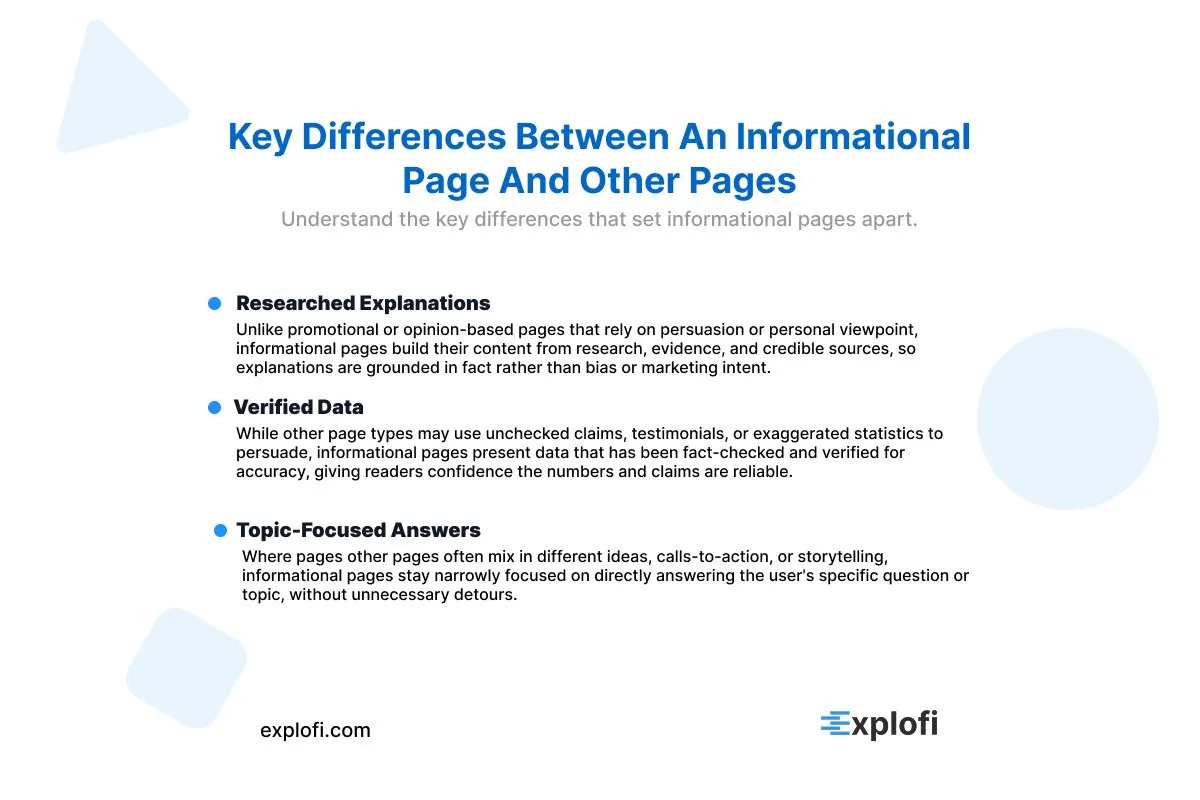
Unlike transactional pages, informational websites don't feature a CTA button pushing purchases or sign-ups. Product pages drive conversions, landing pages capture leads, but informational pages deliver:
- Researched explanations
- Verified data
- Topic focused answers
The user experience here centers purely on knowledge delivery, not funneling visitors toward a sale.
The Role of Informational Pages in the Modern Web Ecosystem
Informational websites function as the web's primary knowledge infrastructure, sitting alongside social media and search engines as core content sources. Their roles include:
- Answering specific queries
- Reducing misinformation
- Supporting research driven browsing experiences
Common Formats an Informational Page Can Take
Informational pages commonly appear in formats like:
- How-to guides
- FAQ pages
- Glossaries
- Encyclopedia style articles
Each format shapes the website layout differently. A glossary uses alphabetical navigation, while a how-to guide relies on sequential headers. The chosen format directly determines the web design structure needed to present complex topics clearly.
Key Characteristics That Define a High-Quality Informational Page
Regularly updating content is one measurable signal of page quality, as outdated content can drop organic traffic by up to 30%. Beyond freshness, a high-quality informational site maintains clear content hierarchy, where each section directly supports the page's core topic without deviation or filler that dilutes relevance.
Accuracy and Credibility of the Content Presented
Verified data and authoritative citations separate credible informational websites from misleading ones. Sources like government databases and peer-reviewed studies benchmark accuracy, with studies showing 63% of users abandon sites presenting unverifiable claims, directly undermining an informative website's core purpose.
Clarity, Readability, and Accessible Language
Plain language directly impacts retention. Studies show readers comprehend content 20% faster when written at a 6th-8th grade reading level. Accessible language on informational websites means:
- Short sentences under 20 words
- Active voice over passive constructions
Depth of Coverage on a Given Topic
Thorough topic coverage means addressing related subtopics, counterarguments, and real-world applications. High-quality informational websites typically include:
- Supporting data
- Contextual examples
- Relevant content across subtopics
Google's guidelines confirm that topical depth directly influences search ranking.
How Informational Pages Fit Into a Website's Overall Structure
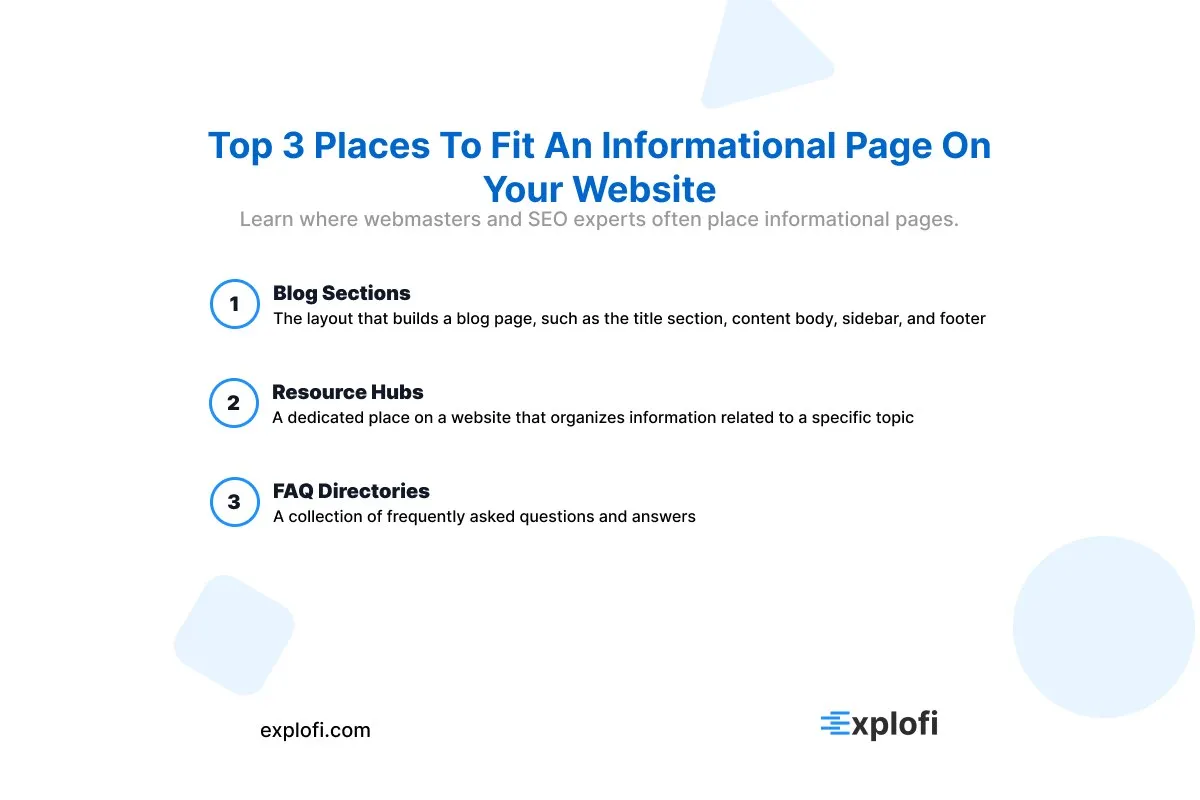
Informational pages typically anchor a site's navigation bar, serving as the backbone between transactional and educational content. They commonly slot into:
- Blog sections
- Resource hubs
- FAQ directories
Organizing Content Into Clear and Logical Categories
Logical grouping, like clustering related topics under broad parent categories, reduces cognitive load by up to 40%, keeping users oriented across informational websites. A clear website design hierarchy, such as "Health > Nutrition > Vitamins," mirrors how users naturally process information.
Building User-Focused Navigation Around Informational Content
Effective navigation on informational websites prioritizes content discoverability through:
- A sticky search field
- A simple header with category links
- A hamburger menu for mobile device users
Studies show that 94% of users cite easy navigation as the most critical website feature.
Using Internal Links, Tags, and Filters to Connect Related Pages
Tags and filters cluster related content, while internal links guide users across an informational website's deeper pages. Effective linking structures include:
- Contextual anchor text links
- Tag based content groupings
- Category filters
The Primary Goals of an Informational Page
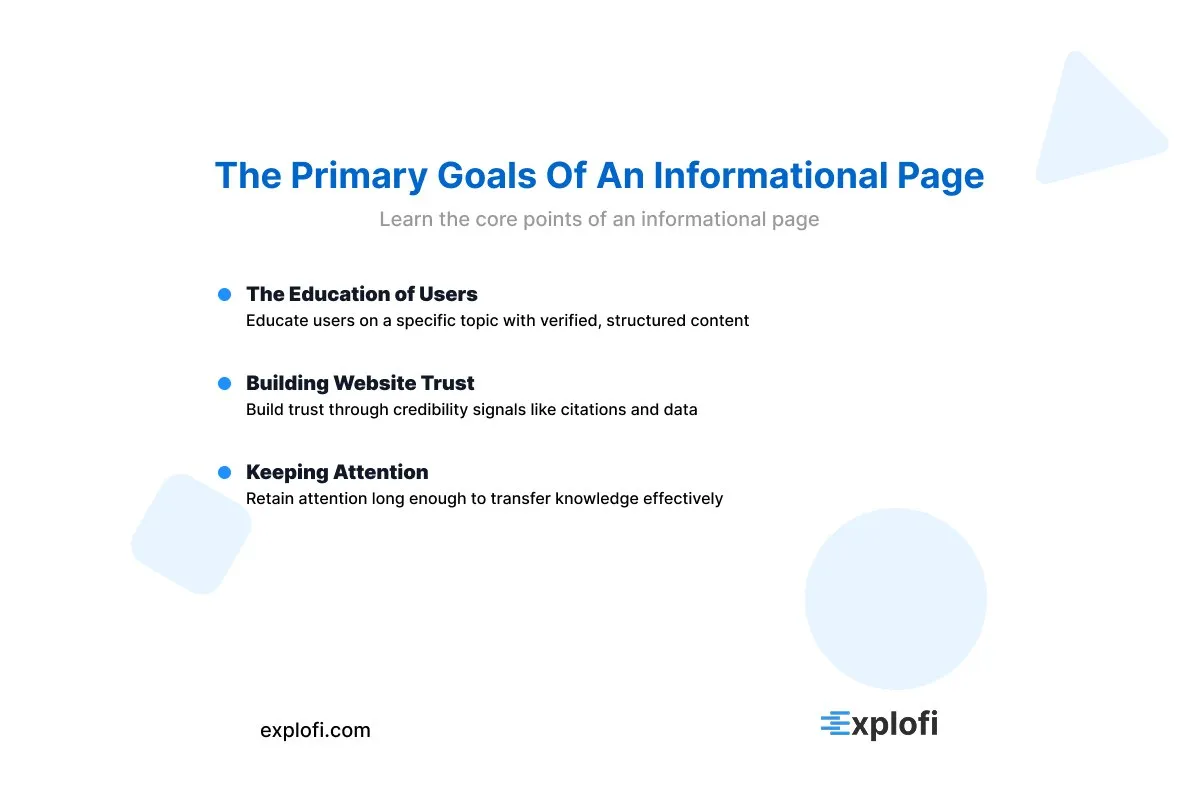
Informational websites are built around three core goals:
- Educate users on a specific topic with verified, structured content
- Build trust through credibility signals like citations and data
- Retain attention long enough to transfer knowledge effectively
Among these, education remains the primary driver. Research from the Nielsen Norman Group confirms that 94% of users visit informational websites specifically to learn, not to purchase. Maintaining a strong online presence through well-structured informational pages directly determines whether that learning objective is met or abandoned.
Educating and Informing the Target Audience
Targeted audiences absorb information most effectively when content addresses:
- Specific pain points
- Verified data points
- Real world use cases
Informational websites built around these elements see 40% stronger engagement than broadly structured pages.
Building Authority and Trust Within a Specific Niche
Consistent, niche-focused content builds domain authority that search engines reward, with topical depth increasing organic rankings by up to 30%. Informational websites that own a specific subject earn 3x more backlinks, signaling trust to both algorithms and readers.
Supporting Broader Business or Organizational Objectives
Informational websites often serve a function beyond education, reinforcing brand authority and organizational trust. Aligned objectives typically include:
- Driving organic search visibility
- Building credibility within a niche
- Supporting lead pipelines indirectly
Types of Informational Pages Commonly Found Online
Common informational website examples include wikis, encyclopedias, government portals, and online magazines, each structured to deliver verified facts rather than drive purchases.
Encyclopedia and Wiki-Style Reference Pages
Encyclopedia and wiki-style reference pages organize knowledge into structured, interlinked entries. Reliable informational websites like Wikipedia cite over 90 million sources globally, featuring:
- Verified citations
- Neutral point of view policies
- Cross referenced internal links
How-To Guides and Explainer Pages
How-to guides typically break complex processes into digestible steps, such as:
- Sequential actions
- Visual aids
- Estimated completion times
These structures improve task completion rates by up to 323%, according to research on instructional content formats.
News and Editorial Informational Pages
News and editorial pages deliver verified reporting and opinion-based content, typically structured around:
- Breaking news articles
- Op-eds and columns
- Factchecks
Informational websites like Reuters publish over 2,000 stories daily, distinguishing factual reporting from editorial perspective.
Research-Based and Data-Driven Informational Pages
Research-based informational pages rely on verified datasets from sources like Data USA, which aggregates U.S. census records, employment figures, and demographic statistics. These informational websites present structured findings, often citing peer-reviewed studies or government-published metrics, to establish measurable credibility.
The Stages of Developing an Effective Informational Page
Developing an effective informational page follows a clear progression that shapes how content gets built and structured. The stages typically include:
- Defining the core topic and user intent
- Researching verified, structured data to support claims
- Outlining content hierarchy before writing
- Building internal linking architecture
- Testing readability and navigation flow
Website development at this level demands that each stage directly informs the next, since skipping outline planning, for instance, often produces fragmented content that drops average session durations by nearly 38%.
Defining the Goals and Requirements of the Page
Clear goals drive every decision in page development. Before writing a single word, define:
- The target audience's knowledge level
- The specific information gap being addressed
- Measurable success metrics like dwell time or bounce rate
Planning the Content Structure and Information Hierarchy
Mapping content into a clear hierarchy shapes how users absorb information. This concept is commonly describes as on page seo. Prioritize structure using:
- Primary topic
- Supporting subtopics
- Evidence and examples
Informational websites perform 47% better in engagement when content follows a logical, layered hierarchy.
Designing the Layout for Readability and Engagement
Layout choices like white space, font size, and column width directly shape how long users stay. Research shows pages with clear visual hierarchy see up to 58% higher retention, making spacing and contrast critical, not optional:
- F-pattern or Z-pattern scanning zones
- Sticky elements anchoring navigation
Developing and Refining the Written Content
Refining written content requires clarity at the sentence level, with an average reading level of Grade 8 ensuring broad accessibility. Effective content typically follows:
- Active voice
- Short paragraphs under 3 sentences
- Keyword integrated headers
Testing for Usability, Accuracy, and Performance
Run Google Lighthouse to score your informational websites on performance, accessibility, and SEO, targeting:
- A score of 90+ in each category
- Load times under 2.5 seconds
- Zero critical accessibility violations
Publishing and Ongoing Maintenance of the Page
After publishing, informational websites require scheduled audits to stay accurate and relevant. Key maintenance tasks include:
- Reviewing outdated statistics
- Fixing broken links
- Refreshing metadata
Content older than 12 months loses up to 37% of its organic traffic without updates.
Frequently Asked Questions
What Is the Purpose of an Informational Page?
An informational page serves to educate readers on a specific topic by presenting facts, data, and relevant details in a clear, organized manner. Its purpose is to answer common questions, clarify complex subjects, and provide reliable guidance. Unlike promotional content, informational pages prioritize accuracy and usefulness, helping readers make informed decisions or better understand a subject.
How Is an Informational Page Different From Other Types of Web Pages?
An informational page is designed purely to educate readers, unlike product pages that drive purchases or landing pages built for conversions. While other web page types prioritize calls to action or lead generation, an informational page focuses on answering questions and explaining topics, making it a key part of a website's content strategy for organic search visibility.
What Are the Key Elements of a Well-Structured Informational Page?
A well-structured informational page typically includes a clear headline, organized body content, and credible sourcing. According to Google's Search Quality Evaluator Guidelines, pages should demonstrate expertise, authoritativeness, and trustworthiness (E-E-A-T). Strong informational pages also prioritize readability, logical flow, and accurate data to effectively serve user intent and improve overall search visibility.
Who Is the Target Audience for an Informational Page?
The target audience for an informational page is anyone seeking clear, factual answers on a specific topic. This typically includes students, researchers, and general readers looking for reliable content. These pages are designed to educate rather than sell, making them valuable to broad audiences across different knowledge levels, from beginners exploring a subject to professionals needing quick reference material.