Deep Dive with AI
What Is Parasite SEO and Why Small Businesses Should Care
Parasite SEO is a digital marketing strategy where you publish content on authority sites like Forbes, Medium, or Reddit instead of your own domain. Rather than spending years trying to build authority from scratch, you leverage the existing domain authority of an established platform to rank for competitive keywords faster.
For small businesses stuck in highly competitive niches, this distinction matters enormously. Google's own documentation confirms that search engine algorithms weigh domain authority heavily when determining search engine rankings, which is why a brand-new website struggles to compete against platforms with decades of established history.
Traditional SEO can take 6 to 12 months to show results, while parasite content on high-authority platforms can index within days.
The Core Concept Behind Parasite SEO in Digital Marketing
Parasite SEO works by publishing optimized content on high authority third-party websites rather than building ranking power from scratch on your own domain. The core idea is straightforward: instead of waiting months for your main site to build domain authority, you leverage platforms that Google already trusts deeply.
Authority sites like Medium, LinkedIn, or Reddit carry domain authority scores often exceeding 90 out of 100, meaning content published there can rank for competitive keywords far faster than a brand-new domain ever could. For small businesses operating in high competition markets, this gap in platform authority is the strategic advantage worth exploiting through a deliberate parasite SEO strategy.
How Borrowed Authority Creates Faster Search Rankings
Publishing content on authority websites transfers their domain trust directly to your content, letting search engines index and rank it faster than a brand-new site ever could. A site with strong domain authority, like a DR 90+ platform, signals credibility Google already trusts, cutting the typical ranking timeline from months to days for competitive keywords.
Why the Term "Parasite" Accurately Describes This Strategy
The term "parasite" fits because the strategy borrows ranking potential from authority websites without building independent domain strength. Like a biological parasite, it survives by attaching to established hosts, leveraging their authority signals rather than developing its own.
The Difference Between Parasite SEO and Traditional Link Building
Unlike traditional link building, which focuses on earning backlinks to your own domain, parasite SEO places promotional content directly on authority sites that already rank. This skips the years-long process of building domain authority independently.
- Borrowed authority ranks faster
- No technical optimization required on your site
How Parasite SEO Works Step by Step for Small Businesses
Parasite SEO works by publishing quality content on authority websites that already hold strong domain ratings, effectively borrowing their credibility to rank for competitive keywords faster than building a new domain from scratch. A small plumbing business in a competitive market, for example, could publish a focused, detailed article on a platform like Medium or a Reddit post to capture local service searches without waiting years for natural ranking to develop.
Google consistently indexes content from high-authority domains within hours, compared to weeks for newer sites. The key is selecting platforms with genuine user trust, then optimizing that content around your target keywords while linking strategically back to your main site.
Step 1: Identifying High-Authority Platforms Worth Targeting
Platforms with a Domain Authority (DA) above 70, like LinkedIn, Medium, or Reddit, are prime targets since Google consistently ranks their pages within days. These authority sites already hold trust signals that take years to build organically, giving small businesses immediate access to competitive keywords.
Step 2: Creating Keyword-Optimized Content for Host Platforms
Content published on authority sites needs exact-match and semantic keywords woven naturally into the body, headers, and meta descriptions. Google's quality content guidelines reward pieces that match search intent, so focused content targeting competitive keywords on platforms like Medium or LinkedIn can index within 24 to 48 hours.
Step 3: Leveraging Domain Authority to Outrank Established Competitors
By publishing on authority websites with domain authority (DA) scores of 70+, small businesses can rank for competitive keywords that would otherwise take years to achieve. Google's algorithm heavily weights domain trust, meaning a well-optimized post on a high-DA platform can outrank an established competitor's homepage within weeks of faster indexing.
Step 4: Converting Platform Traffic Into Leads and Sales
Once platform traffic arrives, converting it requires a direct call-to-value within the content itself. Effective conversion elements include:
- Trackable links
- Lead magnets
- Embedded contact forms
These tools help local businesses capture measurable results from their SEO efforts.
Parasite SEO vs Traditional SEO: A Side-by-Side Comparison for Small Businesses
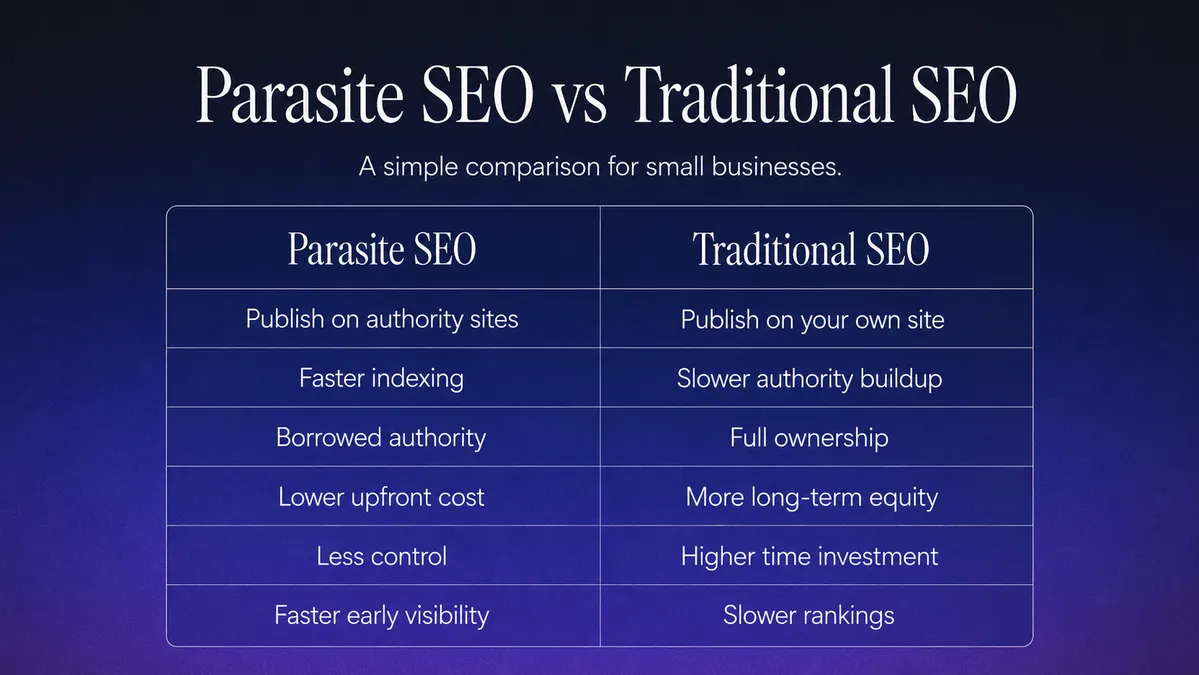
Traditional SEO builds authority gradually through link-building, technical optimization, and creating content that earns trust with search engines over 6 to 12 months on average. Parasite SEO, by contrast, borrows the domain authority of established authority sites like Forbes or Medium to rank competitive keywords in weeks rather than months.
For local businesses operating in competitive markets, that speed difference is significant. Relying solely on traditional SEO means competing against domains with years of authority stacked behind them. Google's site reputation abuse policy, updated in 2024, does add a layer of risk to parasite SEO, but when executed with quality content on legitimate platforms, rankings can appear within days of publication.
Speed of Results Between the Two Approaches
Parasite SEO content published on authority sites like Forbes or Medium can rank within days, while traditional SEO typically takes 6 to 12 months before Google registers meaningful domain authority gains.
Cost and Resource Requirements for Each Strategy
Traditional SEO demands $500-$5,000 monthly for link building, technical audits, and quality content creation, while parasite SEO on authority sites like Medium or Reddit costs significantly less, often requiring only time and strategic placement on established platforms.
Long-Term Sustainability and Risk Factors
Traditional SEO builds equity you own, while parasite SEO depends on platforms you don't control. Google's algorithm updates, like the 2024 Helpful Content Update, have demoted third-party hosted content by up to 40%, making authority sites vulnerable. Building owned assets through traditional SEO remains more resilient against such ranking volatility long-term.
Why Parasite SEO Works So Well for Competitive Keywords
Competitive keywords with high search volume are notoriously difficult to crack through traditional SEO alone, especially for smaller sites with limited domain authority. Parasite SEO sidesteps this barrier by leveraging authority sites like Forbes, Medium, or Reddit, which already hold domain authority scores above 90 on a 100-point scale.
Search engines inherently trust these platforms, meaning content published on them can rank for competitive keywords within days rather than the months it typically takes a new domain. The key factors that make this strategy effective include:
- Pre-established domain trust signals
- High page crawl frequency by Google bots
- Existing backlink profiles with thousands of referring domains
- Builtin audience traffic that reinforces engagement metrics
Quality content placed on these authority websites essentially borrows their credibility, giving smaller publishers a real ranking advantage.
How High-Authority Domains Instantly Boost Content Visibility
Publishing on authority websites with Domain Authority scores above 70 gives content an immediate trust signal that Google recognizes, often pushing published pieces onto page one within days rather than the months *traditional SEO* typically requires.
The Role of Trust Signals in Fast Indexing and Ranking
Trust signals like domain age, backlink profiles, and engagement metrics tell search engines which platforms to crawl and index first. Authority sites with thousands of existing backlinks get new content indexed within hours, bypassing the weeks-long wait traditional SEO requires.
Why Small Business Websites Struggle With the Same Keywords Alone
Competing for high-volume keywords against established domains is nearly impossible without significant domain authority. Google's algorithm weighs a site's trust signals heavily, and new small business sites typically score below 20 on domain authority scales, making page-one rankings statistically unlikely.
Who Should Be Using Parasite SEO as a Growth Strategy
Parasite SEO works best for businesses that struggle to compete against established authority websites in search engines. Local businesses, specifically those serving a defined service area, benefit most since platforms like Yelp or Google Business Profile already carry domain authority scores above 90.
As a SaaS founder, I've seen early-stage companies with little domain authority gain traction by publishing quality content on high-authority platforms rather than waiting years for traditional SEO to compound. Businesses with limited technical resources also fit this model well, since parasite SEO sidesteps crawl errors, indexing delays, and other technical issues that typically slow ranking progress.
Small Businesses in Crowded Local Markets
Local businesses operating in saturated markets, like plumbing or roofing, struggle to compete against established competitors through traditional SEO alone. Parasite SEO bypasses this by leveraging authority sites like Yelp, Angi, or HomeAdvisor, which already rank on Google's first page. These platforms offer:
- Instant credibility from high domain authority pages
- Visibility without years of link building
E-Commerce Sellers Looking to Rank Product Pages Faster
Product pages are notoriously difficult to rank through traditional SEO, often taking 6 to 12 months to gain traction. By publishing content on authority sites like Medium, Reddit, or industry-specific platforms, e-commerce sellers can leverage those domains' established trust with Google to surface product-related content far faster, sometimes within days, reaching buyers already deep in the purchase funnel.
Service-Based Businesses Targeting Niche Audiences
Service-based businesses targeting niche audiences gain the most from publishing on authority sites like Yelp or LinkedIn, where local SEO signals amplify visibility. A plumber serving a specific borough, for instance, can outrank broader competitors by positioning quality content on platforms Google already trusts at a domain authority above 70.
The Best Platforms for Parasite SEO in 2025
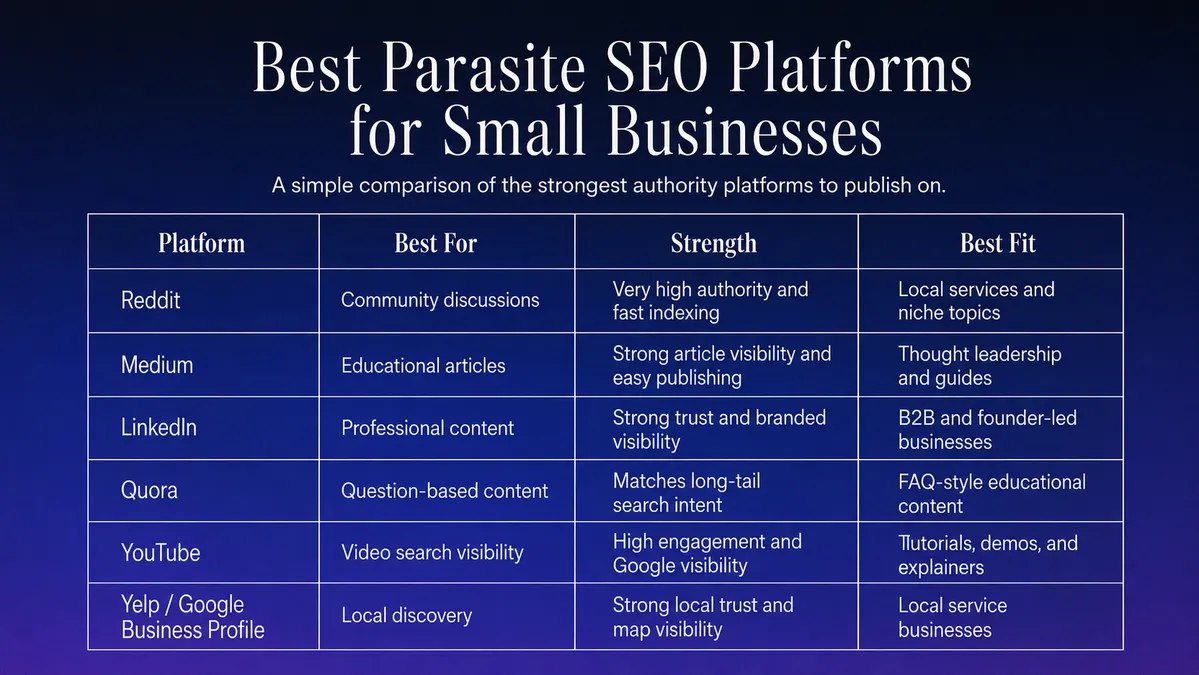
Platforms that carry the most domain authority tend to deliver the strongest parasite SEO results, and a few stand out heading into 2025. Reddit, for instance, holds a domain rating of 91 according to Ahrefs, making it one of the most powerful authority sites for ranking content quickly. Medium follows closely, with publications on the platform regularly appearing on the first page of Google for competitive keywords.
LinkedIn articles also perform exceptionally well, particularly for B2B-focused quality content targeting niche service providers. For local businesses, Yelp and Google Business Profile remain highly effective, as both platforms consistently rank in local search results, often outpacing traditional website listings in local SEO performance.
Reddit as a High-Authority Platform for Local Business Visibility
Reddit's domain authority score sits at 91/100, making it one of the most trusted platforms on Google. Local businesses can leverage subreddits like r/AskLocalCommunity to gain organic visibility through authentic community recommendation rather than paid placement.
Medium as a Publishing Platform for Thought Leadership Content
Medium's domain authority score of 93 makes it a prime platform for thought leadership content. Publishing here lets local businesses establish authority through:
- Long form, research backed articles
- Niche specific publications
- SEO optimized story tags
LinkedIn Articles for B2B and Service-Based Industries
LinkedIn's domain authority score sits at 98 out of 100, making published articles there rank on Google faster than most traditional SEO efforts. For B2B and service-based industries, this means a well-optimized LinkedIn article targeting quality content can outrank authority websites within days.
Quora as a Question-and-Answer Platform for Niche Targeting
Quora's domain authority score sits at 93 out of 100, making it one of the strongest authority sites for parasite SEO. Its question-and-answer format lets local businesses target niche queries directly, with answers ranking on Google for highly specific, low-competition keywords.
YouTube as a Video SEO Platform With Massive Search Authority
YouTube holds a Domain Authority of 100, making it one of the strongest authority sites for parasite SEO. Google indexes YouTube videos within hours, and with quality content optimized around targeted keywords, those videos frequently appear on Google's first page, giving local businesses a faster path to visibility than traditional SEO ever could.
Amazon, Etsy, and eBay for Product-Based Parasite SEO Opportunities
Amazon, Etsy, and eBay collectively attract over 3 billion monthly visits, making them prime authority sites for product-based parasite SEO. Listings on these platforms consistently rank on Google, bypassing the need for traditional SEO groundwork entirely.
How to Select the Right Parasite SEO Platform for Your Business
Choosing the right platform comes down to one critical factor: domain authority. As a founder who has tested this process extensively, platforms with a Domain Authority (DA) score of 70 or higher on tools like Moz tend to deliver the fastest ranking results on Google. Sites like Medium (DA 95), LinkedIn (DA 98), and Reddit (DA 95) consistently rank because search engines treat them as trusted authority sites.
When evaluating your options, look for platforms that offer:
- Indexing speeds under 48 hours
- High engagement metrics like comments and shares
- Niche relevance to your industry
- Permissive content publishing policies
Niche relevance matters because Google's Quality Rater Guidelines specifically reward quality content that aligns closely with the host platform's core audience.
Matching Your Industry to the Most Relevant High-Authority Platform
Industry alignment matters when selecting authority sites. LinkedIn dominates B2B content, with over 1 billion users, while Google favors Reddit for consumer queries, ranking it in roughly 99% of niches across local businesses and service-based industries.
Using SEO Tools Like Ahrefs to Identify Platform Opportunities
Ahrefs' Site Explorer can pinpoint which authority sites already rank for your target keywords, revealing the best platforms for parasite SEO placement. By filtering domains with a Domain Rating above 70, you can identify high-authority websites that search engines already trust. For example, a Medium article ranking on page one signals that Google rewards content published there.
Evaluating Platform Domain Authority and Audience Fit Before Publishing
Platforms with a domain authority (DA) above 70, like Medium or LinkedIn, signal credibility to Google, directly impacting ranking speed. Beyond DA, audience alignment matters just as much, since publishing on authority sites with mismatched readership weakens engagement signals.
How to Create Intent-Focused Content for Parasite SEO Success
Intent-focused content means writing specifically for what a searcher wants to find, not just what ranks well. When building parasite SEO content on authority sites like Medium or LinkedIn, matching search intent precisely is what separates content that converts from content that disappears. Google's algorithms evaluate whether content satisfies the searcher's goal, which is why quality content must align with informational, navigational, or transactional intent.
For local businesses, this means targeting transactional queries like "best plumber near me" rather than broad informational terms. Studies show that content matching exact search intent generates up to 3x more organic clicks, making intent alignment one of the highest-leverage moves in any parasite SEO strategy.
Building a Content Map Around Search Intent and Buyer Stages
Mapping content across buyer stages means aligning each piece with awareness, consideration, or decision intent. When building for parasite SEO on authority sites, target:
- Awareness: "what is" and "how does" queries
- Consideration: comparison and review keywords
- Decision: pricing and location specific terms
Google rewards this structure with stronger rankings.
Integrating Semantic Keywords to Strengthen Content Relevance
Semantic keywords signal topical depth to search engines, with studies showing content covering related terms ranks 3.5x more often in featured snippets. Pairing primary terms with LSI variations strengthens relevance signals on authority sites, improving content visibility substantially.
Structuring Parasite Content for Faster Indexing by Search Engines
Structured parasite content gets indexed faster when it includes a clear H1, keyword-rich subheadings, and internal links pointing to high-traffic pages on authority sites. Google's crawl budget prioritizes well-organized pages, so placing target keywords within the first 100 words signals relevance immediately.
Quality content with proper schema markup can cut indexing time from weeks to under 48 hours.
Aligning Entity and Topic Signals With the Host Platform's Content
Google's search algorithm weighs topical relevance heavily, meaning your parasite SEO content must mirror the host platform's established entity signals. Publishing a local business guide on a platform known for quality content in that niche strengthens topical authority, since Google's systems recognize contextual alignment between the host and published content.
Real-World Examples of Successful Parasite SEO Strategies
One of the clearest examples of parasite SEO working in practice involves local businesses publishing optimized listicles on platforms like Yelp, Medium, or Reddit. These authority sites already carry massive domain authority scores, often above 90 on a 100-point scale, which means content published there ranks significantly faster than content on a brand-new domain.
A small bakery, for instance, could publish a detailed guide on Medium targeting a specific neighborhood keyword and appear on Google's first page within days. Traditional SEO on a new domain typically takes six to twelve months to show comparable results, making quality content placed on authority websites a measurably faster path to visibility for local businesses competing in crowded markets.
Small Businesses Using Reddit Threads to Generate Local Leads
Local businesses have found measurable success posting in city-specific subreddits like r/Austin or r/Chicago, where threads rank on Google for hyper-local queries. A well-crafted post targeting local community searches can generate leads through:
- Organic search visibility
- Direct subreddit engagement
How Medium and LinkedIn Posts Rank for Competitive Industry Terms
Medium and LinkedIn hold domain authority scores above 90, allowing posts on these platforms to outrank dedicated websites for terms like "best CRM software for startups," where traditional SEO campaigns often require 12+ months to gain traction.
Product Listings That Dominate Google Search Results Pages
Amazon and eBay product listings consistently rank on Google's first page because these authority sites carry domain ratings above 90, according to Ahrefs data. A small business listing products on these platforms benefits from that inherited trust, bypassing the traditional SEO timeline of building domain authority from scratch.
Q&A Responses on Quora That Drive Consistent Organic Traffic
Quora answers targeting high-volume questions rank on Google within days, not months, because Quora's domain authority hovers around 93. A single detailed answer addressing "how to fix [problem]" can generate thousands of monthly views consistently.
Parasite SEO for Local SEO: How They Work Together
Parasite SEO and local SEO are a surprisingly powerful combination for local businesses trying to break into competitive markets. Publishing optimized content on high-domain authority sites like Yelp, Google Business Profile, or industry-specific directories gives your business a shortcut to Google's first page, often within days rather than months.
According to BrightLocal, 98% of consumers used the internet to find local businesses in 2022, making local visibility critical. Authority sites already hold significant trust with search engines, so building geo-targeted content on these platforms inherits that credibility instantly. For example, a plumber in Austin publishing a keyword-rich article on a DA 80+ site can outrank competitors relying solely on traditional SEO methods for months.
Using Parasite Content to Support Google Business Profile Rankings
Parasite content on authority websites can directly reinforce Google Business Profile rankings by generating external signals that validate local relevance. Publishing on platforms like Yelp or Medium with location-specific terms strengthens:
- NAP consistency signals
- Local keyword associations
- Profile engagement rates
Creating Locally Targeted Content on High-Authority Platforms
Publishing locally targeted content on authority websites like Medium, LinkedIn, or Yelp lets local businesses borrow domain ratings above 90 to rank city-specific keywords faster. A post titled "Best Plumber in Austin" on Medium can outrank traditional SEO efforts within days.
How Local Parasite SEO Fills Gaps That Traditional Local SEO Misses
Traditional local SEO depends heavily on building domain authority over time, which can take 6 to 12 months before ranking shifts become noticeable. Local parasite SEO bypasses this by placing quality content on authority websites that Google already trusts, targeting geo-specific keywords competitors overlook. For the foundational, owned-site version of this work, see how to rank a small business website on Google without an agency.
For local businesses in saturated markets, this fills a critical visibility gap that traditional SEO structurally cannot address quickly.
Frequently Asked Questions
What is parasite SEO in simple terms?
Parasite SEO is the practice of publishing content on high authority third party platforms like Reddit, Medium, LinkedIn, and Yelp to rank for keywords faster than your own website can. Instead of waiting 6 to 12 months for your own domain to build authority, you borrow the trust Google already has in established platforms to get your content ranking within days. The name comes from the idea that your content lives on someone else's domain and benefits from their authority without building its own.
Is parasite SEO against Google's guidelines?
Parasite SEO is not against Google's guidelines when done correctly. Publishing genuinely useful, high quality content on legitimate platforms is fully within what Google allows. The risk comes when people publish thin, spammy, or manipulative content purely to exploit a platform's domain authority. Google's 2024 site reputation abuse policy specifically targets low quality parasite content, not legitimate publishing on established platforms. If your content genuinely helps the reader and is relevant to the platform you are publishing on, you are operating within the rules.
What are the best platforms for parasite SEO for small businesses?
The best platforms for small businesses depend on your business type. Local service businesses like plumbers, HVAC companies, and cleaners should focus on Yelp, Google Business Profile posts, and local directories. B2B and professional service businesses should focus on LinkedIn articles and Medium. Any business trying to capture question-based queries should publish on Reddit and Quora. YouTube is the strongest platform for any business type because it holds a domain authority of 100 and Google indexes video content within hours.
How long does it take for parasite SEO content to rank?
Content published on high authority platforms can rank within 24 to 48 hours in many cases. Reddit threads and Quora answers are often indexed by Google within hours of being posted. Medium and LinkedIn articles typically appear in search results within a few days. This is dramatically faster than traditional SEO on a new domain which can take 6 to 12 months before seeing meaningful ranking movement. The exact timeline depends on how competitive the keyword is and how well the content matches search intent.
Can parasite SEO replace building my own website's SEO?
No. Parasite SEO is a bridge not a permanent solution. The platforms you publish on can change their policies, remove your content, or lose ranking authority at any time. Content published on third party platforms is also content you do not own or fully control. The right approach is to use parasite SEO to drive early traffic and visibility while simultaneously building your own content library, service pages, and topical authority on your own domain. Over time your own site becomes the primary driver of traffic and the parasite content continues sending signals back to reinforce it.
How does parasite SEO work for local businesses specifically?
For local businesses parasite SEO works best by targeting platforms that already rank in local search results. Yelp, Google Business Profile posts, Angi, and local directories all carry high domain authority and consistently appear on the first page of Google for local service searches. Publishing keyword-optimized content on these platforms with your business name, location, and services mentioned naturally can get you appearing in local search results far faster than building that visibility through your own website alone. A plumber in Dallas publishing a detailed Yelp profile and regular Google Business Profile posts can outrank competitors who have been relying solely on their own website for years.