
Article Summary: Domain authority is a score from 0 to 100 that measures how likely a website is to rank in search results based on the strength of its backlink profile. It is not a Google ranking factor, but it is one of the most useful benchmarks for understanding where your site stands against competitors and what it will take to outrank them. This guide covers what domain authority is, how it is calculated, what scores mean for small businesses in different industries, the difference between domain authority and similar metrics, how to check your score, and the most effective strategies to build it over time.
Deep Dive with AI
What Is Domain Authority?
Domain Authority (DA) is a predictive metric created by Moz in 2009 to score websites on a logarithmic scale from 0 to 100 based on their likelihood of appearing high in search engine results. The logarithmic scale means that increasing DA from 70 to 80 requires much more effort than boosting it from 10 to 20.
Although DA is not an official Google ranking factor, it serves as a useful benchmark by considering factors such as:
- Quality and quantity of backlinks
- Site structure and content quality
- Social signals and search engine accessibility
Moz's calculations are based on data from over 45.5 trillion links across more than one billion domains, making their backlink profile highly reliable for measuring a site's ranking potential compared to competitors.
How Domain Authority Differs From Page Authority
While Domain Authority (DA) measures the overall ranking strength of a website, Page Authority (PA) assesses the ranking potential of an individual page. Both scores range from 0 to 100 and use machine learning models that consider over 40 factors, such as link anchor text distribution and MozTrust.
A major difference is in stability: DA tends to remain more consistent because it's based on a website's cumulative backlink profile, whereas PA can change more frequently due to fluctuations in individual pages' links. For competitor analysis and building opportunities, understanding both scores offers valuable insights into your SEO performance at both the site and page levels.
The History Behind the Domain Authority Metric
Moz introduced Domain Authority in 2009 as a way to measure the strength of a website's backlink profile, which Google's algorithm heavily considers. The metric is based on data from Moz's Link Explorer, which monitors over 45.5 trillion links across more than one billion domains. Over time, Moz improved the scoring model through domain authority updates, changing how factors like referring domains and link quality were considered.
Since Domain Authority uses a logarithmic scale, these updates sometimes caused changes in scores, even if a site's backlink profile remained unchanged.
How Domain Authority Is Calculated
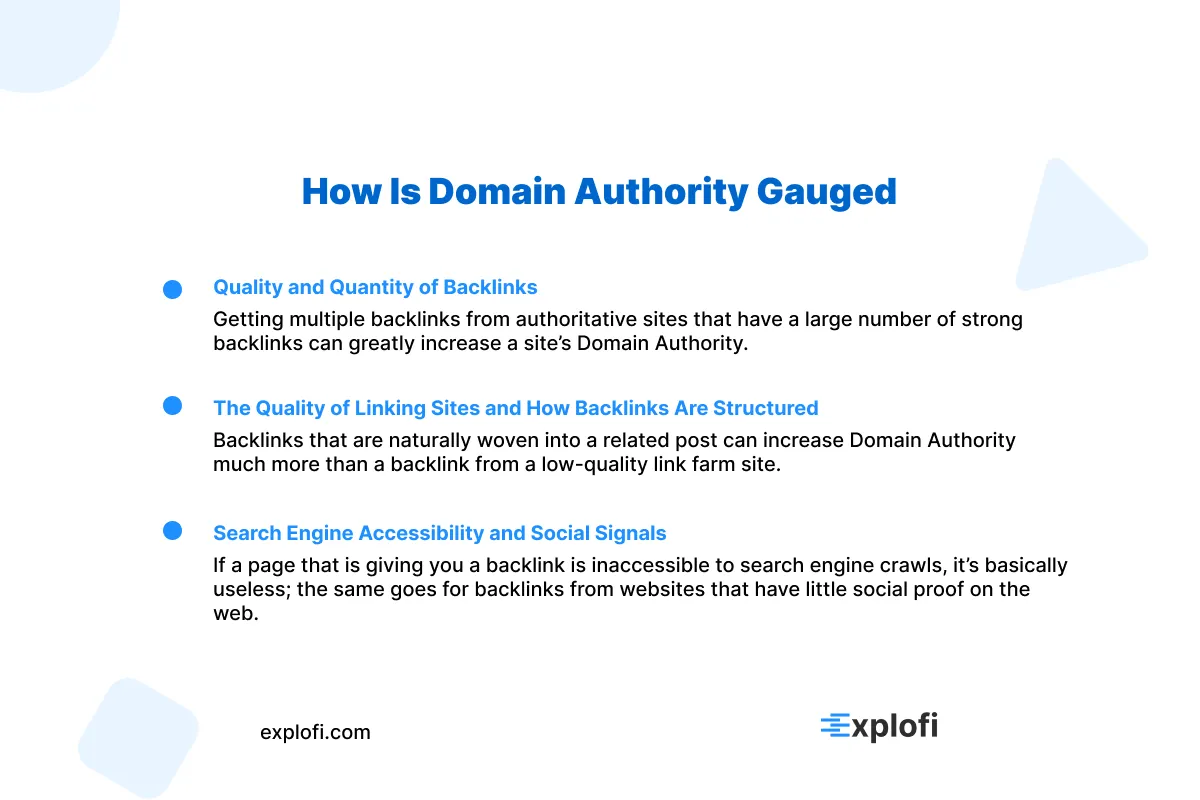
Moz's machine learning algorithm calculates domain authority by considering several important factors that together determine a site's ranking potential. The key inputs include:
- The number of relevant sites linking to your site
- The quality of those referring domains
- Your overall backlink profile strength
- Your site's spam score compared to competitors
Notably, 3, providing a vast comparison base for its algorithm. A clean link profile from diverse, relevant sites is much more valuable than just having many links. For example, 50 high-authority referring domains will generally outperform 500 low-quality ones when search engines evaluate your authority scores.
The Role of Backlinks in Your Score
Backlinks tell search engines that your content is valuable and can boost your Domain Authority (DA) score based on the number and quality of backlinks you have. Moz considers several factors in its calculation, such as:
- The total count of unique domains linking to your site
- The quality of those referring domains
- The diversity of your overall backlink profile
Getting high-quality links from reputable sites is much more beneficial than having many spammy or low-quality links. For example, a single link from a highly authoritative site like The Independent can significantly increase your DA score, whereas dozens of links from less credible sources might not have as much impact.
How Linking Root Domains Factor Into the Formula
Linking root domains indicate the number of unique external websites that point to your site, and their variety affects your Domain Authority (DA) score. The formula considers:
- The total count of distinct domains linking to your site
- The authority level of each referring domain
- How relevant those referring domains are to your niche
High-authority, relevant backlinks hold more weight than just the number of links. So, ten high-quality links from authoritative sources would be better than having hundreds of links from low-quality sites.
Why Your Score Is Relative to Other Websites
DA is a relative measure; your score depends on how it compares to your competitors. For instance, a DA of 40 could be impressive in one field but not in another.
Here are some relative benchmarks:
- DA 1 to 20: These are new or low-authority sites.
- DA 21 to 40: This range includes developing sites.
- DA 41 to 60: Sites in this category are considered established competitors.
- DA 61 to 80: These are strong, well-established sites.
What Is a Good Domain Authority Score for a Small Business
For small businesses, a good domain authority score depends on the competitive landscape of your industry. A domain authority (DA) of 30 could be impressive in a less competitive field but might not be as strong in a more crowded market. Instead of focusing on an arbitrary number, it's better to compare your DA with those of direct competitors using tools that track domain authority metrics.
Similarly, the Ahrefs Domain Rating works on a scale from zero to one hundred, where higher scores indicate stronger authority, but they only make sense when compared to similar websites. Monitoring these domain authority metrics can show if your SEO efforts are paying off. An increasing score suggests that your backlink profile is improving, while a decrease might signal problems that need addressing.
Domain Authority Score Ranges Explained
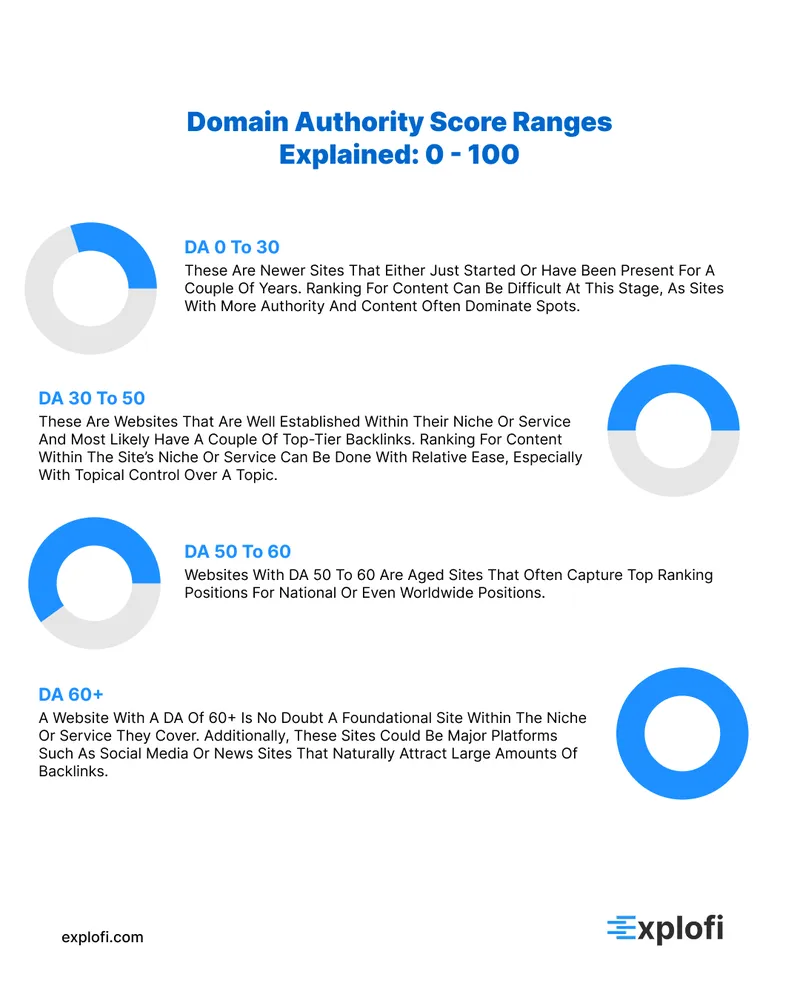
DA scores are categorized into different ranges that show a site's competitive standing:
- DA 0 to 30: These sites are in the early stages, working on gaining authority.
- DA 30 to 50: Sites in this range are well established and have moderate link profiles.
- DA 50 to 60: Strong competitors with quality backlinks can be found here.
- DA 60 and above: These sites are highly authoritative and dominate search engines.
Improving these scores requires time and consistent effort in link building. Moving from a DA of 35 to 45 could take around 12 to 18 months, while reaching a DA between 55 and 65 might need two to three years of earning backlinks from authoritative referring domains. It's normal for there to be monthly fluctuations of two to five points during this process.
How Industry and Niche Affect Your Benchmark
Industry benchmarks for authority scores can differ greatly, so comparing with competitors can be more helpful than aiming for an arbitrary number. A local business in a niche with little competition might consider a Domain Authority (DA) of 30 as highly competitive, whereas the same score could indicate weakness in finance or legal sectors.
The best strategy is to use tools like Moz Link Explorer to benchmark against your direct competitors. In such cases, if a DA of 42 is the top score in your niche, that would be a more realistic target for you.
Why New Websites Start With Low Scores
Every new website starts with an authority score (DA) of 1 or 0 because it has no established backlink profile yet. Since search engines haven't indexed enough data to evaluate the site's authority, this score remains at its lowest point. Gaining quality backlinks over time is what increases this number, but progress happens gradually: reaching a DA of 20 to 30 usually takes about 6 to 12 months.
Without referring domains pointing to your site, authority scores have no foundation to build from.
Why Domain Authority Matters for Small Business SEO
Domain authority serves as a guide for small businesses aiming to improve their online visibility through organic search results. Although domain authority itself isn't directly used by Google in its rankings, there is a strong connection between higher domain authority scores and better Google rankings.
This link exists because both measures reflect the quality of a website's backlink profile and overall SEO health.
According to Moz, key factors that influence domain authority include the number of websites linking to your site, the quality of those links, and the total count of backlinks pointing to your site. For small businesses, this metric is particularly useful when assessing potential link-building opportunities or comparing themselves to competitors.
By using domain authority as a benchmark, you can make data-driven decisions about where improvements are needed rather than relying on guesswork.
How It Influences Keyword Competition
DA directly influences which specific keywords are achievable for a small business. Websites with a robust backlink profile and authority scores above 40 often dominate high-competition keywords. In contrast, businesses with scores between 20 and 30 are better suited to target long-tail keyword variations.
The DA score shows how well a site can compete for a specific keyword against established players. A higher number of referring domains indicates credibility to search engines, which helps in driving more organic traffic and expanding the range of competitive keywords a site can realistically rank for.
How It Helps You Evaluate Competitor Websites
Examining a competitor's backlink profile helps you understand what steps they took to outperform you. Authority scores, like Domain Authority (DA), offer a simple way to compare the strength of different websites. A site with an authority score around 35 that ranks above yours suggests it might be within your reach to surpass them.
However, if a competitor has an authority score over 70, you may need to adopt a more advanced link-building strategy. Monitoring changes in competitors' authority scores can also show which link building strategies are effective in your industry.
How It Guides Your Link-Building Priorities
DA benchmarks your site against competitors, making it easier to identify which backlink opportunities are actually worth pursuing. When a referring domain links to a competitor with a DA of 35, that same source becomes a realistic target for your own outreach. Prioritizing links from sites with strong backlink profiles over spammy links keeps your strategy focused.
Consider targeting:
- High DA blogs in your niche
- Industry directories with real traffic
- Guest post opportunities on authoritative sites
Domain Authority vs. Other Authority Metrics
Domain Authority (DA) and Domain Rating (DR) are sometimes mixed up, but they differ mainly in their calculation methods. DA is calculated by Moz, while DR is determined by Ahrefs. Both use a backlink profile to measure website strength on a scale from 0 to 100. Other tools like Semrush also provide their own authority estimates.
The differences between these metrics are:
- DA considers over 40 signals, such as quality backlinks and organic traffic
- DR focuses more specifically on referring domains and the strength of inbound links
- Page Authority (PA) evaluates individual page strength instead of the entire domain
Unlike DA, PA looks at how a single URL performs. This makes it useful for assessing specific quality content rather than your overall site performance.
Domain Rating vs. Domain Authority
DR scores are based on the number of unique websites linking to your site, their rankings, and the flow of link equity between them. Unlike DA, DR focuses only on referring domains and the strength of backlink profiles.
This makes DR more transparent and easier to understand when tracking link equity flow. However, DA's broader range of signals provides a more complete view of competition.
Authority Score vs. Domain Authority
Semrush's Authority Score stands out from the Domain Authority (DA) by considering both organic traffic data and anti-spam signals in its calculations. This approach means that websites using purchased links or spam tactics will receive lower scores, making it a more reliable measure. In contrast, DA is based on Moz's Link Explorer index and a machine-learning model designed to predict how well a site might rank on Google.
The two metrics differ significantly:
- Authority Score takes into account real organic traffic along with backlink data.
- DA considers over 40 signals, including social media activity and quality backlinks.
- Authority Score includes specific antispam checks that DA does not have.
This makes the Authority Score a useful tool when assessing competitors who might have inflated backlink profiles.
Which Metric Should Small Businesses Track
For small businesses, DA (Domain Authority) is ideal for long-term benchmarking and comparing with competitors. On the other hand, DR (Domain Rating) is better for active link building because it provides real-time updates. Here's how to track these metrics based on your current goal:
- Use DA to observe growth over time
- Use DR when assessing backlink opportunities
- Use Semrush's Authority Score for comprehensive backlink profile audits
How to Check Your Domain Authority Score
Checking your domain authority score is easy, as domain authority tools are widely available. Just enter your domain URL to get a free lookup. Scores between 40 and 50 are usually average, while anything over 60 indicates strong authority. However, the context matters; what might be considered low in one niche could be competitive in another.
Semrush updates its Authority Score every two weeks by pulling data directly from its databases, providing you with a reliable snapshot of your backlink profile strength. Comparing your score to competitors in the same niche can help identify gaps in your link building strategy and show which referring domains are driving authority that your site might be missing.
Free Tools for Checking Domain Authority
Several free tools can help you check the authority of a domain:
- Moz Link Explorer shows Domain Authority on a scale from 0 to 100, along with spam score and the number of referring domains.
- Ahrefs' free version displays Domain Rating, which includes external backlinks and counts the number of referring domains.
- Semrush's free plan provides an Authority Score that estimates monthly organic traffic.
Each tool uses different methods for its calculations. By comparing your backlink profile across all three tools, you can get a better understanding of how your site stacks up against competitors.
Browser Extensions That Display Domain Authority
Browser extensions such as the Ahrefs SEO Toolbar for Chrome and Firefox allow you to check Domain Rating instantly while browsing competitor websites. Instead of running separate lookups, these tools provide backlink profile data right away, including referring domains and DR scores from 0 to 100.
This helps in assessing potential link opportunities and prioritizing outreach to high-authority sites. Extensions that pull data from Moz show DA alongside spam scores, while those based on Semrush display:
- Authority Score
- Estimated organic traffic
- External backlinks
How Often to Monitor Your Score
Monitoring your domain authority score monthly or quarterly provides you with the clearest view of how your backlink profile is growing over time. Instead of reacting to small changes, focus on long-term trends. During each review, keep an eye on these key factors:
- The number of new or lost referring domains
- Changes in organic traffic
- Competitors' domain authority scores
A study looking at about 920 million pages showed that the number of referring domains has the strongest link to search rankings. This makes it the most important data point to track. Since DA uses a logarithmic scale, improvements happen faster at lower scores but require more consistent effort with quality backlinks when trying to get above 70.
Common Misconceptions About Domain Authority
Many small business owners often think that Domain Authority (DA) determines how websites rank on search engines, but this isn't accurate. DA is a metric created by Moz, and Google has clearly said it doesn't use DA for ranking purposes. There are three other common misunderstandings about SEO:
- DA remains constant and never changes
- A high DA score ensures top rankings in search engine results
- The number of backlinks is more important than the quality
In reality, DA can change as your backlink profile and competitors' scores fluctuate. A website with a DA of 35 could outperform one with a DA of 60 through excellent content and strong relevance to the topic. Purchasing high-DA backlinks to boost your score is also risky because Google focuses on relevance and context rather than just having a high score.
Domain Authority Is Not a Google Ranking Factor
Google has stated that Domain Authority (DA) is not a ranking factor they use; it's a predictive metric developed by Moz and scored from 0 to 100. The connection between high DA scores and top rankings exists because both depend on having quality backlinks, not because search engines consider the score directly.
What Google actually looks for includes:
- PageRank, which considers the strength and trust of backlinks
- Relevance and topic focus
- User engagement signals
- Quality content that is useful
A site with a DA of 60 or higher has about 2.1 times the chance to rank in the top 10, but this reflects their shared reliance on quality backlinks, not the DA score itself.
A High Score Does Not Guarantee Top Rankings
A high Domain Authority (DA) score indicates the strength of your website's backlink profile, but it doesn't guarantee higher rankings. Instead, factors that move rankings include:
- Relevance of the content
- Use of keywords
- Topical Authority
- Engagement from users
Even if a site has a DA between 10 and 30, it can still outrank a competitor with a better backlink profile if its quality content more accurately meets what searchers are looking for.
Domain Authority Is Not a Fixed or Permanent Score
DA fluctuates regularly due to changes in your backlink profile, competitor activity, or updates to Moz's calculation model. Moz resets DA scores every month, so a score you have today might drop next month if competitors gain stronger referring domains. The scale used for DA is logarithmic, which means it becomes harder to see significant changes as the range gets higher.
Changes in your DA can be triggered by:
- Losing high-quality backlinks
- Competitors earning better quality backlinks
- Updates to Moz's algorithm
How Explofi Helps Small Businesses Build Domain Authority Through Content
Domain authority is built on two things above everything else. Quality backlinks and consistent content that earns them. Small businesses that publish localized service pages, blog content, and topical maps consistently give other sites something worth linking to. That is how domain authority compounds over time.
Explofi helps small businesses build that content foundation. Every article, service page, and topical map generated inside Explofi is built around your specific business type, location, and competitors so the content carries the depth and specificity that earns real editorial attention. The businesses with the strongest domain authority in their local market are the ones publishing consistently. Explofi is the execution system that makes that possible without an agency retainer.
Start building the content foundation that grows your domain authority. Try Explofi free today.
Frequently Asked Questions
What Is Domain Authority and Why Does It Matter for Small Businesses?
Domain authority (DA) is a score from 0 to 100 that helps predict how well a website will appear in search engine results. Created by Moz, this score looks at factors such as the quality of backlinks and the structure of the site. Although DA isn't directly used by Google when ranking websites, having a higher score can improve a website's visibility in searches. This makes it a useful tool for small businesses trying to compete in their specific market.
How Long Does It Take to Build Domain Authority for a New Website?
Building domain authority for a new website is a slow process that usually takes about 6 to 12 months before you see any significant results. New websites often begin with a low domain authority score of 1 to 2. The Google Sandbox Effect can also delay competitive rankings, making it even slower. To achieve higher scores, such as 45 or above, requires an exponentially greater number of high-quality linking root domains, which takes much longer than the initial period.
What Are the Most Effective Strategies for Improving Domain Authority?
Acquiring high-quality backlinks from authoritative sites remains the most effective strategy for improving domain authority. A DA score between 50 and 60 is considered good, while scores over 60 are excellent. Combining this with quality content creation, on-page optimization following Google's E-A-T guidelines, and strong internal linking can significantly boost your overall domain authority.
How Is Domain Authority Different From Domain Rating and Page Authority?
Domain Authority (DA), created by Moz, measures a website's overall strength in search engine rankings using 40 or more factors on a scale from 0 to 100. Domain Rating (DR), developed by Ahrefs, looks at the quality and quantity of backlinks specifically. Page Authority (PA) assesses the potential ranking of a single webpage rather than an entire site. Although all three use logarithmic scoring, they each have different roles in SEO strategies.